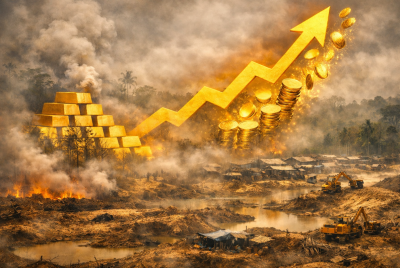
Trump Says the Dollar Is 'Great' Despite Sharp Devaluation, Triggering a New Crash as Gold Prices Continue to Climb
BMO Capital Markets forecast that gold prices could reach $8,650 per ounce by Q4 2027


For over 12 months, the US dollar has experienced a significant decline, falling 10% in 2025 — its worst performance since 2017. A combination of factors has contributed to this downturn, including shifting geopolitics, Donald Trump's policies, Washington's pursuit of a lower exchange rate, and concerns over the US Federal Reserve's independence. Collectively, these elements have played a role in the dollar's sharp fall.
Yesterday, the Dollar Index — which measures the US currency against six major trading partners (excluding China) — dropped further by nearly 1.3%, marking its largest decline since April 2025. The index also reached its lowest level since February 2022, following Trump's remarks on the declining dollar.
During a visit to Iowa to highlight his economic achievements, Trump was asked whether he believed the dollar's current value was acceptable and if its decline over the past year was too severe. His response was unequivocal: 'The value of the dollar is great.' He added, 'I think it's great,' referring to the weaker dollar. 'Look at the business we're doing. No, the dollar is doing great. It's very interesting — if you look at China or Japan, I used to fight like hell with them because they always wanted to devalue their yen... you know that, the yen and yuan, and they'd always want to devalue it. They devalue, devalue, devalue. And I said, "Not fair." They devalue because it's hard to compete when they devalue.'
Trump also stated he was not concerned about the recent decline in the dollar, suggesting he prefers the greenback to 'seek its own level.' His comments imply a willingness to tolerate a weaker dollar to facilitate lower interest rates and boost US exports.
Gold Prices Surge to a New Record
With recent developments around Greenland and Trump's hints that the US might act to influence the dollar — potentially through dollar selling to help Japan strengthen its yen — investors are increasingly turning to hedging assets, notably gold, which continues to rally without signs of slowing. The dollar's free fall has driven gold prices to a new high of over $5,200 (£3,761) per ounce.
This negative sentiment towards the dollar is reshaping demand for USD-denominated precious metals. The latest decline demonstrates how a weakening currency can lead to higher nominal prices for gold and silver, especially as investors become more wary of the dollar's stability.
It is important to note that a weaker dollar makes USD-priced precious metals more affordable for buyers holding other currencies, thereby increasing global demand. However, current rallies in gold and silver are primarily driven by currency dynamics rather than fundamental changes within the metals markets. If the dollar remains under pressure, these precious metals could stay supported near current highs, as global purchasing power improves.
In a recent research note, BMO Capital Markets highlighted that 'last week saw a huge sell-off of Japanese bonds with accompanying dramatic swings in the yen, further raising concerns about traditional safe haven assets.' The analysts revised their model to reflect a scenario where investors continue to add gold at a similar or faster rate amid an eroding USD, projecting a gold price of $6,350 (£4,593) per ounce by Q4 2026 and reaching $8,650 (£6,257) per ounce by Q4 2027.
For silver, the brokerage expects prices to reach $160 (£115.74) per ounce by Q4 of this year and $220 (£159.15) by Q4 2027.
Disclaimer: Our digital media content is for informational purposes only and does not constitute investment advice. Please conduct your own analysis or seek professional advice before investing. Remember, investments are subject to market risks, and past performance does not guarantee future returns.
© Copyright IBTimes 2025. All rights reserved.
- Recommended For You