

Trump's Tariff Stimulus Checks For 'Moderate-Income' Earners – Who's Really Getting $2,000?
Experts warn the maths simply doesn't add up as tariff revenue falls $121 billion short of funding even the narrowest plan
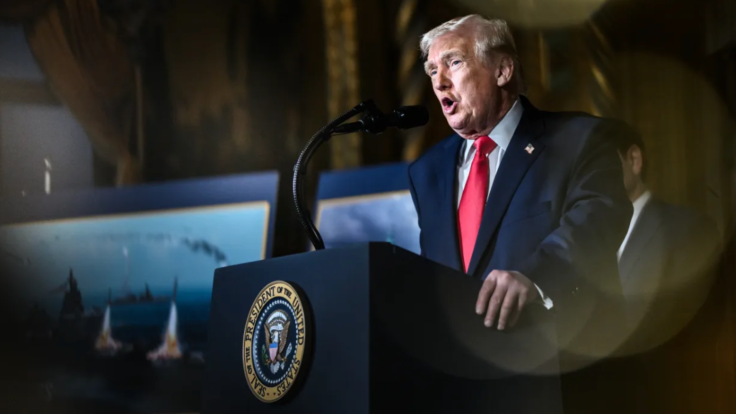
President Donald Trump has pledged to deliver $2,000 (£1,480) 'tariff dividend' checks to American households by mid-2026, but fresh analysis reveals a stark reality: nearly half of US families would be excluded outright, and the government simply cannot afford to pay those who qualify.
Speaking from the Oval Office in November, Trump declared: 'We've taken in hundreds of billions of dollars in tariff money. We're going to be issuing dividends...probably the middle of next year, a little bit later than that, of thousands of dollars for individuals of moderate income, middle income.'
Who Qualifies and Who Doesn't?
Treasury Secretary Scott Bessent confirmed to Fox News that payments would target 'working families' earning 'less than, say, $100,000' (£74,021) annually. That income cap creates an immediate problem for millions of households.
Data from the US Census Bureau, as cited by IBISWorld, indicates that 42% of American households earned above $100,000 (£74,021) in 2025. This means nearly half of all families would be automatically disqualified from receiving the rebate under current eligibility criteria, according to a report from the Irish Star.
The picture shifts for individual earners. According to YouGov Profiles data, only 18% of US adults fall into this high-income bracket, suggesting most single filers could technically qualify. However, the programme's structure remains unclear, with no official guidance on whether payments target individuals, households, or both.
Complicating matters further, the US Census Bureau reported the median family household income in 2024 stood at $108,600 (£80,387) – meaning the typical American family already exceeds the proposed threshold. The overall median income for all households was $83,730 (£61,978), placing many squarely in eligible territory but leaving middle-class families in an uncomfortable grey zone.
The $121 Billion Funding Gap
The fundamental obstacle lies not in eligibility but in affordability. Analysis from the Tax Foundation exposes a massive shortfall between tariff revenue and programme costs.
Trump's tariffs are projected to generate $158.4B (£117.2B) in 2025 and $207.5B (£153.6B) in 2026, according to Tax Foundation calculations. However, distributing $2,000 (£1,480) checks exclusively to tax filers and spouses with a hard $100,000 cutoff would cost $279.8B (£207.1B) – exceeding 2025 revenue by $121B (£89.5B).
Should dependents and non-filers be included, that figure balloons to $606.8B (£449.1B), nearly double the combined tariff revenue of the two years.
'Under nearly any design option, sending out $2,000 (£1,480) payments to Americans would increase, not decrease, the federal budget deficit,' say Tax Foundation experts Erica York, Huaqun Li, and Aleksei Shilov. 'A better way to provide relief from the burden of tariffs would be to eliminate the tariffs.'
Through mid-September 2025, Trump's new tariffs had generated approximately $117B (£86.6B) in payments, according to US Customs and Border Protection data cited by the Tax Foundation – far short of what would be needed.
Congressional Approval Required
Even if funding were available, Trump cannot authorise payments unilaterally. Congressional approval remains essential, and fiscal conservatives are reluctant to add hundreds of billions to the national debt, which topped $38T (£28T) late last year.
The Yale Budget Lab estimates a per-person credit with the strict $100,000 (£74,021) income cutoff would cost around $450B (£331.1B), projecting the debt-to-GDP ratio would rise by 1.5 percentage points.
Legal challenges further add to the uncertainty. Supreme Court justices have expressed scepticism over the administration's use of emergency powers to impose tariffs during recent hearings. The Tax Foundation estimates that tariffs potentially deemed illegal could account for roughly 75% of new revenue.
What This Means For Your Wallet
For households earning below the threshold, the wait for payout continues, with no guarantee of receiving anything. Prediction markets place just an 11% chance that dividend checks will materialise before March 2026, according to CNN.
The harsh reality: tariffs have already cost the average American household nearly $1,200 (£888) in higher prices since Trump returned to office, according to calculations from Democrats on Congress' Joint Economic Committee using Treasury Department data.
A $2,000 (£1,480) rebate would barely offset what families have already paid for inflated consumer goods.
© Copyright IBTimes 2026. All rights reserved.