

Trump Warns Rodriguez To 'Pay A Very Big Price Bigger Than Maduro' If She Doesn't Do What's Right
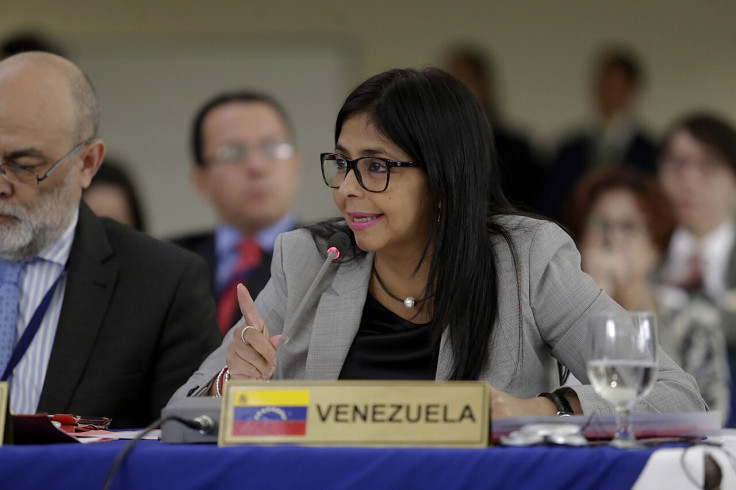
Venezuela's new leader, Delcy Rodriguez, has to deal with a complicated political environment with US threats and cooperation offers after the dramatic capture of Nicolas Maduro and military intervention by US forces.
Delcy Rodriguez assumed her role during an intense period of tension that had increased due to an undercover military operation by the U.S., which led to the arrest of Nicolas Maduro.
The Venezuelan Supreme Court and military forces supported Rodriguez, who officially took power at a ceremony in Caracas. Her influence is a crucial turning point in the political situation in Venezuela, and she assumed the leadership in an unstable and vulnerable situation.
Rodriguez's ascension can be attributed to her long history of service in the government of Maduro, who was a vice president, foreign minister, and minister of oil.
She is credited with being a strong advocate of Maduro's socialist regime, and her new position places her at the heart of a possible power struggle, given that the U.S. is not afraid of publicly asserting control over the future of Venezuela.
A change of direction to co-operation and regime change
Rodriguez took a diplomatic approach in her first cabinet meeting, although the tone has shifted by seeking cooperation with the U.S. under the scope of international law.
In a published statement, Rodriguez said, "We prioritise moving towards balanced and respectful international relations between the United States and Venezuela, and between Venezuela and other countries in the region, premised on sovereign equality and non-interference."
"These principles guide our diplomacy with the rest of the world," she added.
She appealed to dialogue and joint development that can be seen as a successful attempt to prevent the new aggravation and maybe to negotiate between the country under the pressure of external influences.
"We invite the US government to collaborate with us on an agenda of cooperation oriented towards shared development within the framework of international law to strengthen lasting community coexistence," the statement reads.
Rodriguez was ready to interact with the U.S. in contrast to her original refusal to accept the military operation, which she described as a disrespect to sovereignty.
Her invitation to the cooperation can be interpreted as an effort to stabilise a divided political situation in Venezuela and possibly the way to negotiations that would allow bringing some kind of order.
"President Donald Trump, our peoples and our region deserve peace and dialogue, not war," she wrote.
U.S. threats and diplomatic signals
U.S. President Donald Trump made stern threats against Rodriguez even before she was sworn in, saying that she might face the same fate as Maduro unless she gives way to U.S. requests.
In an interview with The Atlantic, Trump pronounced, "If she doesn't do what's right, she is going to pay a very big price, probably bigger than Maduro."
The government, which charges Maduro with the act of leading a narco-terrorist government engaging in drug trafficking and weapon-related crimes, has changed its position and is now centred on regime change, with the Trump administration making a clear indication of wanting to shape the political course of Venezuela.
"Regime change, anything you want to call it, is better than what you have right now. Can't get any worse," he added.
Although Trump made veiled threats, the comments also highlighted how the U.S. had a larger strategy of trying to dominate the region of Venezuela with its huge oil deposits.
Trump also showed his readiness to provide American oil companies with the right to enter the energy infrastructure of Venezuela, and the action is seen as a way to restore and stabilise the economy of the country.
This strategy is consistent with the overall U.S. objective of having access to the resource richness of Venezuela, which is approximated to be in excess of over a trillion US dollars in mineral and mineral-based resources.
International response and regional security issues
The operation by the U.S. in Venezuela has elicited a heated controversy between the regional and international actors.
A number of Latin American governments, such as Brazil, Chile, Colombia, Mexico, Uruguay, and Spain, made comments denouncing the military operation as a dangerous precedent, which poses a threat to the regional peace and security.
España no reconoció al régimen de Maduro. Pero tampoco reconocerá una intervención que viola el derecho internacional y empuja a la región a un horizonte de incertidumbre y belicismo.
— Pedro Sánchez (@sanchezcastejon) January 3, 2026
Pedimos a todos los actores que piensen en la población civil, que respeten la Carta de…
According to critics, the operation sets a dangerous precedent for unilateral military intervention and will lead to an unstable region that is already unstable.
Cuba, which has long been an ally of Maduro, declared a nationwide mourning period after it was reported that 32 Cuban warriors were killed in the operation. The government of Cuba vehemently criticised the U.S. step by putting it in the context of aggression towards the sovereignty of Venezuela.
Maduro and Venezuela's political future
The arrival of Maduro in New York and his court visit is another start of a new era in the leadership of Venezuela. Accused of drug trafficking, weapons crimes, and conspiracy, the legal issues faced by Maduro will also make the political life of the country even more complicated, considering that Rodriguez has taken the leadership.
Maduro and his wife, Cilia Flores, have refuted the accusations and accused the U.S. of using the war on drugs as an excuse to oust him and steal oil deposits in Venezuela.
As Rodriguez tries to stabilise the situation in her nation and find a way of cooperating, the threat of additional U.S. intervention is overshadowing the country, causing it to continue living under distress and altering the geopolitics in the region.
© Copyright IBTimes 2026. All rights reserved.