Jeffrey Zang Is Building the AI Assistant That Does Not Need to Be Asked

Most people do not need another AI tool sitting in a separate window, waiting for instructions. Jeffrey Zang is building for a different kind of moment: the second before a user repeats the same small task again, whether that means opening a link, filling out a form, moving a file, pressing a button, or finding the next step inside the work already in front of them. Through Proletic, he wants the computer to stop acting like a passive machine and start offering useful suggestions at the exact point where friction usually begins.
Through Proletic, Zang is working on a desktop app that gives proactive, autocomplete-style suggestions across a user's computer. The idea is familiar at the smallest level. A keyboard might suggest the end of a word or phrase. Proletic pushes that idea further, with suggestions that apply to actual computer tasks. It might suggest opening a link, pressing a button, completing a form, filing a document, or taking the next small action a user was already moving toward.
"I think autocomplete is a much bigger idea than text," Zang said. "The computer should be able to understand what you are trying to do and offer the next useful step, not wait for you to describe everything in a prompt."
That is important in the current AI market. Much of the public conversation still revolves around chatbots, prompts, and tools that sit in a separate window from the work itself. Zang is interested in something quieter and more direct. He wants AI to live inside the flow of daily computer use, where the user can accept or ignore a suggestion with minimal friction.
The goal is not to remove the person from the process. It is to remove the unnecessary work around the person.
"I do not want AI that takes control away from you," he said. "The best version gives you a suggestion at the right moment and lets you decide. You stay in charge of the machine."
That philosophy puts Zang in the middle of one of the most active areas in artificial intelligence: computer-use agents. These are AI systems designed to click, type, move through apps, and complete tasks on a computer. Major AI labs are working on their own versions, backed by enormous teams, budgets, and compute resources. Zang sees the same frontier, but he is approaching it from a different direction.
He is 19, studying computer science in the co-op program at the University of Waterloo, and building with far fewer resources than the trillion-dollar companies now circling the same category. He does not think of that as a disadvantage as much as a forcing function.
"When you do not have unlimited compute or a giant team, you have to be honest about what actually matters," Zang said. "You cannot hide behind scale. The product either helps people or it does not."
His earlier work shows why he believes he has earned a place in the conversation. One year ago, he built Opus, a computer-use agent that executes real mouse and keyboard inputs in the background. He used a combination of the macOS Accessibility API, AppleScript, JavaScript injection, and Bash. It went from nothing to launch in three days, drew more than 200,000 views, brought in 500+ beta users, and attracted inbound venture capital interest.
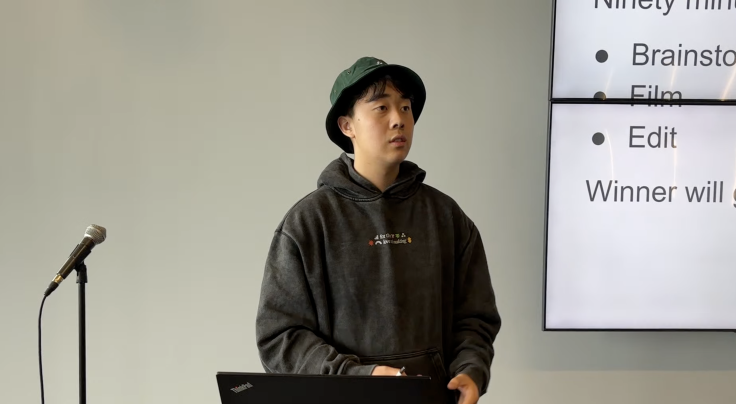
For Zang, Opus was proof that computer-use agents did not have to remain expensive demos or distant research projects.
"Opus was built quickly because I wanted to test the real idea, not polish something forever in private," he said. "Once people used it, the question became much clearer. How do you make this faster, cheaper, and useful enough to run all the time?"
That question led to OSX-Query, an agent harness Zang designed to address what he sees as one of the major technical bottlenecks in computer-use AI. Many systems rely on screenshots and visual models to understand what is happening on a screen. Zang's approach is built around reading structured computer state as compact text, including accessibility trees, window metadata, and UI hierarchy.
In simple terms, he wants agents to understand a computer without constantly looking at it like an image.
"The screenshot approach can work, but it is heavy," he said. "If agents are going to run in the background and actually be useful, they need to be cheap, fast, and context-efficient. I do not think every small computer action should require a huge vision model."
That technical bet connects directly to his larger product vision. Proletic is not meant to be another single-task AI wrapper. Zang is openly skeptical of that category. He sees a market crowded with tools built around narrow functions, often because large language models made those products easy to ship.
"There are too many AI products that exist because they were easy to build," he said. "That is different from solving a real problem. A note-taking app for meetings can be useful, but five versions of every tiny AI task does not mean the industry is moving forward."
His view is blunt: the model is not the full product. As powerful models become more widely available, he believes the more valuable work will be problem selection, product discipline, and user experience. He has a simple rule for that discipline.
"Products die from obesity, not starvation," Zang said. "Most software does not fail because it was too simple. It fails because the team kept adding things until the core became harder to understand."
That belief shapes Proletic. The product is still in stealth as he works on building the company and sharpening the experience, but the center of the idea is restrained. Suggest one useful next step. Let the person accept or reject it. Learn from the way the user works. Stay local-first so users keep ownership of their data.
The privacy point is imperative for Zang. If AI is going to operate closer to the operating system, it will be near sensitive information, work habits, personal files, and communication patterns. That makes control and data ownership central to the product, not optional.
"If software is going to understand your workflow, you should own that data," he said. "People should not have to trade away control just to make their computer less annoying to use."
Zang's background gives that argument more weight than theory alone. He was a founding engineer at 10x, where he helped develop an AI app that reached 2,000+ users, became profitable, and kept monthly churn under 5%. As an ML engineer intern at Nokia, he built an LLM-powered, RAG-based internal assistant adopted by more than 200 employees and helped cut compute costs by about $1,000 per month. He has also been named an MLH Top 50 honoree, selected from 500,000+ hackers globally, and was the second-youngest recipient in the program's history.
The next stage of AI, in his view, will not be defined by who can make the loudest chatbot or the most crowded feature list. It will be defined by whether AI can reduce the ordinary drag of computer work without making people feel watched, replaced, or managed by their own tools.
"Computers ask too much of people right now," Zang said. "There is so much manual effort around things the computer should understand. If AI can remove that friction while keeping the user in control, that changes the relationship completely."
That is the bet behind Proletic. Not a machine that does everything. Not a chatbot waiting for instructions. A computer that sees enough context to offer help, then steps back.
The future Zang is chasing may not announce itself with a new window or a long prompt. It may look more like one well-timed suggestion, appearing exactly when the user needs it.
© Copyright IBTimes 2026. All rights reserved.
- Recommended For You