

Shreyans Jain Is Building AI Marketing Systems That Start With Context, Not Content

Shreyans Jain has built the shared AI platform behind Manicule's work with developer-focused companies, while the company reached approximately $53,000 in monthly revenue during Y Combinator. As Co-Founder and CTO, he develops software and agent pipelines designed to give AI systems enough context to understand a business, its products, and its day-to-day operations before generating content. That approach draws directly from Jain's earlier work as the founding engineer and employee No. 1 at Supermemory, where he helped develop context and memory systems for AI in a product that grew to more than 100,000 users. His work at Manicule now applies the same technical problem to marketing and documentation.
"People focus on the model, but the model only works with what you give it," Jain says. "If the system does not understand the company well enough, the output will still be generic."
At Supermemory, Jain worked directly on the infrastructure that allowed AI systems to retain and use information over time. He built the consumer app, MCP v2, Console, and integrations for the Vercel AI SDK and OpenAI's JavaScript and Python SDKs, reducing memory integration to about two lines of code. He also contributed to API v3, the memory engine, and support for video, images, PDFs, and Google Docs. Jain says those integrations helped the company land annual contracts worth more than $50,000.
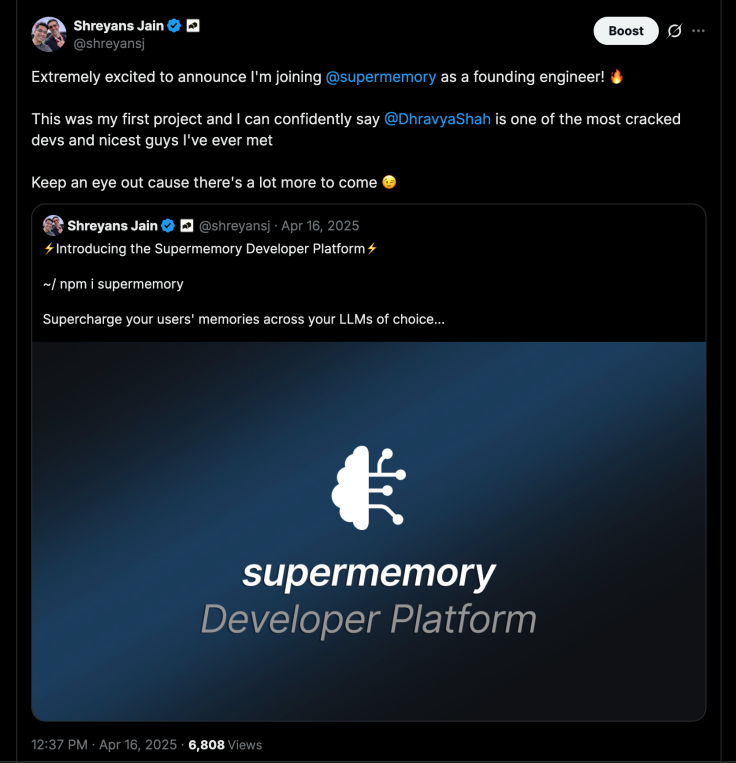
Jain says his engineering work helped Supermemory grow to more than 100,000 users and raise $3 million. He also says the open-source project attracted more than 20,000 GitHub stars and that the memory system ranked first on LongMemEval, LoCoMo, and ConvoMem. That work gave Jain direct experience with a problem that would later become central to Manicule: getting the right information into an AI system's context when it needs to act.
Manicule applies that principle to marketing and documentation. Jain built the company's shared platform for client context, content production, and publishing. Product specifications, code, and customer knowledge move through workflows for research, drafting, human review, verification, and publication. Agents operate in isolated sandboxes, edits are versioned, and finished material can serve developers and AI agents through company websites, llms.txt, and MCP.
The result is a system built to give AI agents a working understanding of a company before they begin producing content. Jain's platform supports Manicule's work across developer-focused businesses. Across its client engagements, Manicule has reported roughly 37 percent fewer support tickets and millions of impressions.
Jain's role in those engagements begins with the infrastructure beneath the individual campaign or documentation project. The shared platform determines how product information, technical material, and customer knowledge are organized and made available to agents throughout the workflow. That gives Manicule a common technical foundation even when the final output and goals differ from one client to another.
Developer marketing is changing as AI systems play a larger role in product discovery and implementation. Jain points to answer engine optimization, generative engine optimization, and the growing use of coding agents as evidence of that shift. For developer-focused companies, he argues that publishing volume alone cannot compensate for weak product context. The information available to an AI system has to be accurate enough for the system to understand what a product does and detailed enough to answer technical questions usefully.
"If the information is bad, scaling it does not fix the problem," Jain says. "You are just giving the system more bad information to work with."
The same infrastructure supports marketing work as well. For Supermemory, Manicule reported more than 1 million SEO impressions and 90 percent traffic growth over three months from a developer-relations campaign. A benchmark-led Reddit campaign generated more than 200,000 views, while a documentation launch was completed in 23 days and was followed by a reported 30 percent improvement in answer success. Those outcomes show how the same underlying context and publishing systems can support discovery, documentation, and technical communication across different types of work.
Jain's engineering background has pushed Manicule's work upstream, toward the information an agent receives before it ever generates copy. A model can produce fluent content from incomplete context, but fluency does not make the underlying information accurate. For developer companies, where products can change quickly, and technical claims can be checked by users almost immediately, that gap becomes difficult to hide.
"Companies want to know what they can publish to get recommended more often," Jain says. "The harder question is whether the agent actually has enough accurate context to understand what the product does."
Jain's work connects his earlier experience in AI memory with a newer problem in automated marketing. At Supermemory, he helped build systems designed to remember, retrieve, and use information. At Manicule, he has turned that experience toward infrastructure that organizes company knowledge before agents create marketing or documentation from it. The visible output may be an article, a documentation page, or another form of content. The technical work begins earlier, with the systems that determine what an AI agent knows before it writes anything at all.
© Copyright IBTimes 2026. All rights reserved.