

SpaceX Stock Is Still Down 39% From Its Peak: JPMorgan Says Buy, But One Target Sees $95
Wall Street's lowest actual target for SpaceX is $75 with a Sell rating, while its highest targets are either $450 or $800
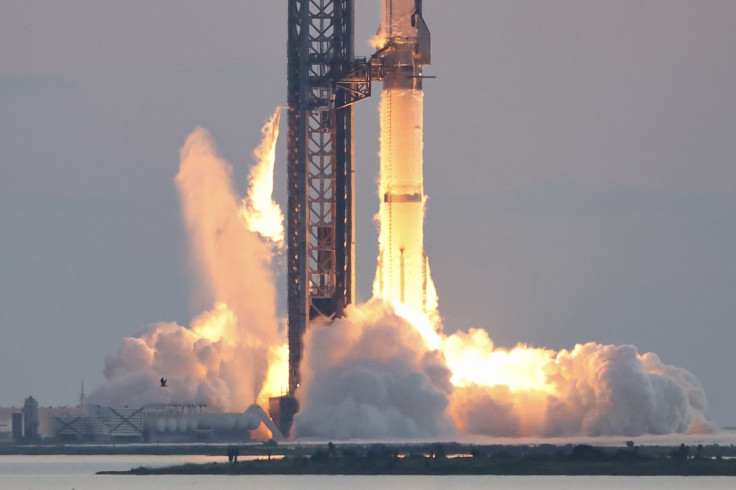
SpaceX shares are still 39% below their June peak, and J.P. Morgan told clients on Tuesday to buy them anyway, at a target of $240 (£176). A rival figure of $95 (£70) is circulating alongside it, and that figure is not an analyst target at all. Shares in Space Exploration Technologies closed at $137.95 (£101) on Wednesday. The company listed on the Nasdaq in June in the largest flotation ever staged, and it has spent most of the time since falling.
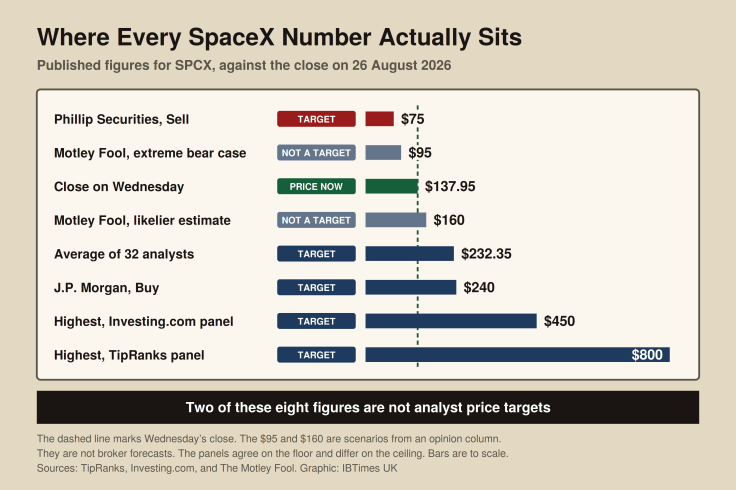
The $95 comes from a Motley Fool column published on Wednesday, which used it as an explicitly extreme bear case for 2028. Its author, Steven Porrello, reached the number by applying a hypothetical multiple of 12 times sales, and put his own likelier estimate at $160 (£117). Wall Street's lowest actual price target is lower still, at $75 (£55), and it belongs to Phillip Securities. Glenn Thum, the analyst behind it, reiterated a Sell rating in August.
A Record Flotation and a Fast Fall
SpaceX priced its flotation at $135 (£99) a share and closed the first session at $160.95 (£118), a first-day gain of 19%. Four days later it touched $225.64 (£165). That high has not been beaten since. On day one, the listing valued Elon Musk's rocket company above Tesla, Saudi Aramco, and Broadcom.
Then came the fall. By 3 August the shares had fallen to $104.83 (£77), the lowest they have ever traded, which meant the round trip from record to floor took barely seven weeks. Some ground has come back since, and the stock changed hands at $139.63 (£102) on Thursday morning. Even so, the price sits barely 3% above what institutions paid in June.
The Business Underneath
Growth is not the problem. Revenue in the second quarter reached $7.81B (£5.73B), up 92% on the same period a year earlier and ahead of the $6.81B (£4.99B) analysts had expected. SpaceX still lost $541M (£397M) over those three months. Expansion at that pace has not yet produced a profit.
Valuation is where the argument sits. SpaceX was worth about $1.83 trillion (£1.34 trillion) at Wednesday's close, which puts it among the 10 largest listed companies anywhere in the world. Shares change hands at roughly 63 times sales, or $63 for every dollar of yearly revenue. Analysts expect revenue of about $105B (£77B) in 2027, and most of the optimism rests on that number arriving.
Two dates are worth marking. SpaceX reports third-quarter results on 5 November, its second set of numbers as a public company. Analysts expect sales of $12.79B (£9.38B) for that quarter, well above the $7.81B just delivered. A standard 180-day lock-up on insider shares expires in December, releasing a large block of employee and institutional stock onto the market. Results and lock-up both fall inside the 12 months a price target is meant to cover.
What Wall Street Actually Thinks
Thirty-two analysts have put a target on SpaceX in the past three months. The consensus is a Moderate Buy: 24 rate the shares a buy, five a hold and three a sell. An average target of $232.35 (£170) implies a rise of about 68% from Wednesday's close, enough to carry the stock past its own June record. Few of them agree on much else.
The spread is where it gets strange. Wall Street's most and least optimistic analysts are not arguing about a few percentage points. TipRanks puts the range at $75 (£55) to $800 (£587), a gap of more than tenfold. Investing.com, drawing on a different panel of analysts, puts the top at $450 (£330) instead. Both agree on the floor, and the chart below sets every published figure against Wednesday's close.
Analysts have been moving in both directions this month. Argus Research upgraded the shares to a buy on 6 August and set a target of $160 (£117). Bernstein and Arete Research raised their targets too. DZ Bank went the other way on 20 August and cut its rating to Sell.
The $95 doing the rounds this week is a columnist's thought experiment, and the column says so plainly. Wall Street's lowest target is $75 (£55), and it arrives with a Sell rating attached. The highest is either $450 (£330) or $800 (£587), depending on whose panel is counted. On a company this size, nobody is pretending to know.
Disclaimer: Our digital media content is for informational purposes only and does not constitute investment advice. Please conduct your own analysis or seek professional advice before investing. Remember, investments are subject to market risks, and past performance does not guarantee future returns.
© Copyright IBTimes 2026. All rights reserved.