

Xtend Telescope Detects Never-Before-Seen X-Ray Burst From Strange Visitor 3I/ATLAS
The breakthrough by XRISM's Xtend instrument reveals a faint X-ray halo around 3I/ATLAS — offering the first X-ray clues about a visitor from beyond our Solar System.
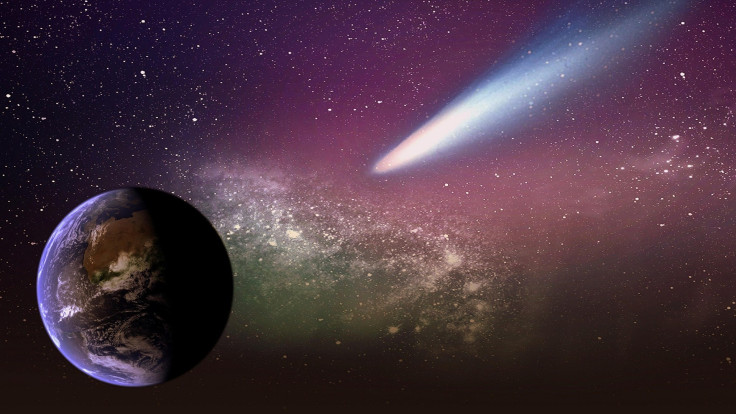
Astronomers utilising the X-ray Imaging and Spectroscopy Mission (XRISM) have reported the detection of a faint X-ray halo encircling 3I/ATLAS, marking the first time such high-energy emissions have been observed from a confirmed interstellar comet.
The observation transforms the scientific understanding of the object, revealing a dynamic interaction between the visitor's gaseous coma and the solar wind that extends far beyond the visible nucleus.
A Faint Glow from a Distant Visitor
After decades of observing comets within the Solar System, known to emit X-rays when their outgassed material interacts with the solar wind, scientists had never definitively recorded X-ray emissions from a comet that originated beyond our system.
The XRISM mission team, a collaboration between the Japan Aerospace Exploration Agency (JAXA) and NASA, announced the new detection. Early data 'hint at a faint X-ray glow spreading hundreds of thousands of kilometres across its coma'.
Subsequent data reconstruction reveals that the glow extends roughly 5 arcminutes around the comet's nucleus, equivalent to a physical span of about 400,000 km. This observation suggests a diffuse, comet-centred cloud of gas, glowing weakly in X-rays, far larger than the nucleus itself.
XRISM has caught sight of interstellar #comet 3I/ATLAS !
— XRISM (@XRISM_jp) December 6, 2025
Our early data hint at a faint X-ray glow spreading hundreds of thousands of kilometers across its coma — a first glimpse of this rare visitor from beyond the Solar System.
Stay tuned for more.#JAXA #NASA pic.twitter.com/je3rT6UhyJ
The Physics of the Glow: Charge-Exchange
Cometary X-rays in our Solar System arise through a well-known process called solar wind charge exchange (SWCX). As a comet's ices sublimate under solar heating, they release gas that forms a coma. This coma interacts with the solar wind, a stream of charged particles from the Sun.
In a 'charge-exchange' reaction, a highly charged ion from the solar wind collides with a neutral atom or molecule from the coma, steals an electron, and in the process emits an X-ray photon. This mechanism essentially turns the comet's atmosphere into a screen that fluoresces when struck by solar particles.
Analysis of the Xtend spectral data indicates emission lines consistent with elements such as carbon, nitrogen, and oxygen. The presence of these specific elements provides a chemical fingerprint of the comet's volatile inventory, offering clues about the protoplanetary disk in which 3I/ATLAS formed billions of years ago.
These signatures are inconsistent with known background X-ray sources like galactic background or Earth's atmospheric emission, bolstering confidence that the glow indeed arises from 3I/ATLAS itself.
🚨 The First X-Ray Signal From an Interstellar Visitor — What Is 3I/ATLAS Hiding? 👀
— Astronomy Vibes (@AstronomyVibes) December 9, 2025
Just when we thought 3I/ATLAS couldn’t surprise us anymore, scientists have detected X-rays coming from it — the first time any interstellar object has ever done this.
Japan’s XRISM space… pic.twitter.com/sBKi2mDsnf
Multi-Wavelength Analysis
3I/ATLAS is only the third confirmed object from outside our Solar System ever observed to pass through our celestial neighbourhood, after 1I/ʻOumuamua and 2I/Borisov.
Since July 2025, astronomers have mobilised dozens of ground and space-based telescopes to gather data across the spectrum. For instance, ultraviolet observations with the Neil Gehrels Swift Observatory recently confirmed water activity in the comet, indicating active outgassing at a heliocentric distance of 3.51 AU.
This is complemented by polarimetric observations carried out by the Very Large Telescope (VLT), which have revealed that the coma exhibits an unusually strong negative polarisation at small phase angles, a property hitherto unseen in either comets or asteroids, including 2I/Borisov. This suggests that the dust and ices surrounding 3I/ATLAS could be distinct in composition and structure, perhaps reflecting the environment in which it formed around a distant star.
Infrared measurements with the James Webb Space Telescope have shown that its coma is dominated by carbon dioxide, with water, carbon monoxide, OCS, water ice, and dust also present, pointing to a volatile-rich nucleus unlike typical Solar System comets.
A New Frontier for Science
If the X-ray halo around 3I/ATLAS is indeed real and comet-centred, this signals a new frontier in the study of interstellar objects. It demonstrates that 3I/ATLAS is not merely a passive visitor but actively interacts with the Sun's environment, unlike distant asteroids or inactive interstellar fragments.
This detection allows scientists to probe the composition and structure of interstellar cometary comae in ways not possible with optical or infrared observations alone. X-rays may reveal ionisation processes, gas densities, and the distribution of volatile materials in the coma, offering clues to how 3I/ATLAS formed, and by extension, the formation conditions in its home system.
Moreover, the confirmation of X-ray emission from an interstellar object suggests that other such visitors, whether icy comets or rocky fragments, might also produce detectable X-rays when passing through our heliosphere. This validates X-ray astronomy as a viable tool for hunting and characterising future interstellar interlopers.
Still, caution is warranted. The initial data from Xtend come with caveats: instrumental effects such as vignetting or detector noise could mimic diffuse structures. The team behind XRISM acknowledges that a more rigorous analysis will be required to confirm the emission's origin definitively.
As 3I/ATLAS continues on its outbound path, never to return, the faint X-ray glow caught by XRISM may be its final farewell signal, a fleeting but profound message from an object born around a distant star.
© Copyright IBTimes 2026. All rights reserved.