Affordable Ways to Improve Your Language Skills From Home
Affordable, practical strategies for daily practice and real progress
If you live in the UK and want to pick up Spanish for a city break, revive rusty GCSE French, or finally crack those stubborn English phrasal verbs, you no longer need to empty your wallet. Streaming subscriptions, AI chatbots, and old-fashioned notebooks can be woven together into an affordable, home-based routine that sticks. Below you'll find realistic tactics, timeframes, and a handful of digital tools worth trying without the hard sell or inflated promises.
Price obviously matters, but affordability is also about value per hour. A £9.99 subscription you use every evening is cheaper, in real terms, than a £200 textbook set gathering dust on a shelf. We'll keep our focus on options under roughly £15 a month (or totally free) that require little extra kit and that slot naturally into busy British schedules.
Build a Micro-Immersion Zone at Home
True immersion means living in the target language 24/7, but recreating a mini version in your flat, bedsit, or student digs can deliver most of the same brain-switching benefits.
Swap Default Settings And Labels
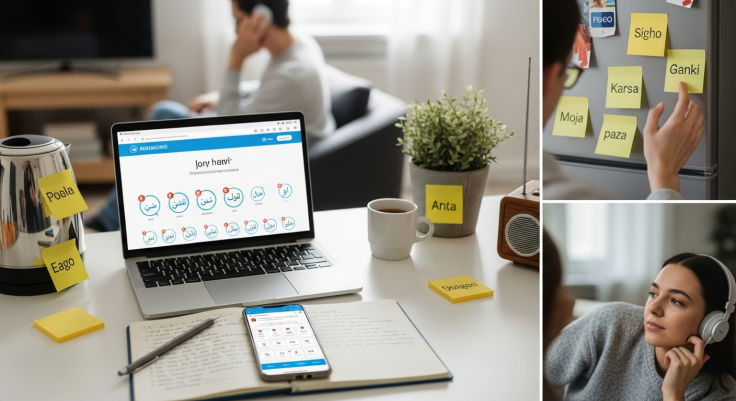
Start by switching your phone, laptop, streaming box, and smart speaker to the language you're learning. Yes, you'll fumble through menus for a day or two, but your passive vocabulary balloons almost immediately. Next, raid the stationery drawer for sticky notes. Label the kettle, fridge, mirror, plant pot, and anything you touch daily, and force your eyes to absorb the words. Retrieval practice, that "search-and-find" moment when you recall a word, is still one of the most efficient routes from short-term to long-term memory.
To push the idea further, rewrite shopping lists, calendar events, and even low-stakes WhatsApp messages in the target language. The trick is to make it unavoidable: a micro-switch every couple of minutes tells your brain, "We use this code now; better file it properly."
Curate Ambient Audio
Instead of letting the radio mumble in English, stream a foreign station while cooking, jogging or folding laundry. The BBC Sounds app hosts France Inter, Radio Nacional de España and Deutsche Welle for free. You're not listening attentively, yet your ear absorbs rhythm, intonation and the top 500 high-frequency words almost by osmosis.
If live radio feels too random, compile a low-attention playlist. Blend children's stories, slow-news podcasts and easy songs - anything with clear diction. Repetition matters more than variety at this stage, because the brain likes predictable sound patterns when it's building new phonetic categories. Commit to 30 minutes a day, and you'll soon find yourself humming foreign lyrics without noticing.
Harness On-Demand Video And Smart Lingopie Alternatives
Netflix and YouTube are obvious treasure troves, yet their algorithms rarely serve learning goals. Dedicated subtitle-layered services let you click on a word, hear it in slow motion and flip it into a flashcard. Lingopie pioneered this approach, but it isn't the only show in town.
Pocket-friendly choices
Lingopie costs roughly £12 a month, and many students still find that steep. If that's you, try these four Lingopie alternatives, each with its own sweet spot:
Promova. A freemium mobile and web app that weaves bite-sized video dialogues with AI-powered speaking drills and optional live tutoring. The core lessons stay free; an upgrade during holiday sales can slip under £10 a month while still unlocking full dialogue libraries and group conversation clubs.
Yabla. £8.99 monthly for curated TV clips in Spanish, French, German, Italian, and Chinese, with slow-play mode and bilingual transcripts.
Viki Learn Mode. Free inside the Rakuten Viki app: East Asian dramas with dual subtitles; you can toggle scene by scene.
Language Reactor (Chrome extension). Adds clickable dual subs and one-tap dictionary lookup to any YouTube or Netflix episode you already pay for.
Before you hit play, set ground rules: pause after each sentence, repeat it aloud three times, then shadow-read the full line in real time. This "speak-along" habit converts passive binge-watching into vocal rehearsal. Over weeks, your mouth muscles memorise common sentence intonation, ready for spontaneous conversation.
Keep a Dialogue Diary
As you watch, jot down two expressions per scene that feel "so native". Later, squeeze each phrase into a one-paragraph diary entry about your actual day. This bridges input and output - the missing link that stops many UK learners from progressing beyond comprehension. The diary also becomes a personalised phrasebook you can skim while waiting for the bus.
Craft A Zero-Cost Structured Study Plan (And Actually Stick To It)
Buying resources is easy; using them day after day is harder. A simple framework turns scattered apps, podcasts, and notebooks into a coherent journey.
The 3-2-1 weekly cycle
- Three input sessions: two video-based (see section 2) and one reading-based (graded reader, kids' news, or a blog).
- Two output sessions: one solo AI dialogue (section 3) and one tandem call (section 4).
- One review block: Sunday night, recap new vocabulary, update Anki deck, and jot down micro-goals for next week.
Each block runs 25 minutes, the classic Pomodoro chunk. Total: 2 hours 30 minutes for the week, less than a Premier League match plus adverts.
Some learners prefer a visible checklist to keep themselves honest. Try pinning a colour-coded post-it grid on your wall:
- Green: input done
- Yellow: output done
- Blue: review done
Ticking boxes sparks a tiny dopamine hit that nudges you back tomorrow.
Track Progress Visually
Print a wall calendar, cross off study days with a bold red X, and aim for streaks rather than perfection. Users who reach a 7-day streak are 3.6 times more likely to complete their language course. If you miss a day, restart the streak immediately. Don't let a single gap turn into a lost week.
When to add grammar
Grammar is important, but learning all the tables of conjugation on the first day is discouraging. Use the 80/20 rule: learn to master the present, simple past, and near future early on and only dig deeper when what you are typing is popping up over and over again. Small reference books such as the Teach Yourself Essential series cost less than 12 pounds, have little weight, and do not lead to late-night Googling.
Stretch Goals For The Ambitious (Still On A Budget)
Once the routine sticks, sprinkle in challenges that mimic real-life stakes and push you beyond comfort.
Sit an Online Proficiency Test
Bodies such as LanguageCert and the Goethe-Institut offer remote proctoring with tiered fees; early booking nets discounts. Even aiming for A2 or B1 injects urgency into your study calendar. Add mock tests every other Saturday morning. Recording your speaking section and comparing it three months later is eye-opening and a neat portfolio for university or job applications.
Plan a Micro-Immersion Weekend In the UK
Surprisingly, you can spend 48 hours "abroad" without leaving England. Book a hostel in New Malden (London's Korean enclave) or Manchester's Chinatown. Until Sunday night, pledge to speak only Korean or Mandarin: order bulgogi without English, browse local supermarkets, attend a community church service, and sing karaoke with on-screen lyrics.
To prep, build a survival phrase sheet:
- Greetings & polite fillers
- Ordering food & drink
- Asking for prices and directions
- Complimenting dishes or décor
- Apologising for mistakes
Handwriting this list cements phrases faster than typing. Travel cost: rail fare and two nights' dorm bed - still cheaper than flights, visas and airport meals.
Pack a notebook, record snippets of overheard language and debrief on the train back. The sensory overload etches vocabulary in a way digital flashcards rarely do.
Final thoughts: consistency compounds, laziness costs nothing
Affordable does not mean easy; however, the good news is that all the tactics mentioned above can easily go into a typical British routine: podcasts on the way to work, chatbots when the pasta is boiling, and subscriber sitcoms before sleep. Choose two of the methods you like, match them with one speaking outlet and commit to 12 weeks. It can happen to you by Easter when you find yourself in a cafe in London, and a tourist is asking the way, and you start speaking French without having to translate in your mind.
© Copyright IBTimes 2025. All rights reserved.
- Recommended For You