Shiza Charania Is Building the Sense Robots Are Missing
Long before she founded a robotics company, Shiza Charania was trying to understand the human body through machines. At 15, she was building brain-tumor analysis algorithms using computer vision and conducting research at Toronto's University Health Network and Toronto Metropolitan University. The technical questions were different from the ones she works on now, but the fascination behind them was already taking shape. She was interested in how complex biological systems worked, and in what technology could learn by studying them.
"I was always drawn to the human body because there is so much intelligence built into things we barely think about," Charania said. "You can start with the brain and very quickly realize that every part of the body is solving difficult problems all the time."
Her early work gave her exposure to research environments at an unusually young age. She worked in the lab of neurosurgeon Dr. Andres Lozano at University Health Network and conducted tumor-segmentation research under Dr. April Khademi at Toronto Metropolitan University. She also began speaking publicly about technology, including a TEDx talk and appearances at other conferences, and was named Young AI Role Model of the Year in North America.
Her interests then moved from software toward hardware, where she taught herself CAD and PCB design and began building side projects. Charania read textbooks, experimented with physical systems, and gradually became more interested in the machines themselves. For her, the humanoid became the most complex dynamic system she could work on, a machine built around the form and functions of the human body. The shift gave her a new way to pursue the same fascination that had drawn her toward medical research.
"I had spent so much time thinking about how the body works that the humanoid felt like the machine I had to understand," she said. "You are taking something humans do almost automatically and trying to rebuild it piece by piece."
The path into that work was not conventional. She cold-emailed the vice president of hardware engineering at 1X Technologies and landed a role engineering hardware and test rigs for the company's humanoid robot. At 1X, she worked directly on the physical systems behind humanoid robotics, including safety hardware and testing. The experience gave her a close view of the hardware problems that can determine whether a humanoid succeeds in real-world deployment.
One problem kept standing out. Robot hands had become mechanically sophisticated, but touch sensing had not advanced in the same way. Across the industry, she saw increasingly capable systems relying heavily on vision while lacking the tactile information human hands use constantly. That contrast eventually became difficult for her to ignore.
"The hand is an incredibly complicated system, but so much of what makes it useful comes from touch," Charania said. "If you build the mechanical structure and give the robot cameras, you still have not recreated what a human hand actually uses to manipulate the world."
The human comparison is striking. She points out that each hand contains roughly 17,000 touch receptors that continuously transmit information about force, texture, vibration, and slip. In laboratory studies, people have distinguished surface textures with differences measured at about 13 nanometers. Humans use that sensory stream in routine movements that barely register consciously, from inserting a charger to steadying an object as it starts to slip.
Robotics had already recreated other parts of the human sensory and motor system in recognizable ways. Cameras function as eyes, motors provide movement, and neural networks increasingly serve as decision-making systems. She believed touch had been left behind. That became the foundation for Midas, the company she founded to develop tactile sensing for robotic manipulation.
"I kept coming back to the same question," she said. "If human hands depend on touch for nearly every contact task, why are we expecting robot hands to become truly dexterous without giving them a comparable signal?"
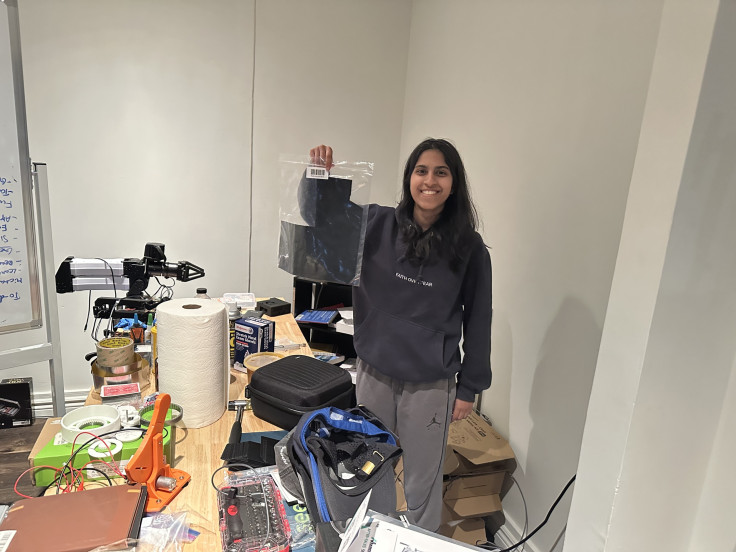
At Midas, Charania is building sensors and software intended to give robotic hands information about pressure, texture, and slip. She has architected the tactile-sensing stack with her founding engineers across sensor design, materials, test rigs, and software. The company is also building for practical deployment rather than laboratory performance alone, with an emphasis on durability, manufacturability, and straightforward integration at a cost that can support wider use.
The work is aimed at a persistent limitation in real-world automation. Robots already perform rigid, repetitive tasks effectively in structured environments, but fragile objects, deformable materials, and contact-rich processes remain more difficult. Connector insertion, delicate component handling, food, textiles, and other forms of dexterous manipulation depend on information that cameras cannot always provide.
Her route into the field has also shaped how she approaches credibility. She has often been the youngest person in technical rooms, from research labs filled with neurosurgeons and PhDs to humanoid robotics environments and, now, company-building. Her response has been to rely on physical proof: working demos, test rigs, and systems that can be evaluated directly.
"Hardware gives you something concrete to evaluate," she said. "You can show the sensor, show the test rig, show the data, and let the engineering speak."
Midas is now moving from prototypes toward production, running integrations with robotics companies and growing its U.S. team. Charania's longer-term goal is to make touch a standard sense wherever machines interact physically with the world, including robot grippers, full hands, and data-collection systems.
For Charania, that ambition grew out of a question she first encountered while studying the human body: what information makes complex physical behavior possible? Years later, the answer she is pursuing is no longer centered on the brain. It is in the hand.
"I want touch to become a standard sense for machines," she said. "If robots are going to handle fragile and unpredictable work, they need information about what is happening at the point of contact."
© Copyright IBTimes 2026. All rights reserved.
- Recommended For You