

UN Security Council Meets After US Strikes Venezuela as Guterres Warns of 'Dangerous Precedent'
Colombia requested the meeting with backing from Russia and China
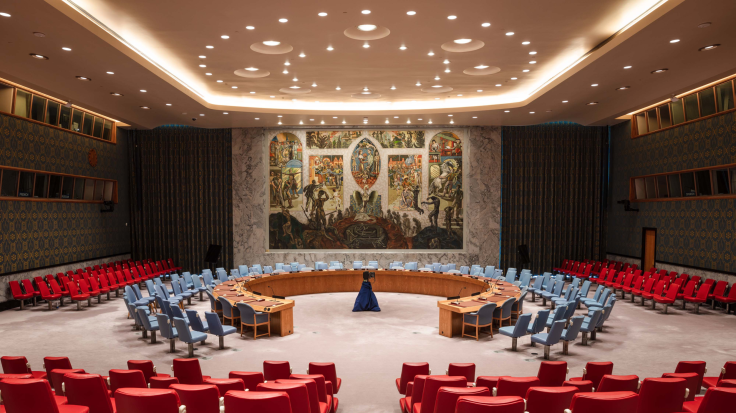
The United Nations Security Council is set to convene on Monday following the dramatic United States military operation that deposed Venezuelan President Nicolas Maduro. Secretary-General Antonio Guterres expressed concern that this action sets 'a dangerous precedent' for international relations.
The emergency session was requested by Colombia, with backing from Russia and China. According to Reuters, the 15-member council is scheduled to meet at 10:00 am in New York.
In a statement released Saturday, Guterres' spokesperson, Stephane Dujarric, was forthright in his statements. 'These developments constitute a dangerous precedent,' he said, stressing that 'the Secretary-General continues to emphasise the importance of full respect—by all parties—of international law, particularly the UN Charter.'
Dujarric went on to say Guterres is 'deeply concerned that the rules of international law have not been respected'.
Saturday's Military Operation
Early Saturday morning, US forces struck targets in Caracas before seizing Maduro and his wife, Cilia Flores. President Donald Trump ordered the operation, which culminated in the pair being transported aboard the USS Iwo Jima.
Trump later shared an image on Truth Social showing Maduro blindfolded and handcuffed, dressed in a grey Nike sweatsuit and holding a water bottle whilst in US custody.
The Venezuelan leader now faces formal charges in the Southern District of New York. US Attorney General Pam Bondi confirmed that Maduro, his wife, and his son have been indicted on narco-terrorism conspiracy charges. This isn't the first time - Maduro was previously indicted on similar charges back in March 2020.
Last August, Washington doubled its bounty for information leading to Maduro's arrest to $50 million (£40 million). Maduro has consistently denied the allegations against him.
Venezuela Denounces 'Colonial War'
Venezuela's response was swift and scathing. UN Ambassador Samuel Moncada fired off a letter to the Security Council on Saturday, describing the US action as nothing less than 'a colonial war aimed at destroying our republican form of government'.
Moncada accused Washington of violating the UN Charter's prohibition on using 'the threat or use of force against the territorial integrity or political independence of any state'.
In his letter, he argued the operation aims to impose 'a puppet government that allows the plundering of our natural resources, including the world's largest oil reserves'. The message was clear: Venezuela views this as an assault on its sovereignty.
Washington Defends Its Actions
The Trump administration isn't backing down. US Ambassador to the UN Mike Waltz took to X to defend the operation, drawing a sharp distinction between regime change and law enforcement.
'This is not regime change this is justice', Waltz wrote. 'Maduro was an indicted, illegitimate dictator that led a declared Narco-terrorism organisation responsible for killing American citizens'.
Speaking to reporters at Mar-a-Lago, Trump struck a more paternalistic tone. Venezuelans 'suffered', he said, adding they 'are not going to suffer anymore'.
But his next comments raised eyebrows. 'We're going to run the country until such time as we can do a safe, proper and judicious transition', Trump explained. 'We don't want to be involved with having someone else get in, and we have the same situation that we had for the last long period of years'.
This is not regime change this is justice.
— Ambassador Mike Waltz (@michaelgwaltz) January 3, 2026
Maduro was an indicted, illegitimate dictator that led a declared Narco-terrorism organization responsible for killing American citizens. I commend our brilliant military & law enforcement operators 🇺🇸 https://t.co/0jYM56t5v4
A Slow Build to Crisis
Saturday's operation didn't come out of nowhere. For months, the Trump administration has been ratcheting up pressure on Venezuela through a combination of military operations and economic sanctions.
US forces have been targeting vessels suspected of drug trafficking off Venezuela's coast and across Latin America's Pacific waters. Just last month, American forces intercepted two tankers carrying Venezuelan crude, part of an expanded blockade against sanctioned vessels.
Washington has maintained that its actions are lawful under Article 51 of the UN Charter, which permits self-defence measures. The catch? It also requires immediate notification to the Security Council.
The military planning stretched back months. General Dan Caine, Chairman of the Joint Chiefs of Staff, revealed in a press conference that forces were positioned and ready by early December. The operation was carefully choreographed, not hastily thrown together.
Global Condemnation Mounts
The international community hasn't exactly rallied behind Washington. UN human rights chief Volker Türk issued a pointed statement calling for restraint and adherence to international law. 'The protection of the people of Venezuela is paramount and must guide any further action', he warned.
Latin American leaders were particularly vocal. Brazilian President Luiz Inácio Lula da Silva slammed the strikes as crossing 'an unacceptable line' and establishing a 'dangerous precedent'. Colombia's President Gustavo Petro responded by deploying security forces along the Venezuelan border, bracing for potential refugee flows.
Moscow and Beijing weren't having it either. Russia's Foreign Ministry branded the action an 'unacceptable assault' on Venezuelan sovereignty. China's response was equally harsh, with the Ministry of Foreign Affairs saying it was 'deeply shocked and strongly condemns' the operation.
December's Warning Signs
Those paying attention saw this coming. Back in December, the Security Council met to discuss escalating tensions, with UN Assistant Secretary-General Khaled Khiari briefing members on mounting US military operations in the Southern Caribbean.
The numbers were already alarming then. Khiari told the Council that US authorities had reported 105 people killed in strikes on vessels allegedly involved in drug trafficking since early September.
Even at that stage, the UN High Commissioner for Human Rights was raising red flags, insisting the airstrikes violated international human rights law. The argument was straightforward: countering drug trafficking is law enforcement, not warfare, and there are strict limits on lethal force.
Now, with Maduro in custody and Venezuela in political limbo, Monday's Security Council meeting will likely determine whether the international community can find any common ground on what happens next.
© Copyright IBTimes 2026. All rights reserved.