

West Africa's Latest Coup Attempt: Benin Soldiers Storm State TV Before Being Crushed by Loyalist Forces
Lt Col Pascal Tigri named himself president before 14 arrested in failed mutiny
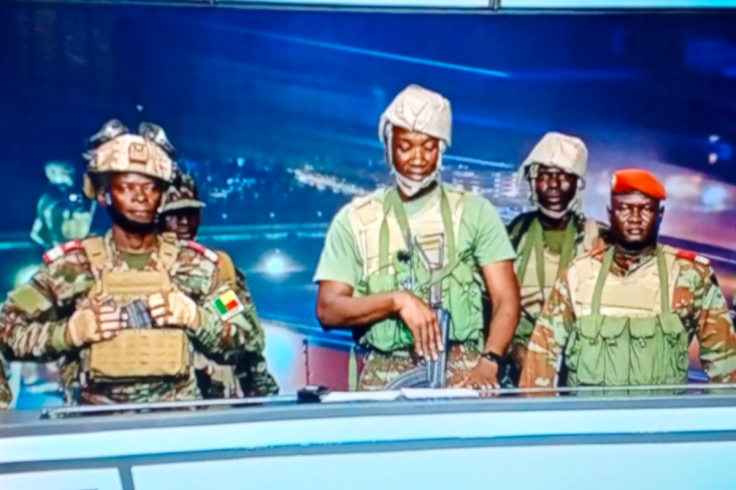
Rebel soldiers seized control of Benin's state television on Sunday morning, announcing that they had deposed President Patrice Talon and dissolved the government before loyalist forces swiftly crushed the coup attempt.
The incident marks the latest in a wave of military insurrections across West Africa, though the rapid failure of the mutiny in Cotonou suggests a lack of broad support within the armed forces.
Guns, Hostages, and a Televised Declaration
The insurrection began in the early hours around President Talon's place in Cotonou. Gunfire echoed through the streets. Journalists at the state broadcaster were reportedly held hostage as the rebels took over.
At least eight soldiers appeared on screen to announce their 'Military Committee for Refoundation'–led by Lt Col Pascal Tigri–had seized power. They announced the suspension of the constitution, the dissolution of government institutions, and the closure of the nation's borders.
'The army solemnly commits to give the Beninese people the hope of a truly new era, where fraternity, justice and work prevail', one of the soldiers read out during their brief broadcast.
Foreign embassies went into overdrive. France told its nationals to stay home after gunfire near the presidential compound. Russia's mission said the same. The United States told their citizens to stay away from Cotonou.
Government Hits Back Fast
The rebels were unable to consolidate their position. Foreign Minister Olushegun Adjadi Bakari stated that the 'small group of soldiers' only succeeded in taking over the network briefly. The Beninese Armed Forces neutralised the threat promptly.
'In the early morning of Sunday, 7 December 2025, a small group of soldiers launched a mutiny with the aim of destabilising the state and its institutions', Seidou said on telly. 'Faced with this situation, the Beninese Armed Forces and their leadership, true to their oath, remained committed to the republic'.
Government spokesperson Wilfried Leandre Houngbedji said 14 people had been arrested by Sunday afternoon. A journalist in Benin reported that 12 of them stormed the TV offices, including an individual who had already been relieved from the army.
A presidential adviser told the BBC that Talon was in a secure location. Nigeria–Benin's absolutely massive neighbour–called the whole thing a 'direct assault on democracy'.
Why They Did It
When the rebel soldiers were on TV, they listed their grievances. They criticised Talon over his handling of the 'continuing deterioration of the security situation in northern Benin', where jihadist insurgents linked to Islamic State and al-Qaeda have been creeping down from Niger and Burkina Faso.
They also decried what they called 'the ignorance and neglect of the situation of our brothers in arms who have fallen at the front and, above all, that of their families, abandoned to their sad fate by Mr Patrice Talon's policies'. Healthcare cuts were also cited as a grievance–including the scrapping of state-funded dialysis, alongside tax hikes and political crackdowns.
Massive Explosions Rock Capital
Several large explosions later rocked the capital. Flight-tracking data caught three aircraft coming into Benin's airspace from Nigeria. Two flew back to Lagos, and a third headed towards an airbase in western Nigeria. A French air force plane was also observed doing circles over Cotonoubut French diplomats denied rumours that Talon had fled to their embassy.
There is a coup ongoing in Benin 🇧🇯
— Africa Facts Zone (@AfricaFactsZone) December 7, 2025
Soldiers led by Lieutenant Pascal Tigri announce that they have taken over the country.
They have suspended all political parties and announced the closure of land, sea and air borders.
Benin is one of West Africa's most peaceful countries. pic.twitter.com/mGmntV0TDl
West Africa's Coup Epidemic Continues
This failed takeover came barely a week after Guinea-Bissau's President Umaro Sissoco Embaló was toppled. West Africa's been plagued with coups lately. Burkina Faso, Guinea, Mali, and Niger–they have all had military takeovers in recent years.
Russia has been strengthening ties with these Sahel countries. Burkina Faso, Mali and Niger walked out of ECOWAS–the West African bloc–to set up their own alliance called the Alliance of Sahel States. Pro-Russian accounts on social media were reportedly supportive of the Benin coup attempt.
Both ECOWAS and the African Union condemned the action. AU Commission chair Mahmoud Ali Yousouf reiterated the organisation's 'zero tolerance stance toward any unconstitutional change of government'.
Challenges to Benin's Democracy
This incident exposes the fragility of democratic institutions across West Africa right now. Benin used to be one of the more solid democracies in Africa since 1991. Talon, 67, made his money in cotton–earning him the nickname the 'king of cotton'–and he has been in power since 2016. He is due to step down next April.
But critics allege he has been squashing dissent. Last month, the Benin administration changed the constitution to stretch terms from five to seven years for everyone except the president. This move was seen by the opposition as a precursor to future constitutional manoeuvres that could allow Talon to extend his own rule.
West Africa needs regional bodies like ECOWAS to actually crack down on these unconstitutional power grabs whilst also tackling why soldiers keep getting so fed up–security threats, poverty, corruption. Otherwise, this pattern will keep repeating itself.
© Copyright IBTimes 2026. All rights reserved.