

3I/ATLAS Interstellar Comet Says Goodbye As Experts Fear We May Miss The Next Impact
3I/ATLAS says goodbye: As the interstellar visitor departs, experts warn that satellite clutter could blind us to the next high-velocity space impact.

For those of us who spent the last few months glancing nervously at the heavens, wondering if our latest celestial visitor was a harbinger of something more sinister, there is good news. The interstellar traveller known as 3I/ATLAS has officially completed its closest approach to Earth, and it did so without deploying an invading fleet or colliding with our fragile blue marble.
Last Friday, the cosmic wanderer reached its perigee at a distance of 168 million miles—roughly double the space between us and the Sun. This milestone marks a significant moment in the object's trajectory, which saw it travelling at a staggering speed of 137,000 miles per hour during its dash through the inner solar system.
While that might sound like a vast gulf in human terms, in the grand theatre of the cosmos, it was a relatively intimate 'near-miss'. Our visitor is now beginning the long, slow journey back into the dark. Over the next few years, it will perform a grand tour of our outer neighbours—Jupiter, Saturn, Uranus, and Neptune—before finally exiting our solar system entirely by 2028.

The Bizarre Chemistry Of 3I/ATLAS
Though it may not be an alien mothership—much to the disappointment of certain corners of the internet—the data harvested from this rock has been nothing short of extraordinary. Scientists believe this object could be as ancient as the Milky Way itself, a pristine relic from a time before our own world even existed.
As it approached the Sun, the heat began to melt the comet's icy core, releasing a cocktail of gases that has kept researchers awake at night. Spectroscopic data from the James Webb Space Telescope recently confirmed that 3I/ATLAS contains a unique isotopic signature, suggesting it originated from a protoplanetary disk around a red dwarf star in the galactic neighbourhood.
It has discharged cyanide, which is surprisingly common for comets, alongside unusually large quantities of carbon dioxide. Even more baffling was the detection of iron and nickel. Finding heavy metals in the outgassing of a comet is rare, making 3I/ATLAS a genuine scientific goldmine. As only the third interstellar object ever detected within our borders—preceded only by 'Oumuamua and Borisov—it offers a rare glimpse into the chemistry of distant star systems. This outsider was not in town for long, but the field of astronomy may never be the same again.
Why 3I/ATLAS Proves We Need Better Eyes On The Skies
The 'ATLAS' part of its name refers to the Asteroid Terrestrial-impact Last Alert System, a sophisticated network of telescopes designed to give humanity a heads-up before anything significant makes an impact. This particular visitor was first spotted by the Chilean branch of the survey in early July. Since that initial sighting, the Earth has continued its orbital dance, moving away from the comet's path even as the visitor skimmed past Mars and performed a slingshot manoeuvre around the Sun.
The success of the ATLAS system in tracking 3I/ATLAS highlights a growing concern among the scientific community. While we successfully saw this 'guest' coming, our ability to spot the next one is under threat. The ever-increasing density of satellite constellations is beginning to obscure ground-based observatories to a point of near-uselessness.
If our view of the stars becomes too cluttered with man-made debris, we risk missing the next interstellar visitor entirely. Dr. Robert Jedicke, a specialist in near-Earth objects, has warned that 'light pollution' from these satellites could reduce our early detection capabilities for smaller, high-velocity interstellar objects by as much as 30 per cent within the next decade.
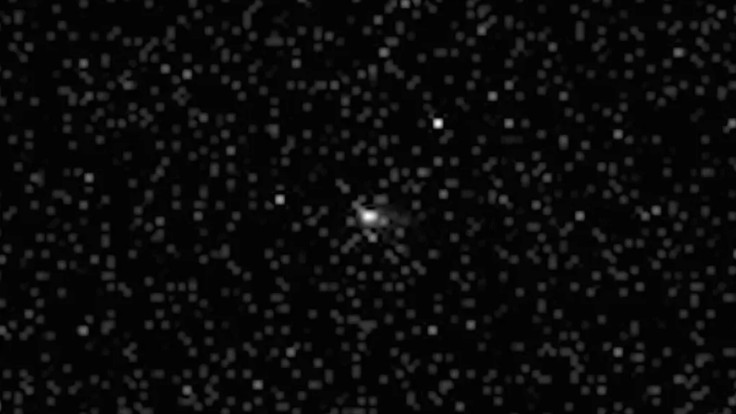
If a future object decides to make an 'impact' rather than a polite flyby, we would ideally like more than five minutes' notice. For now, we can only watch as 3I/ATLAS fades into a tiny speck on the galactic horizon. It has provided us with a wealth of data and a sobering reminder of our place in a very busy, very ancient universe.
The departure of 3I/ATLAS leaves behind a wealth of data that will keep astronomers busy for years, but it also serves as a stark warning about our vulnerability to the unknown. As we watch this ancient traveller fade into the void, the focus must now shift to protecting our ability to see what else might be lurking in the dark.
© Copyright IBTimes 2026. All rights reserved.