

3I/ATLAS Update: Harvard Expert Claims 'Alien Spaceship' Is From Milky Way Disc
An interstellar wanderer with too much metal and too many questions, 3I/ATLAS is forcing astronomers to rethink what a 'normal' comet from our own galaxy should look like.
A mysterious comet named 3I/ATLAS, spotted in July 2025 streaking through our Solar System from deep space, is likely not an 'alien spaceship' but a visitor from the main disc of the Milky Way, according to Harvard astrophysicist Avi Loeb. His claim, based on the object's galactic trajectory and unusual chemistry, has added a fresh twist to the debate over what 3I/ATLAS actually is and where it originated.
The news followed confirmation by astronomers that 3I/ATLAS, also catalogued as C/2025 N1, is only the third known interstellar object to enter the Solar System. Its discovery by the ATLAS survey in Chile immediately drew comparisons with ʻOumuamua and comet 2I/Borisov, the first two recognised interstellar visitors. Unlike those earlier cases, where the debate quickly centred on exotic explanations versus more mundane ones, 3I/ATLAS has opened a more complicated puzzle, grounded in the hard data of orbital dynamics and chemistry rather than science-fiction speculation.
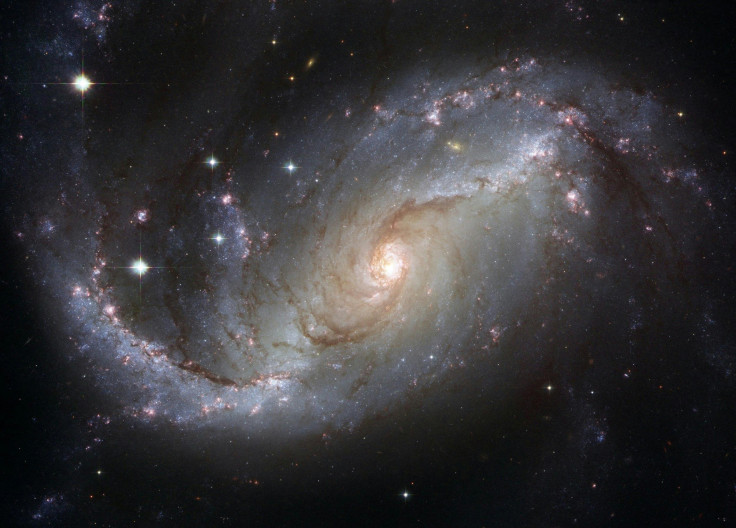
3I/ATLAS, the Milky Way Disc and a Cosmic Paradox
Loeb has become one of the most controversial figures in modern astrophysics, in part for suggesting that ʻOumuamua might have been a piece of alien technology. With 3I/ATLAS, he has again leaned towards an attention‑grabbing interpretation, but this time the headline claim is more measured, with his latest Medium blog arguing that 3I/ATLAS is very likely native to the Milky Way's stellar disc.
'The Galactic orbit of 3I/ATLAS suggests a likely origin in the disc of the Milky-Way galaxy,' Loeb wrote, pointing to the way the object is moving through space. In simple terms, its trajectory looks similar to the motion of stars and other material in the central band of the galaxy, rather than something flung in from a more exotic halo or intergalactic region. On that point, at least, his argument sits comfortably with mainstream galactic dynamics.
Where things become murkier is the object's age and internal composition. Avi Loeb has suggested that 3I/ATLAS could be older than the Solar System and 'maybe up to 14 billion years old.' That figure approaches the cosmic maximum, roughly the age of the universe itself. Even by the generous standards of theoretical speculation, it is a bold claim and is not independently confirmed by the observational data currently available. For now, any precise age estimate should be treated with caution.
The composition of 3I/ATLAS makes the story stranger still. Telescopes have detected an atmosphere, or coma, around the object that is heavily dominated by carbon dioxide, along with carbon monoxide, water vapour and trace quantities of methanol and cyanide. According to Loeb, the balance of carbon, oxygen and nitrogen based molecules implies that 'most of its mass is associated with heavy elements.' That is astrophysics shorthand for saying the comet is rich in what scientists confusingly call 'metals' anything heavier than hydrogen and helium.
That point is significant because other clues initially suggested that 3I/ATLAS might have formed in a region of the galaxy with relatively few heavy elements. On the surface, that would align with the idea of an extremely ancient object, created when the Universe had not yet been thoroughly enriched with metals from dying stars. Instead, the gas streaming from 3I/ATLAS appears to be far from primitive.
'Alien Spaceship' Claims and 3I/ATLAS Data
The gap between a metal‑poor birthplace and a metal‑rich coma has fuelled wilder claims, including social‑media chatter about an 'alien spaceship.' The original report used that phrase, but nothing in the current scientific record supports the idea that 3I/ATLAS is artificial. There are no confirmed signs of propulsion, signalling, communications or structure beyond what would be expected from a large, volatile‑rich body rapidly heated by the sun.
The numbers alone are striking without invoking extraterrestrial engineers. Observations suggest 3I/ATLAS contains roughly 16 times more carbon dioxide than typical comets in the Solar System. It is also releasing significant amounts of nickel gas but, so far, no detectable iron. That combination of nickel without iron is described as 'very unusual' and has understandably drawn scientists' attention.
The solid nucleus at the heart of 3I/ATLAS is estimated to be somewhere between 300 metres and more than a kilometre across. That puts it well within the size range of ordinary comets, but its chemistry does not sit easily with any neat category. If this is just another frozen remnant of planet formation, it is an oddly assembled one.
Scientists are, at this stage, openly puzzled about how such an object could have formed and then travelled across interstellar space to pass through the Solar System. One possibility is that it originated in an environment with initially low levels of heavy elements, only to be later altered by processes that enriched its outer layers. Another is that assumptions about what early, metal‑poor regions of the galaxy can produce may be too rigid.

What is clear from the reported data is that 3I/ATLAS behaves like a highly active comet exposed to sunlight after a long, cold journey. It outgasses, it develops a coma and likely a tail, and its trajectory through the Solar System can be tracked using standard gravitational models. The 'alien spaceship' label, while catchy, does more to confuse than to clarify.
No space agency has yet announced a dedicated mission to fly by or rendezvous with 3I/ATLAS, and none of the claims about its exact age or formative history have been independently verified in peer‑reviewed journals on the basis of the information presented. Until those checks are made, all suggestions about when and where it was born remain provisional and should be taken with a grain of salt.
Researchers agree that every interstellar visitor is precious. Only three have been observed with confidence, including 3I/ATLAS, and each carries a unique chemical and dynamical signature of its origin. As telescopes continue to monitor the object and refine measurements of its motion and outgassing, scientists hope it will provide a small but telling sample of the broader Milky Way disc that Avi Loeb argues is its home.
If he is correct, 3I/ATLAS is not an outsider crashing into the Solar System from beyond the galaxy, but a fellow resident of the Milky Way, ejected from one stellar cradle and briefly illuminated in another.
© Copyright IBTimes 2026. All rights reserved.
- MOST POPULAR IN Trending


