Classified DOJ Memo Claims Trump 'Not Restricted' by US or International Law in Maduro Capture

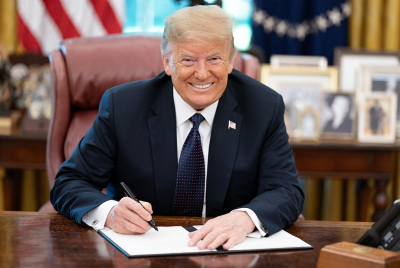
A newly revealed Justice Department legal opinion asserts that US President Donald Trump was not constrained by either American or international law when he authorised a military-backed operation to seize Venezuelan President Nicolás Maduro.
Trump argued that his constitutional powers as commander-in-chief and the framing of the mission as a law-enforcement action gave him authority to act.
Late in December of 2025, the US executed a secret mission called 'Absolute Resolve' to capture Maduro. The administration presented the operation that was carried out with the help of US military forces as a law enforcement operation to take Maduro to justice because of decades of alleged drug trafficking and corruption.
'This was an administration-wide effort to arrest the head of a major narco-trafficking foreign terrorist organization, who has long been a fugitive of American justice,' a White House Official told CNN in an interview. 'The Department of Justice routinely executes federal arrest warrants abroad.'
The legality of the operation has, however, attracted stiff debate, particularly following the release of a legal opinion in the Justice Department that is legally declassified.
Authorities insist that the operation could not be considered a war, but a well-calculated law enforcement measure.
Critics, especially Democrats, believe that this military-like intervention in a foreign head of state is an act of war and that it is a violation of international standards.
The newly disclosed legal memo seems to be in favour of the administration, which states that Trump had constitutional powers to approve the operation without prior congressional agreement and observation of international law limitations.
What does it say? Information on the 'secret memo'
The Office of Legal Counsel (OLC) theorized on legal matters (in 20-30 pages) that were classified and which were released to Congress on Tuesday.
Even though there were unclassified snippets that were published, this memo shows that Trump was entitled to grant the operation because he was the Commander-in-Chief, as stipulated in Article II of the U.S. Constitution.
The memo makes heavy reference to an opinion prepared by then-Acting Attorney General William Barr in 1989, which stated that presidents have an inherent constitutional power to order covert operations in foreign states, even when such operations violate international law.
It's the basis of the most recent memo, which stated that the extent, the size, and the length of the 'Absolute Resolve' was not a war under the constitutional interpretation and, accordingly, was not to be authorised by Congress under the War Powers Resolution.
The document highlights that even in cases where the president has been engaging in rendition and law enforcement missions abroad, international law does not limit the president, provided that they do not violate the US Constitution.
It makes clear that the operation was to be proportional and focused, and instead of regime change, the US military intervention was based on the apparent threat and the risk of resistance.
It has been observed in the document that the Justice Department has failed to specifically review the application of international law, indicating that the international legal restrictions do not restrain the authority of the president when carrying out such domestic law enforcement measures, even when done outside the country.

The presidential powers and the extent of the operation
The legal basis of the operation depended on the constitutional rights of the president as Commander-in-Chief that provide him/her with extensive authority to use the forces and engage in unseen actions abroad.
The Trump administration felt that the operation was not escalated into a declaration of war or needed congressional permission since it was seen as law enforcement and not a military conflict.
Another fact highlighted in the document is that the operation was to be limited in nature so that it was only going to address the presence of Maduro and not to overthrow the Venezuelan government wholesale.
The memo states that the military intervention was relative and the level of threat was evaluated to be manageable, considering the possibility of resistance that Maduro could have put up.
What is sovereignty in the eyes of many people?
Publication of this legal opinion has received mixed responses. The proponents claim that it confirms the constitutional power of the president to exercise his discretion in matters pertaining to national security and law enforcement, particularly those involving a fugitive drug smuggling suspect. To them, the operation was legal, and it was within the president's rights.
Those against it, however, argue that this is weakening the international norms and the constitutional powers of Congress to authorise military actions.
Democratic legislators have termed the action as an overreach since the forceful removal of a foreign leader may be precedential. They further claim that the fact that the operation was characterised as a law enforcement act and not a military operation is dubious, given the military reinforcement that was used.
The responses of the international community have been reserved. Some countries believe the action may be a possible contravention of Venezuelan sovereignty and international law, whereas some consider it an excellent example of the US's readiness to employ hidden force and take down drug traffickers and terrorists abroad.
© Copyright IBTimes 2025. All rights reserved.
- MOST POPULAR IN Politics