

Eerie Early Image of 3I/ATLAS Sparks Panic and Wild Speculation Among Scientists
Unsettling early capture of interstellar visitor 3I/ATLAS ignites debate over cometary norm and alleged anomalies among scientists and researchers
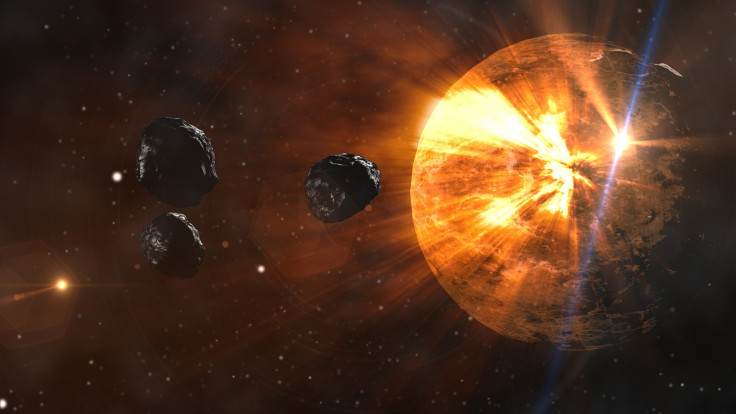
An unsettling early image of the interstellar object 3I/ATLAS has forced scientists to confront anomalies that defy simple classification and fuel tense debate within the astronomical community. The image, captured by ground-based telescopes shortly after the object's discovery, shows a highly asymmetric light distribution that defies expectations for a typical comet.
While later, more professional observations from NASA depict a standard cometary body, this peculiar early frame—with its 'over-brightened, lopsided glow'—has been difficult to reconcile with standard models. The discrepancy has ignited a debate over whether the image is a meaningless artefact or a crucial clue to the object's true nature.
Early Anomalies and Scientific Context
From the moment its hyperbolic trajectory was characterised, indicating an origin beyond the solar system, astronomers recognised 3I/ATLAS as a rare and scientifically valuable object. Confirmed through archival observations by the Zwicky Transient Facility and follow-up imaging by multiple professional telescopes, the object's interstellar nature is settled science.
Images taken by NASA assets, including the Hubble Space Telescope, the Solar and Heliospheric Observatory (SOHO), and the Mars Reconnaissance Orbiter, show a diffuse body with a coma typical of active comets. These data confirm the presence of volatile outgassing as it nears the Sun, with spectroscopic measurements identifying carbon dioxide, water vapour, and other compounds.
Yet the early amateur image, taken weeks before these professional observations, appears strange. It fails to conform to the symmetric coma patterns expected from solar heating. Many astronomers have labelled early frames as noise or exposure artefacts.
🚨 3I/ATLAS LETEST ALERT 🚨
— 3I/ATLAS updates (@Defence12543) January 4, 2026
☄️THE FIRST IMAGE OF 3I/ATLAS THAT SHOULD HAVE STOPPED US COLD 😱
⚠️An early image of the interstellar object 3I/ATLAS, captured roughly two to three months before today’s sharper observations, is now resurfacing—and it feels unsettling in hindsight.… pic.twitter.com/AyDnmyzJPf
The Loeb Scale and 'Gaps' in NASA Data
The controversy surrounding the early image rose significantly after commentary from Harvard astrophysicist Avi Loeb. Loeb has argued that some features of 3I/ATLAS warrant careful consideration beyond traditional natural explanations. Drawing on his Loeb scale, where zero implies a natural origin, and ten signifies confirmed artificiality, he placed 3I/ATLAS at a four, meaning largely consistent with natural hypotheses but not dismissible.
Loeb's commentary includes several key points: that the object's orientation within the plane of the solar system is statistically unusual; that the early image's asymmetry could hint at non-gravitational forces; and that certain compositional signatures, such as unexpectedly high nickel readings in some spectral analyses, challenge typical comet profiles. Loeb has reaffirmed these views in multiple interviews and media appearances, highlighting what he sees as gaps in NASA's public data releases.
Despite these claims, mainstream organisations have reaffirmed the object's natural cometary status in peer-reviewed venues. NASA's science teams have emphasised that the observed features, including anti-tails and irregular jet structures, fall within expected variation due to outgassing asymmetries and viewing geometry.
Scholars publishing in research archives, such as arXiv, have provided rigorous spectroscopic evidence of both water and carbon dioxide in the coma, reinforcing the object's classification as a comet with complex but explicable behaviour.
Misinformation and Public Confusion
Alongside professional debate, public discourse has been marked by confusion over misinformation and mischaracterisation. Deepfake videos purporting to quote leading physicists like Michio Kaku about alien origins were publicly disavowed by the scientists themselves, who clarified their views on 3I/ATLAS's nature while condemning misrepresentation.
Online forums reflect a saturation of misleading content surrounding the object, with amateur communities attempting to vet real scientific sources from conjecture. These discussions underscore a broader cultural challenge: distinguishing verified scientific findings from viral speculation.
The release of images on 19 November 2025 by NASA and allied agencies offered a critical counterpoint to earlier uncertainty, showing the comet's characteristic coma and trajectory consistent with hyperbolic interstellar passage. Even among experts, consensus holds that 3I/ATLAS does not pose any threat to Earth and remains a remarkable natural visitor from beyond our solar system.
© Copyright IBTimes 2026. All rights reserved.