

More Women Are Turning to AI for Financial Advice, but Their Prompts May Be Costing Them $60,000
The chatbots gave broadly sound guidance in the simulation, but question wording still moved wealth at age 60 by 4.1%

The way women ask artificial intelligence (AI) for financial advice could leave them nearly $60,000 (£44,000) worse off by age 60, according to new research showing how seemingly small differences in prompts can shape long-term wealth.
Researchers from the Massachusetts Institute of Technology and Stanford collected money questions from 952 real people, then simulated what would happen if they followed the AI-generated advice throughout their lives.
Prompts written by women resulted in $59,890 less wealth by age 60 than those written by men, despite both groups facing identical simulated circumstances. The difference came down to what they asked and how the AI responded.
Nobody actually lost $60,000. Researchers sent participants' real-world questions to GPT-5.2, then ran its advice through a model simulating decades of job losses, income shocks and market swings. In other words, they tested what could happen if people didn't just ask AI for money advice, but actually followed it for years.
The Words That Move the Number
Women's prompts leaned on debt, credit, and safe deposits. Men's prompts leaned on stocks, strategy, and rebalancing. The model answered each in kind, steering one group towards liquid savings and the other towards heavier stock exposure.
Across the simulated working life, women were told to hold 2.94 percentage points less in equities on average, while the amount they were told to save came out almost identical. A separate test, one prompt at a time on diversified funds, asked how much is the wording and how much is the label, as the graphic below shows.
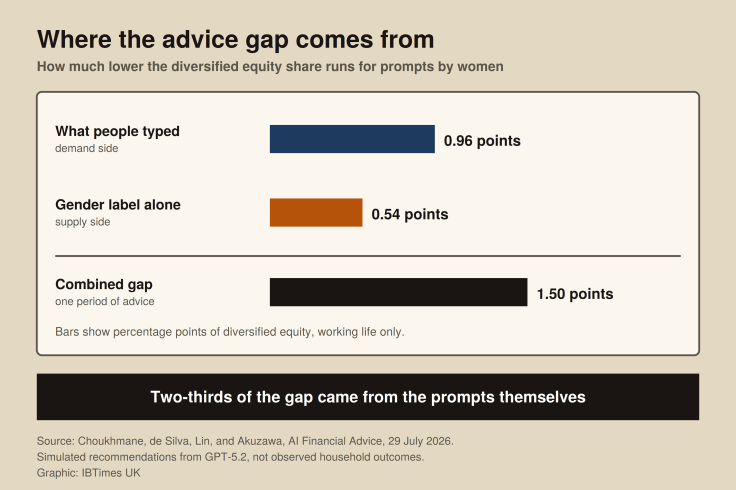
Tested one prompt at a time, the diversified fund gap came to 1.50 points, 0.96 of it from what women typed. The rest showed up when researchers took prompts that revealed nothing about the writer and randomly bolted on 'I am a woman' or 'I am a man.' Same finances and same sentences produced a lower stock recommendation.
Race behaved differently under the same method. An explicit racial label changed almost nothing, which may reflect safeguards enforced more tightly for race than gender. The authors warn a blunt label is exactly what safeguards catch.
Britain Has Already Made Money Its Main Use of AI
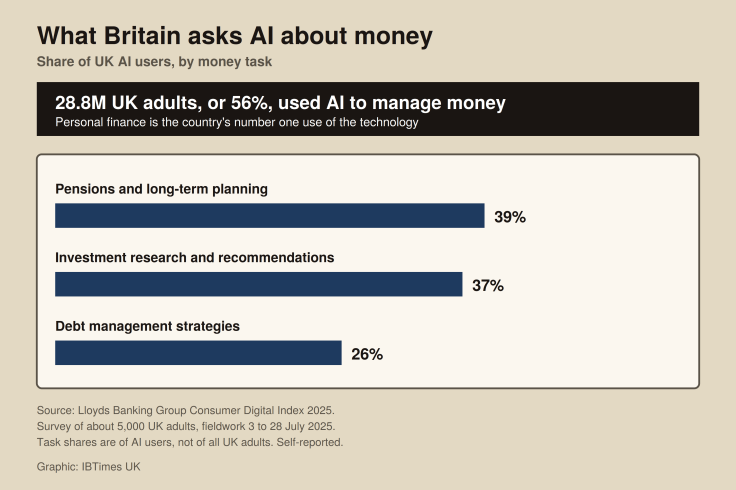
Lloyds Banking Group's Consumer Digital Index put UK adults using AI to manage money at 28.8M, or 56%, across 12 months. Personal finance was the country's most common use of the technology, ahead of health, shopping, and travel.
Some 39% of those users asked about pensions and long-term planning, and more than a third about investment research, as the chart below shows.
J.D. Power surveyed 4,000 US consumers in June and found 40% had asked AI for help with money. Some 34% credited it with better decisions, one point behind the 35% who credited their bank.
Neither survey splits its figures by gender, so the idea that women are arriving faster than men rests on nothing either publishes. Pew Research Centre found the overall gender difference in chatbot use has closed since 2024, though men still reach for one daily more often, at 27% against 20%.
The Advice Was Mostly Good, Which Is the Awkward Part
Following the recommendations moved most simulated savers closer to textbook theory than their own reported behaviour. Stock market participation went close to universal, buffers above $10,000 (roughly £7,400) appeared by age 30, and equity shares fell after 45.
The model's failures were odd rather than large. Saving rates bunched on multiples of ten, 31% of them. More than 98% of retirement withdrawals came in at 4% of assets or less, an old rule of thumb, not a calculation. Portfolios drifted with the market instead of being rebalanced.
A structured prompt spelling out every figure and telling the model to act as a professional adviser fixed most of that. The round-number share fell to 14.6%, the 4% habit to 8.8%. Portfolio drift did not budge.
Prompts from people with weaker financial literacy produced roughly $46,000 less, and from people new to AI, $100,000 less. That is uncomfortable for anyone using these tools instead of advice they cannot afford. The people best equipped to write the prompt that gets the better answer are the ones who need it least.
Disclaimer: Our digital media content is for informational purposes only and does not constitute investment advice. Please conduct your own analysis or seek professional advice before investing. Remember, investments are subject to market risks, and past performance does not guarantee future returns.
© Copyright IBTimes 2026. All rights reserved.