Trump Student Loan Rule Could Cut Federal Loans for Degrees Whose Graduates Don't Out-Earn High School Diploma Holders
Colleges must report on every course by 1 October, but about 4% of aided students could be on failing ones
Students in low-paying courses could lose access to new federal Direct Loans under a federal earnings test that takes effect for most courses on 1 July 2027. The US Department of Education will compare graduates of each course with working adults aged 25 to 34 who have only a high school diploma. The department estimates that 93 per cent of cosmetology certificate programmes subject to the test will fail.
Under current rules, 99 per cent of cosmetology certificate programmes subject to the test would fail, the department says. Drama and theatre degrees face a sharp rise in risk. Programmes that fail the earnings test in two of three consecutive award years lose eligibility for federal Direct Loans for at least two years. Colleges must send in data by Thursday, 1 October.
How the Earnings Test Works
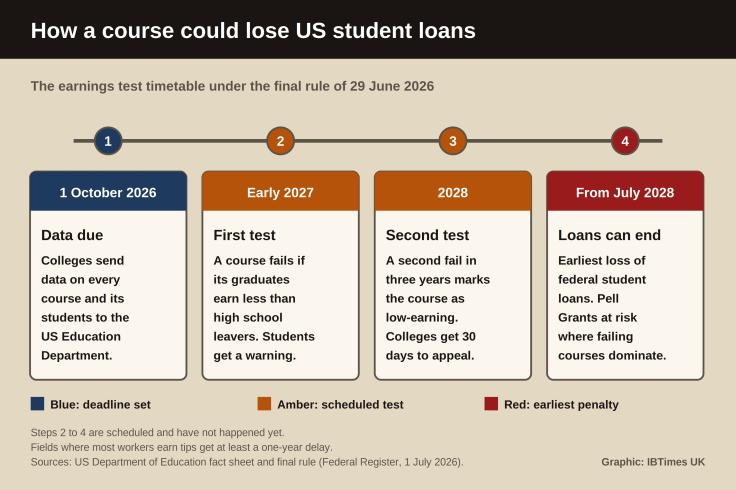
Officials take graduates' median, or middle, pay from tax records four years on. A course fails if that median trails working adults aged 25 to 34 who stopped at a high school diploma. The benchmark is statewide if at least half a college's students are local, otherwise national. Graduate courses face the lowest of several benchmarks for same-age bachelor's holders, including state and same-field ones. The timeline shows each step.
If low-earning courses hold over half a college's aided students or federal aid in two of three consecutive years, it can face provisional status. Those courses can lose all federal aid, including Pell Grants for low-income students, which rarely need repaying. Under Secretary of Education Nicholas Kent said on 29 June that courses unable to show graduates are better off 'should not be underwritten by federal taxpayers.'
The Courses Most Exposed to the Test
Officials expect failing courses to hold 4 per cent of aided students. Congress's 2025 law omitted short certificate courses; the department added many under existing rules. Jobs where at least half of workers earn tips get at least a year's delay, covering about 77 per cent of cosmetology courses. Checking Michigan schools in May, beauty-school owner Stacy Wells told American Salon: 'Not one school, including the community colleges, passed this metric.'
Drama, two-year teacher training, and master's courses in mental and social health face the fastest-rising risk, the department says. Each is often 10 to 20 times likelier to fail than now. Preston Cooper of the American Enterprise Institute called the test an easy bar. Hope College president Matthew Scogin wrote in Forbes in July that the test 'is fundamentally opposed to the very idea of education itself.'
What Happens Next for Students and Colleges
After a first failure, colleges must warn current and prospective students the course could lose federal loans. A college can agree with the Education Secretary to block those loans for at least five years, which can protect its other aid. It can also close the course to new students with approval.
In a closure, current students keep borrowing for up to three years, or less for shorter courses. Appeals, due within 30 days, can only challenge calculation errors. Courses failing the first two checks could lose loans from 1 July 2028. Officials cite rising defaults and arrears on $1.7 trillion (about £1.3 trillion) in federal student debt.
© Copyright IBTimes 2026. All rights reserved.
- Recommended For You