The Case for Looking at Your Portfolio Less: NAGA's Analysis
Research on myopic loss aversion found that investors shown performance less frequently took more risk and achieved better outcomes than those receiving constant updates

Picture two groups of investors, given the same money and the same choice between a riskier option and a safer one, round after round. The only difference between them is how often each group is shown the result.
This is not a thought experiment. Richard Thaler, Amos Tversky, Daniel Kahneman and Alan Schwartz ran it, in work appearing in the Quarterly Journal of Economics, and the two groups ended up in genuinely different places.
Group One: Shown the Result Every Round
This group had, on paper, the best information. Every round, they saw exactly how their allocation had performed. Nothing was hidden from them.
They also took the least risk of any group in the experiment, and finished with the weakest outcome. The mechanism has a name: myopic loss aversion.
Losses register more strongly than equivalent gains, and the more often you check, the more individual losing moments you witness. Sampled every round, an ordinary allocation looked alarming often enough that this group flinched away from it.
The obvious objection is that undergraduates in an experiment are not real investors, and it is a fair one. It has been tested since. Francis Larson, John List and Robert Metcalfe ran a field experiment with professional traders that applied the same manipulation to people who trade for a living, and found behaviour consistent with the laboratory results.
If experience alone dissolved the effect, professionals would be immune, but they are not.
Group Two: Shown the Result Rarely
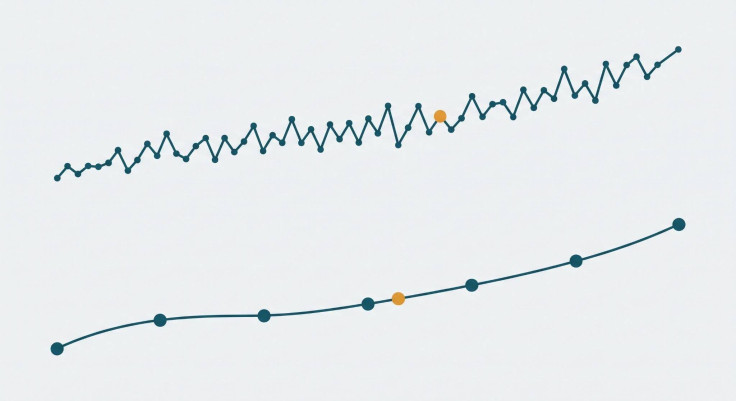
This group had, on paper, worse information. Long stretches passed between updates. Over a long enough horizon the same underlying allocation simply looked fine, because there was no minute-by-minute noise to react to.
Group two took more risk and finished ahead. Not because they knew more. Because they were shown less, less often, and had fewer opportunities to flinch.
Which Group Does a Modern Trading App Put You In?
The original 1997 work predates the smartphone. When it was published, checking a portfolio meant waiting for a statement or making a phone call, and that friction did some of group two's work for it automatically. Nobody had to choose infrequent feedback. It was the default.
In the view of NAGA, where market access, structured learning material and an open record of what other users are doing sit in one place, that friction is now gone and nothing has replaced it. The default on most platforms today is continuous visibility, group one's condition, and it is rarely a decision anyone made deliberately.
The uncomfortable implication for the industry, including for firms that build these products, is that an interface working exactly as intended can quietly move users towards the worse-performing group.
Building a Way Back to Group Two
Nobody is going to build a trading app that hides your balance. The realistic answer is narrower: the difference between information that arrives because you sought it and information that arrives because it was pushed at you. Price alerts you set at levels you chose are the first kind. A running feed you scroll out of habit is the second.
On NAGA, alerts can be set at levels the user chooses, so that a position reports to them rather than the other way round. The technical indicators available on the platform are documented in the education library too, which supports reading a chart on a defined basis rather than watching it continuously.
Neither is a restriction. Both change what triggers a look, moving the decision closer to group two's condition without removing anyone's access to their own account.
NAGA's own position on this is more cautious than the category norm. A platform can make a considered interval easier to keep, by letting the user decide what is worth an interruption. It cannot make anyone keep one, and presenting that as a feature would overstate what any interface does.
What the Experiment Does Not Say
Two qualifications are worth adding, because the group-two comparison is easy to overextend into advice it does not support.
NAGA's first qualification: it does not say ignore your positions. An unmonitored leveraged position is not a considered long-term holding; it is an unattended risk, and the experiment was about allocation over a horizon rather than about neglecting open trades.
The second: belonging to group two does not improve a poor decision on its own. It changes how often you are tempted to revise one, which is a different thing and a smaller claim.
And the underlying exposure is unchanged either way. Trading on leverage exposes an account to substantial loss regardless of which group you are in.
Checking a position often feels like diligence. What group one's experience suggests may be happening underneath that feeling is usually something narrower: a way of staying involved in a decision that was actually made once, at the point the position was opened.
A fixed interval, set in advance and matched to how the position itself moves, may do more for the outcome than any amount of extra attention paid in between.
© Copyright IBTimes 2026. All rights reserved.
- Recommended For You