

Read the Full Interview: Sri Sri Ravi Shankar on AI, US-Iran Conflict, Success and Mental Health
Exclusive Interview: Insights on Meditation, AI, and Achieving a Violence-Free Society
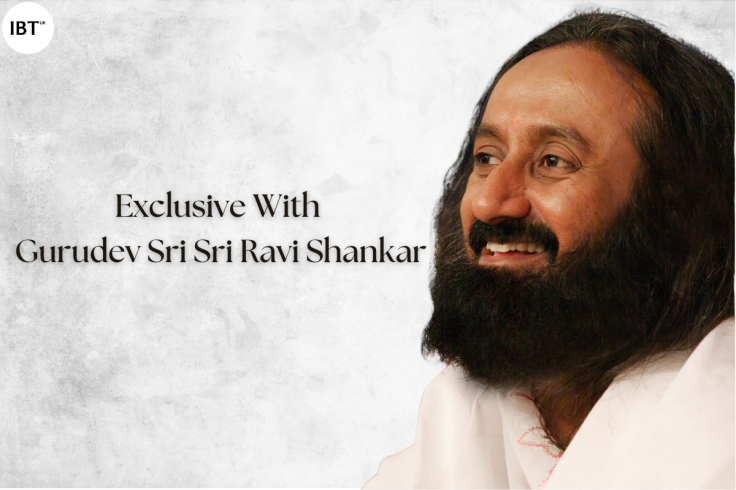
This is the full transcript of the IBTimes UK's exclusive interview with Gurudev Sri Sri Ravi Shankar, founder of global humanitarian organisation Art of Living.
IBT: You've worked extensively in the mental health and well-being space across the world. What is one mental habit today that appears normal but is quietly damaging millions?
Sri Sri Ravi Shankar: Why are we so bent on that one thing? If you go to a pharmacy and ask them, "Give me one medicine that can give me health for my whole life," what will the pharmacist say? Similarly, the world is so diverse that you may have multifaceted problems.
Today, people have more experiences than their senses and minds can handle. There is stimulation coming from so many sources, but direction in life is missing. Their experiences are so fast and so numerous, more than the mind can process. Therefore, they feel emotionally exhausted and inwardly lost. If they are given the right direction, they become more creative, more calm and can achieve their goals. But if they are not given this direction, if they do not have philosophy in life, then society is in the throes of violence and aggression on one hand and depression on the other.
Today, meditation is not a luxury but a very basic need; I call it mental hygiene, just like we maintain dental hygiene. When the mind is free of fear, guilt, and anger, and is more centred, then it can help heal the system of any ailment.
IBT: Recent research suggests short-form videos are rewiring attention spans and reducing focus, yet this form of addiction is barely being addressed despite its long-term impact. How does an individual recognise and overcome it before it starts shaping behaviour?
Sri Sri Ravi Shankar: Sixty to seventy years ago, our attention span was 45 to 50 minutes. Today, do you know what our attention span is? It is 30 seconds. Social media is a big part of this. Looking at a screen for hours without blinking causes big damage to the parasympathetic nervous system, and the part of the brain responsible for creativity starts shrinking. When you stare at a screen for too long, you blink less, and this affects the freshness and creativity of the mind. Blinking the eyes and free body movement are both important to keep the brain vibrant and creative.
The answer is not to reject technology, but to strengthen awareness. Meditation, breathing practices like Sudarshan Kriya, and spending some time in silence help the mind become calm, focused, and alert. Then, social media remains a useful tool, not a distraction that pulls you away from yourself.
IBT: A recent study showed that many people are now turning to AI platforms like ChatGPT for advice and emotional support. Do you think a machine can fill in for real human connection?
Sri Sri Ravi Shankar: The purpose of technology is to bring comfort to humans and make life easier. But comfort alone is not enough. Technology must enable connection, wisdom, joy, and the journey within.
Intelligence is not just about stuffing information or processing data. There is also emotional intelligence, intuitive intelligence, and a deeper intelligence that arises from consciousness itself. Human consciousness is a part of an Absolute Intelligence that maintains the natural order of the universe. This intelligence is of a much higher quality, and I do not think any machine can replicate this real human connection.
IBT: In a world driven by ambition and constant comparison, how do you define success in a way that doesn't lead to burnout or dissatisfaction?
Sri Sri Ravi Shankar: Success is not just money in the bank or what happens to you. It is your confidence, your strength, and your smile that measure your success. Every day you spend happily is a successful day. If you are tense, upset, and angry, would you call such a person successful? Often, people spend half of their health to gain their wealth, then they spend half their wealth to regain their health. This is not a sign of success.
Success is an attitude; it is not a phenomenon. People running after success only exhibit their limitations. Success means going beyond a limit. To cross a limit you need to assume that you have a limit. Assuming a limit is underestimating yourself. If you have no boundaries, then where is your success? If you have limitless access, then there is no success. You don't say that you successfully drank a glass of water, because it is well within your capabilities. But when you do something that is beyond your perceived limits, you claim success.
When you realise your unboundedness, then no action is an achievement. Anyone who claims to be successful only reveals his limitations. If you feel very successful, it means that you have underestimated yourself. All your gains can only be smaller than you. Taking pride in any gains is belittling yourself.
True success comes from sattva (purity and awareness), not just your skills or the instruments you possess. When sattva is high, the mind is alert, joyful, and enthusiastic, and you get results with much less effort.
IBT: You've said, 'war is the worst act of reason.' In the context of rising tensions between countries like the US and Iran, how should ordinary people cope with the anxiety that follows?
Sri Sri Ravi Shankar: Yes, it is a tough time for people, especially those who are caught in this conflict. To deal with such a volatile situation, you need a lot of inner strength and enormous patience. We have seen in our experiences that meditation and prayer help develop the inner strength needed to move on despite challenges that are not in one's control.
IBT: Through your engagement in conflict zones and peace-building efforts globally, do you believe a truly violence-free and stress-free society is achievable in today's world?
Sri Sri Ravi Shankar: In my view, the root cause of conflict is a lack of inner peace in individuals. In our experience of working with people in conflict zones, what we have found is the need for people who can build bridges. To restore communication and rebuild trust you need to work with the parties in conflict. Those mediators are very essential today. I would want each youth to be the one who builds these bridges whenever they find conflict or breakdown of communication in communities.
We talk of peace and security in the same breath. So much attention is given to security, but so little is paid to peace. The youth should be engaged in peace-building. Until and unless everyone blossoms into higher levels of consciousness, conflicts will continue on this planet.
This is why spiritual practice is required to burn down the seed of violence inside. A violence-free and stress-free society is achievable only if a wave of humanism and spiritual awakening rises and envelopes people everywhere, raising our collective consciousness. Inside every culprit is a victim crying for help. When the victim is healed, the culprit disappears.
IBT: If peace is possible, what is the first realistic step governments and people can take today, not in theory, but in practice?
Sri Sri Ravi Shankar: World peace begins with inner peace, because calm and compassionate individuals create harmonious communities. It is peaceful individuals who can build a peaceful society. If a person is agitated, restless and very unhappy, you can only spread that unhappiness and agitation around. So individual peace is the basis for world peace.
The very first realistic step is addressing the breakdown of communication, which is a major cause of escalating disputes. Dialogue is the most important practical tool we have. Even people who have taken to violent means can be engaged in dialogue if they are approached with clean intentions.
We must introduce a shift in education. To prevent fanaticism, leaders must play a role in imparting multi-religious education and peace education. Honouring diversity as an essential characteristic of our planet changes our mindset from merely tolerating differences to celebrating them.
IBT: Right now, the conflict between Iran and the US has caused global chaos. What message would you give to the leaders of the world to choose peace over escalation?
Sri Sri Ravi Shankar: The massive human suffering war brings in its wake reiterates the undeniable lesson of history that war is not a way to resolve conflicts. Force and aggression can never bring a lasting solution.
I would encourage the leaders to exercise restraint and take steps to rebuild trust and create an environment for meaningful dialogue.
© Copyright IBTimes 2026. All rights reserved.