

Hubble 3I/ATLAS Discovery: Interstellar Object Reveals 'Controlled' Jet System
Hubble detects 'controlled' jets on 3I/ATLAS, raising questions about alien technology

As the cosmic visitor 3I/ATLAS moves away from the outer solar system, it leaves behind a trail of scientific data that reads more like a high-stakes detective novel than a regular astronomical log. Many people thought the interstellar interloper was just a simple icy wanderer at first, but new observations from the Hubble Space Telescope have sparked a heated debate. Is this thing just a comet from a faraway star, or could it be a piece of advanced alien technology quietly surveying our neighbourhood in space?
On Dec. 12 and again on Dec. 27, Hubble captured high-resolution images of 3I/ATLAS that revealed a stable, double-jet structure behaving in a way few experts expected to see this far past its closest approach to the sun. These images, taken via 170-second exposures with the WFC3 UVIS camera, were processed using a Larson-Sekanina rotation gradient filter to expose the nucleus's activity in unprecedented detail.
Across these observations, the jets exhibited a striking 'anti-correlation': as one jet brightens, the other fades in a clean, repeatable and geometrically consistent swap. This is not the random, chaotic outgassing one might expect from a dying snowball. Instead, it suggests a system governed by a shared, rhythmic mechanism.

The Mystery of the Heartbeat in 3I/ATLAS
Harvard astrophysicist Professor Avi Loeb, a vocal proponent of investigating the object's potential technological origins, has highlighted this structured behaviour as a primary anomaly. He notes that these jets maintain their shape and direction across time, suggesting fixed source regions on or near the nucleus.
This pattern aligns perfectly with a previously observed 16-hour brightness modulation — often described by researchers as a 'heartbeat' — that was first hinted at months ago. Loeb argues that the clean 'swap' in brightness between the jets on Dec. 12 and 27, is a classic signature of rotational wobble, implying the jets are misaligned with the object's main axis of rotation.
In a recent analysis, Professor Loeb outlined two natural explanations that frame the current debate. The first suggests that the jets originate from opposite sides of the nucleus. As 3I/ATLAS rotates, one source is activated by solar heat while the other is shaded.
However, this theory requires incredibly efficient thermal transport through the object's core — a physical feat that is far from certain for a body of unknown interstellar composition. Loeb points out that if the rotation axis hasn't shifted since July, the original sun-facing pole should now be on the 'nightside' — yet Hubble shows it is still actively spewing material in a direction opposite to the sun.
The second explanation keeps both jets on the sunward side but suggests they are composed of different particle sizes. Larger dust grains, less affected by solar pressure, would form the persistent 'anti-tail,' while smaller particles would be rapidly decelerated by solar wind to form a shorter jet.
As the object's rotation shifts the angle of sunlight, the brightness of these two components would flip. While this model explains the data without invoking 'chaos', it still fails to resolve a nagging geometric problem: the sun-facing pole identified back in July should now be on the nightside, yet the sunward jet remains stubbornly active.
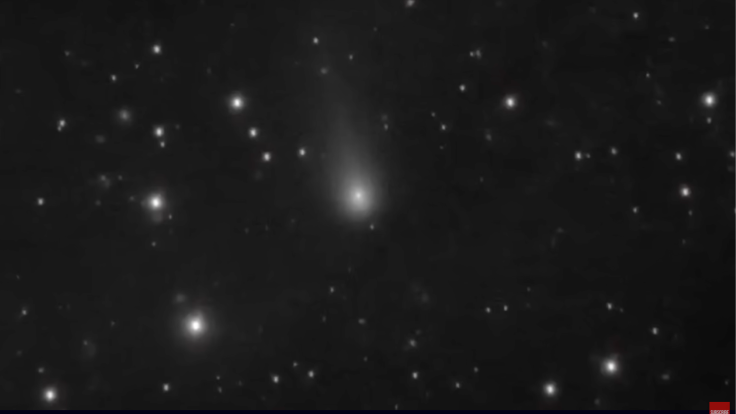
Decoding the Rhythmic Signature of 3I/ATLAS
The persistence of this structure is precisely what makes 3I/ATLAS so difficult to categorise. It does not behave like a small, exhausted snowball fading into inactivity. Instead, the variability is patterned and the rotation appears to be in complete control. Furthermore, the object's sheer speed — recorded at a staggering 130,000 miles per hour — makes it the fastest visitor ever tracked in our solar system, suggesting it has been accelerating through interstellar space for billions of years.
As Professor Loeb pointed out, 'You can't just say, 'I know the answer' and ignore the anomalies. That's not viable'. For a fandom of space-watchers that has spent months tracking the object's sprint through our system, the idea that the 'heartbeat' could be a signature of a hot engine or a controlled rotational system is a tantalising possibility.
The final word on this cosmic mystery may soon come from the James Webb Space Telescope. Scientists are preparing to use spectroscopy to determine the exact velocity and composition of these jets. Specifically, Webb will look for signatures of sulfur-to-oxygen ratios and launch speeds to see if they align with the 10-micron dust particle models proposed by natural theories.
If the launch speeds are found to be unusually high or inconsistent with standard models of ice turning into gas, the 'natural' narrative will face its toughest test yet. For now, the world must wait for the data, watching as 3I/ATLAS continues to defy every expectation we have placed upon it.
© Copyright IBTimes 2026. All rights reserved.