

Latest Images of 3I/ATLAS Confirm the Jets Coming From the Interstellar Comet
The newest images of 3I/ATLAS confirmed the appearance of the comet's sunward anti-tail
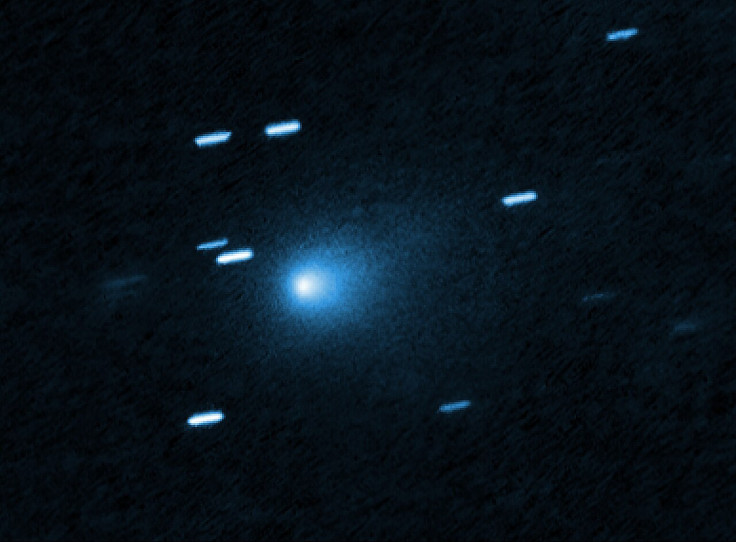
New images of the interstellar comet 3I/ATLAS from the Hubble Space Telescope appear to confirm the existence of a powerful jet of material pointing directly toward the Sun, a highly unusual feature that defies conventional cometary behaviour.
The images, captured on 7 January, are the clearest yet of the third interstellar object ever detected in our solar system. After processing, they reveal a distinct triple-jet structure emanating from the comet's nucleus, with one jet pointing sunward in a phenomenon known as an 'anti-tail'.
The Hubble Space Telescope captured images of 3I/ATLAS on 7 January and it is reportedly the clearest yet of the interstellar comet. The images were later processed using a Larson-Sekanina rotational filter, and showed a very distinct triple-jet coming from the comet's nucleus. It is likely what the USA Herald refers to as a 'tightly collimated' jet that is pointing toward the Sun.
An Unprecedented Sun-Facing Structure
According to NASA, the European Space Agency, and the Space Telescope Science Institute, this particular jet extends to a scale comparable to the distance between the Earth and the Moon. This 'anti-tail' is unlike anything typically seen from a solar system comet.
Comet tails normally form as solar radiation and solar wind push gas and dust away from the nucleus, resulting in a tail that points away from the Sun. While some anti-tails can appear as an optical illusion depending on Earth's vantage point, the Hubble images of 3I/ATLAS rule out that explanation.
Go, Comet 3I/ATLAS, go! ☄️
— Hubble (@NASAHubble) August 7, 2025
Hurtling at a whopping 130,000 miles per hour, this comet has the highest velocity ever recorded for a solar system visitor.
Hubble observations allow astronomers to more accurately estimate the comet's size: https://t.co/s5XkgJcWkF pic.twitter.com/3MihzFCXVx
Previous Detections Hinted at Anomaly
Hubble first detected 3I/ATLAS on 31 July 2025. At the time, astronomers noticed that its coma – the cloud surrounding its nucleus–appeared to be elongated toward the Sun. The angle of observation suggested the actual structure was six times longer than it appeared.
Subsequent detections of 3I/ATLAS after its closest approach to the Sun have confirmed this feature. Images taken at different points have consistently shown the sunward jet, along with two other jets spaced evenly from it.
We've just released the latest images of the interstellar comet 3I/ATLAS, as observed by eight different spacecraft, satellites, and telescopes.
— NASA (@NASA) November 19, 2025
Here's what we've learned about the comet — and how we're studying it across the solar system: https://t.co/ZIt1Qq6DSp pic.twitter.com/ITD6BqVlGn
CIA's Ambiguous Response on 'Alien Life' Records
As scientists continue to observe 3I/ATLAS, Harvard astronomer Avi Loeb, in a new post on Medium that the CIA seemed to hint at the existence of classified documents related to the comet.
Loeb cited a response the CIA gave to UFO researcher John Greenewald Jr., who had filed a query about the object. According to a letter Greenewald shared on X, the CIA stated it could 'neither confirm nor deny the existence or nonexistence of records' related to the interstellar comet.
We're hosting a live event on Wednesday, Nov. 19 to share the latest images of the interstellar comet 3I/ATLAS, collected by several NASA missions.
— NASA (@NASA) November 17, 2025
Tune in for the details—and send in your questions for the livestream with #AskNASA: https://t.co/vcFamtcjK2 pic.twitter.com/0d7fkTwRVP
Loeb contrasted this ambiguous response with statements from NASA officials, who have publicly described 3I/ATLAS as a regular comet.
'If this conclusion was clear all along to everyone within government and academia – as NASA officials presented the case, then why would the CIA treat the possible existence of records dealing with a natural comet as sensitive enough to be classified?' wrote Loeb.
© Copyright IBTimes 2026. All rights reserved.