

Monks Walking for Peace Are Crossing the US on Foot — Here's Why They Started, Who It's For, and Where They're Going
A group of 19 Buddhist monks is walking more than 2,300 miles across the US to promote peace and nonviolence
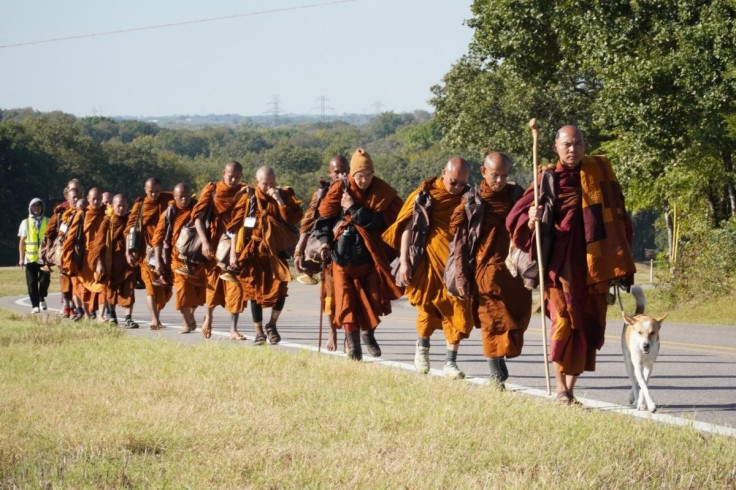
A group of Buddhist monks is undertaking a months-long walk across the United States, covering more than 2,300 miles on foot in a pilgrimage intended to promote peace, mindfulness and nonviolence.
The journey, known as the Walk for Peace, began in Fort Worth, Texas, in late October 2025 and is expected to conclude in Washington DC in mid-February. Since setting out, the monks have travelled steadily through several southern states, drawing attention from local communities and a growing online audience.
Although rooted in a quiet spiritual tradition, the walk has taken on a public dimension as it passes through towns and cities at a time of heightened political and social tension in the United States.
A Pilgrimage Rooted in Buddhist tradition
The group consists of around 19 Theravada Buddhist monks who follow a long-standing practice in which walking is used as a form of meditation and ethical discipline. Each day follows a structured routine of slow walking, chanting and silent reflection, with the monks covering significant distances along roads, through residential areas and across rural stretches.
Organisers say the walk is not intended as a political protest and does not involve banners, slogans or formal demands. Instead, the monks describe it as an effort to cultivate inner calm and compassion, which they believe can influence wider society through example.
Accompanying the group for much of the journey is a rescue dog named Aloka, meaning 'light' in Sanskrit. The dog has become a familiar presence alongside the monks and has helped draw attention to the pilgrimage on social media platforms, where followers track the group's progress.
Aloka had surgery on one of his legs today.
— Mr. Spock 🖖 (Commentary) (@SpockResists) January 12, 2026
🖖 pic.twitter.com/lK36pbNo9q
Who the Walk Is For
Those behind the Walk for Peace say it is aimed at people of all backgrounds, not only those who practise Buddhism. They describe the purpose as encouraging reflection on patience, empathy and restraint during a period when public discourse is often marked by division.
Along the route, the monks have paused in towns and cities to meditate and engage quietly with residents. In places including Selma, Alabama, and Columbia, South Carolina, members of the public have gathered to observe or walk alongside the procession, sometimes in silence.
Organisers say the response has been largely positive, though there have been isolated incidents of hostility. They say such encounters have reinforced the principles guiding the walk, particularly the emphasis on nonviolence and composure in the face of tension.
When monks leave their monasteries to walk for peace, it's not symbolic, it's a warning.
— MARTHA ACUÑA (@MARCIAN2003) January 12, 2026
They don't seek attention. They don't ask for power. They are not trying to convince you to change your religion (and they are been attacked by Christians).
They walk only when the world is… pic.twitter.com/dgxirzeTTl
A little girl from Alabama made a handmade sign for the Walk for Peace. It has a stop sign on it that reads "Kindness starts here." It also says "Good character counts" and "Friends respect good choices."
— 𝔠𝔬𝔠𝔬⧌ (@ChristianGentis) January 2, 2026
The Buddhist monks, who are walking 2,300 miles across America for peace,… pic.twitter.com/Z8naAA5xch
When monks leave their monasteries to walk for peace, it's not symbolic, it's a warning. They don't seek attention. They don't ask for power. They walk only when the world is out of balance.
— Jimmy Loud (@xloudforeverx) January 6, 2026
If you see them, offer food and water. They carry nothing but what's given to them. This… pic.twitter.com/ypqlnwwNI2
When monks leave their monasteries to walk for peace, it's not only symbolic, it's a warning. They don't seek attention. They don't ask for power. They walk only when the world is out of balance. They carry nothing but what's given to them. This isn't a protest. It's a prayer in… pic.twitter.com/6FTu6M1lmi
— Boston Smalls (@smalls2672) January 12, 2026
Challenges on the Road
The pilgrimage has involved significant physical and logistical challenges. The monks are travelling through changing weather conditions and varied terrain, relying on local support for food and temporary shelter as they move between communities.
In November, a vehicle accident near Dayton, Texas, seriously injured two monks. One lost a leg and later rejoined the group after receiving medical treatment, continuing the journey with assistance. Organisers said the incident highlighted both the risks involved and the group's determination to complete the walk.
Meet Maha Dam a monk who was struck by a car in Texas while walking for peace and forced to lose his leg.
— Everything Georgia (@GAFollowers) January 1, 2026
Doctors at Piedmont helped him and now he's back Snellville, Georgia healing. 🙏🙏 pic.twitter.com/JlyrUSI4wd
Despite setbacks, the monks have continued towards their destination and remain on schedule to reach Washington DC, where they plan to conclude the pilgrimage with prayers and meditation.
As the Walk for Peace enters its final stages, organisers say their aim has remained consistent throughout. They hope the sight of monks moving quietly through busy public spaces encourages reflection on how peace can be practised in everyday life through individual actions.
© Copyright IBTimes 2026. All rights reserved.