

Is 3I/ATLAS Alien Tech? NASA Associate Administrator Reveals Truth About Interstellar Comet
NASA reveals the truth about interstellar comet 3I/ATLAS with new high-res images. Is it alien tech? Find out the agency's official verdict here.

NASA is back on the world stage after a month of frustrating silence caused by the recent US government shutdown. They are bringing with them a stunning new look at one of the most important astronomical events of the decade. The space agency has ended its forced digital fast by releasing new pictures of the interstellar traveler known as Comet 3I/ATLAS.
This celestial nomad has fascinated both experienced astronomers and internet conspiracy theorists. The Mars Reconnaissance Orbiter (MRO) and the Parker Solar Probe took these pictures during the peak of the blackout. They show the Manhattan-sized nucleus in the highest resolution yet.
This isn't just another icy rock tumbling through the dark. Discovered in July by the NASA-funded Asteroid Terrestrial-impact Last Alert System (ATLAS) observatory in Chile, 3I/ATLAS is only the third confirmed interloper from another star system to ever be recorded.
It follows in the legendary footsteps of the cigar-shaped 1I/'Oumuamua in 2017 and the more traditional-looking 2I/Borisov in 2019. Its arrival offers a rare, fleeting window into the chemistry of a world far beyond our own sun's reach.

The Long Road to Revealing 3I/ATLAS During a Federal Blackout
The timing of the comet's arrival couldn't have been more dramatic—or more difficult for NASA's public relations wing. As the US government ground to a halt, so did the agency's ability to share updates. While the scientists behind the scenes continued their vital work, the public was left in the dark just as the comet was making its most critical moves.
About 15,000 NASA employees were put on leave because of the shutdown. This delayed the processing of important data and drew criticism from well-known people like Harvard astrophysicist Avi Loeb, who said that bureaucracy was getting in the way of scientific discovery.
The good news is that the international scientific community kept going. The European Space Agency (ESA) stepped in and used orbiters around Mars that were never meant to track fast-moving objects in space. In October, ESA released breathtaking shots captured during a Mars flyby, proving that even without NASA's primary communication channels, the world was watching.
Now that the lights are back on at NASA, the agency has unleashed a treasure trove of data from the SOHO mission, the Perseverance rover, and the Mars Reconnaissance Orbiter (MRO), providing a multi-angled view of this high-speed traveler. The new data even includes the first-ever radio signal detected from an interstellar object, picked up by the MeerKAT telescope in South Africa.
Debunking the Myths and Studying the Science of 3I/ATLAS
As with any object originating from outside our solar system, the 'alien' chatter on social media reached a fever pitch during the news blackout. Some suggested the object's trajectory or composition hinted at artificial origins, specifically pointing to a rare 'anti-tail' that appeared to stretch toward the sun.
However, NASA Associate Administrator Amit Kshatriya was quick to pour cold water on these sci-fi fantasies upon his return. '3I/ATLAS is a comet,' Kshatriya stated firmly, emphasizing that while its origins are extraordinary, its nature is entirely natural. He explained that the 'signal' detected was consistent with natural water jets shooting out of the nucleus as it was heated by our star.
The scientific value of 3I/ATLAS lies in its chemical 'signature.' Because it formed in a different part of the galaxy, it carries a unique recipe of ices and dust. Analysis from the James Webb Space Telescope (JWST) has already revealed unusually high levels of carbon monoxide, suggesting the comet was born in a frigid environment billions of years ago.
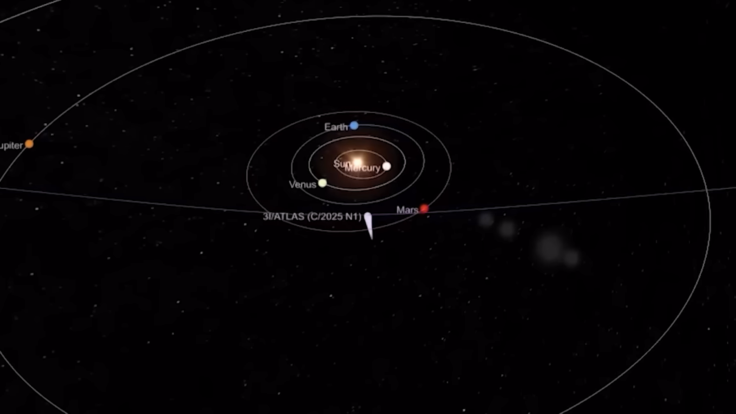
Astronomers are currently obsessed with how the comet behaved as it reached perihelion—its closest point to the sun—on 31 October. Passing within 126 million miles of our star, the heat likely caused the comet to 'off-gas,' revealing its internal secrets to the nearly a dozen telescopes currently pointed at it.
The next important date is December 19, when the comet will come closest to Earth. It will still be 170 million miles away, but being closer will let scientists make even better observations. Researchers want to figure out the building blocks of faraway planetary systems by comparing 3I/ATLAS to comets that were born in our own Oort Cloud. This way, they can study a part of the deep cosmos without ever leaving our own backyard.
As 3I/ATLAS hurtles through our celestial neighbourhood, it serves as a powerful reminder of how much of the universe remains a mystery. Whether it is a frozen relic of a distant star system or a messenger from the deep past, its presence is a once-in-a-generation opportunity for discovery. NASA's return to the fold ensures that we won't miss a single second of this cosmic flyby as it nears its closest point to Earth.
© Copyright IBTimes 2026. All rights reserved.