3I/ATLAS Is Pulsing Every 16.16 Hours: What Does This Mean For Callisto?
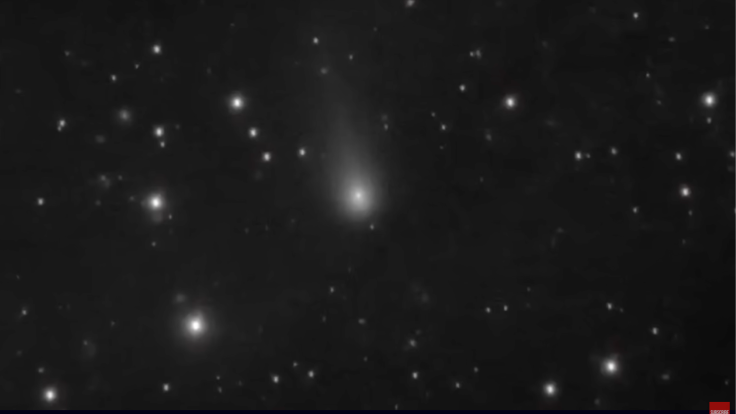
Astronomers have detected a strange, heartbeat-like pulse coming from the interstellar object 3I/ATLAS, which brightens and dims every 16.16 hours, a rhythm that has fascinated researchers and set social media buzzing with speculation about its potential impact on Jupiter's moon Callisto.
But despite the attention, scientists stress that the effect is purely optical and carries no threat whatsoever to Jupiter, its moons, or the wider Solar System. NASA says the flicker is due to reflected sunlight, not a change in mass, orbit, or energy output.
3I/ATLAS, an object from outside the Solar System first detected on 1 July by the ATLAS sky-survey project, has been observed brightening and dimming every 16.16 hours.
Reports from Axy Media describe the effect as a 'heartbeat' because of how consistently the light rises and falls.
Brightness changes are common among comets because their solid nuclei spin. However, recent analysis casts doubt on rotation as the sole explanation.
According to NASA's published Hubble Space Telescope observations from 21 July, most of the light seen from 3I/ATLAS does not come from a solid surface but from its coma—a large cloud of dust and gas surrounding the object.
NASA's imaging shows that the nucleus contributes only a small fraction of the light, making it difficult to explain such a strong brightness pulse solely through rotation.
Scientists Consider Jet-Like Activity
Researchers are now looking closely at a different explanation. Axy Media and other outlets report that astronomers increasingly suspect periodic jets of gas and dust may be responsible.
Under this theory, a patch of the object rich in frozen material turns towards the Sun as 3I/ATLAS rotates.
When sunlight warms this area, gases escape rapidly, creating a jet that expands the coma. This larger, denser cloud reflects more sunlight, temporarily making the object appear brighter.
The cycle repeats when the same region rotates back into sunlight roughly 16 hours later. Scientists say this kind of 'outgassing' behaviour is typical among comets, and the pattern seen here fits what they would expect from a jet-driven process.
Why Most Experts Reject Unusual Interpretations
Some commentators, including Harvard astrophysicist Avi Loeb, have suggested that the extreme regularity of the pulse could indicate something out of the ordinary, and he has raised this idea in previous interviews. But comet specialists say the simplest explanation is still the most likely.
NASA's size estimate for the nucleus—no more than around 2.8 km in radius—combined with the dusty environment around it, supports a natural origin. Jet activity can easily produce strong, periodic changes in brightness without requiring any exotic scenario.
No Threat to Callisto or Jupiter
Astronomers stress that the pulsing does not affect Jupiter or its moon Callisto in any way, despite speculation circulating online. The change is purely a light phenomenon, not a change in size, mass or trajectory.
In other words, the object is reflecting sunlight differently at different times—it is not emitting energy or altering its orbit in a way that could influence any planetary body.
There is also no evidence, according to current tracking data, that 3I/ATLAS will pass anywhere near Jupiter.
Scientists describe the behaviour as an 'optical curiosity', not a potential danger.
What Researchers Plan Next
According to reporting from PrimeTime and Axy Media, astronomers now want more continuous, long-duration observations—essentially 'time-lapse' sequences—to confirm whether the brightening events always correspond to the same region rotating into sunlight. This would strengthen the jet explanation.
NASA has also emphasised in its Hubble releases that 3I/ATLAS represents only the third confirmed interstellar object ever observed, providing a rare look at the chemistry and behaviour of bodies formed around distant stars.
As 3I/ATLAS continues its path through the Solar System and eventually returns to interstellar space, scientists expect its rhythmic pulses to remain a subject of curiosity—not concern—for months to come.
© Copyright IBTimes 2026. All rights reserved.
- MOST POPULAR IN Trending