

3I/ATLAS Radio Silence And 'Impossible' Jets Push Scientists To Rethink Comets
Scientific analysis of interstellar object 3I/ATLAS confirms its massive size and eerie radio silence, leaving experts baffled by its 'impossible' sunward jets.

The cosmos has a way of humbling our best technology, and the latest visitor from beyond our solar system is doing exactly that. Since its discovery on 1 July 2025 by the ATLAS survey in Chile, the interstellar object known as 3I/ATLAS has been at the centre of a whirlwind of scientific speculation. As only the third interstellar visitor ever detected—following the footsteps of 1I/'Oumuamua and 2I/Borisov—it has sparked a global race to determine its true nature.
Two new studies have just narrowed the field of what this mysterious wanderer could actually be. While some were hoping for a 'beaming' sign of artificial life, the latest data suggests a profound, eerie silence—accompanied by a physical scale that challenges our understanding of cometary physics.
A recent peer-reviewed analysis of radio observations has set the most stringent limits to date on whether 3I/ATLAS is emitting any form of artificial radio signals. At the same time, a separate preprint has independently converged on a nucleus size that completely reshapes how we view its bizarre behaviour. Together, these findings trim the margins of the unknown, yet they leave the deeper question of why this object refuses to act like a normal comet wide open.

The Search For Signals From 3I/ATLAS
The hunt for 'ET' is often a process of elimination, and the Allen Telescope Array (ATA) has just done some heavy lifting. Researchers spent 7.25 hours on 2 July 2025, scouring frequencies from 1 to 9 gigahertz. In that massive ocean of data, they initially flagged nearly 74 million narrowband signal 'hits'. After a brutal filtering process to remove terrestrial interference and unrelated celestial background noise, the list was whittled down to two million candidates.
When the team applied precise sky localisation—essentially checking if the signals moved in lockstep with the position of 3I/ATLAS—only 211 hits remained. Each of these was visually inspected in the time–frequency domain. The result? Total silence. None of the signals displayed the hallmarks of a credible transmission originating from the object. The search even looked for 'drifting' signals that would account for the object's staggering speed of 137,000 miles per hour.
Accounting for the object's rapid radial velocity and Doppler drift, scientists derived an upper bound on any potential radio transmission of approximately 10 to 110 watts. This threshold was later tightened even further by independent observations using the 100-metre Robert C. Byrd Green Bank Telescope.
On 19 December 2025, just as the object made its closest approach to Earth at a distance of 1.8 astronomical units (170 million miles), they constrained any possible emissions in the 1–12 gigahertz range to roughly a tenth of a watt. For perspective, that is less power than a standard household lightbulb. This data strongly disfavours the existence of any continuous, beacon-like transmission.
Sizing Up The Nucleus Of 3I/ATLAS
While the radio telescopes were listening, other astronomers were measuring. A newly released preprint has combined updated measurements of non-gravitational acceleration—the 'push' an object gets that isn't caused by gravity—with estimates of mass-loss rates to figure out how big 3I/ATLAS actually is.
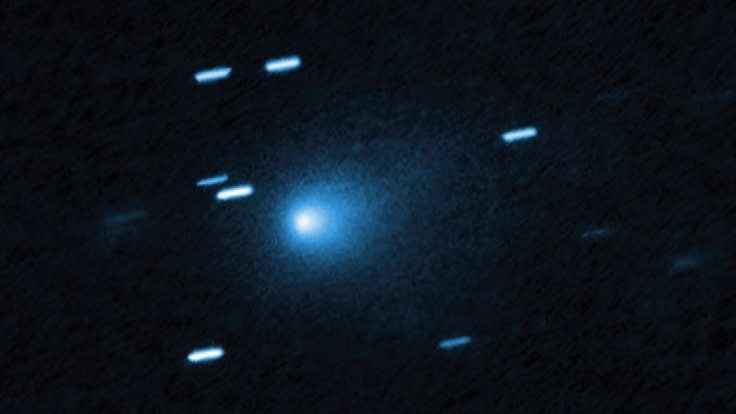
Using the principle of momentum conservation, the analysis concludes that the nucleus is on the order of one kilometre in diameter. This aligns with observations from the Hubble Space Telescope, which previously placed the diameter between 440 metres and 5.6 kilometres.
This estimate puts 3I/ATLAS firmly in the size range of large cometary bodies, at least on paper. However, the clarity of that number is deceptive. Since November 2025, NASA's JPL Horizons system has repeatedly revised downward the measured non-gravitational acceleration as more data came in.
These revisions are sensitive; small changes in how we model positional uncertainty can lead to massive differences in the calculated mass and size of the object. Davide Farnoccia at JPL has been key in these routine updates, which suggest the 'push' the object receives is significantly weaker than initially thought.
The biggest headache for researchers remains the 'recoil force.' Standard models assume that gas is shooting off the surface at thermal speeds. However, prior work suggests the force might actually come from the ejection of icy fragments. If 3I/ATLAS is spitting out chunks of ice rather than just gas, it changes the efficiency and direction of the 'kick' it receives, making it incredibly difficult to calculate its true size from its movement alone.

The orientation of its jets is equally baffling. High-resolution images from the Hubble Space Telescope showed a dominant anti-tail jet pointed toward the Sun both before perihelion in July 2025 and after perihelion in late November. Remarkably, the object maintained this sunward jet even after the Sun's gravity deflected its trajectory by 16 degrees during its closest approach on 30 October 2025. Under these conditions, the jets would almost cancel each other out in terms of momentum.
For now, 3I/ATLAS remains a refined mystery. It appears large and dynamically active, yet it remains energetically constrained in ways that defy easy explanation. While earlier observations by the MeerKAT telescope in South Africa detected the chemical fingerprint of water vapour—confirming its cometary nature—the 'impossible' geometry of its sunward jets continues to baffle experts. As we wait for the James Webb Space Telescope to provide direct spectroscopic measurements of its jet velocities, the world continues to watch this interstellar visitor, waiting to see if it fits our models or forces us to write new ones.
The mystery of 3I/ATLAS highlights how much we still have to learn about the visitors from beyond our solar system. As researchers refine their models and wait for more definitive data from the James Webb Space Telescope, this silent wanderer remains a profound challenge to our understanding of the universe.
© Copyright IBTimes 2026. All rights reserved.