3I/ATLAS Sparks Panic Claims of an Alien Battleship—Space Agencies Say the Data Shows Nothing Unnatural
NASA dismisses Harvard professor's claims of a passing alien battleship.
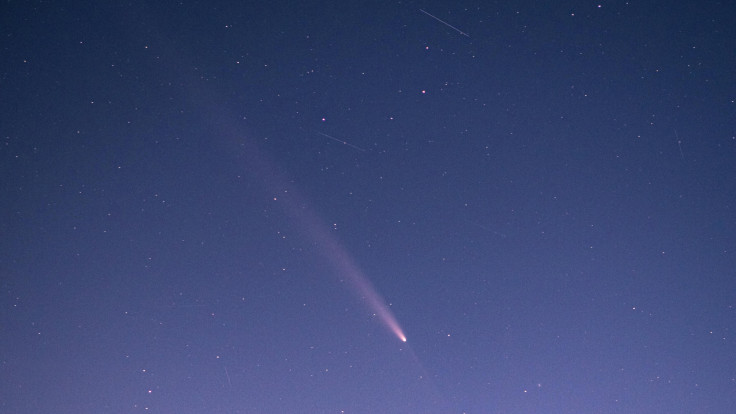
The vast silence of the cosmos was momentarily interrupted on Friday as a mysterious celestial traveller reached its closest point to Earth. Moving at a staggering 130,000 mph (209,214 km/h), the object known as 3i/ATLAS passed our planet at a distance of 170 million miles (273 million kilometres).
This flyby has triggered a fierce intellectual battleground. While most astronomers categorise the object as an interstellar comet, a prominent Harvard University astrophysicist refuses to dismiss a more provocative origin.
Why a Harvard Scientist Refuses to Rule Out Extraterrestrials
Professor Avi Loeb has ignited a global debate by suggesting that humanity must prepare for the possibility of an encounter with non-human technology. Speaking to Sky News, Loeb warned that the arrival of such an object could represent a 'black swan event'—a highly unlikely occurrence that carries profound, life-altering consequences for human civilisation.
Loeb argues that the risks associated with ignoring potential alien technology are too great to overlook, regardless of how improbable the scenario seems. 'Alien technology is a potential threat because when you go on a blind date of interstellar proportions, you never know whether you have a friendly visitor as your dating partner or a serial killer,' he stated. Loeb believes the stakes for society demand that we 'collect as much data as possible to convince us otherwise.'
Evidence of Mining and Propulsion Systems in Deep Space
Loeb points to several anomalies that he believes distinguish 3i/ATLAS from standard celestial bodies. He claims that images of the object reveal an unusual tail, which he suggests might be the byproduct of an artificial propulsion system rather than natural outgassing. Loeb even floated the idea that the nickel detected in the gas cloud could be chemical evidence of active metal mining on the craft's surface.
In his professional view, the odds of a random piece of space junk following such a precise route are too unlikely to be a total coincidence. He argues that this level of mathematical precision suggests intent rather than just a wandering rock.
Global Space Agencies Stand by Natural Origins
While Loeb's theories have captured headlines, the mainstream scientific community is far less convinced. Major space agencies in the US and Europe haven't budged from their initial findings after tracking the object with over a dozen spacecraft.
NASA representative Amit Kshatriya insists that the data confirms a perfectly natural origin for the visitor. 'This object is a comet. It looks and behaves like a comet. All evidence points to it being a comet,' he confirmed.
Astronomers estimate that 3i/ATLAS is approximately eight billion years old, suggesting it is a 'cosmic fossil' from the birth of a distant star system.
3I/ATLAS was published by Sebastian Voltmer on December 19th.
— Scorpweb 🦂 (@Scorpwebb) December 21, 2025
Personally, I don't understand how this could be a "comet" 🫣
Notice its two tails, which comet had a such an appearance in the past 🤔#Space #3IATLAS #UFO #3Iアトラス pic.twitter.com/ybKoVJZKJ1
Dismissing the Alien Battleship Theory As Pure Nonsense
Professor Chris Lintott of the University of Oxford has been vocal in his opposition to the 'alien battleship' narrative. He maintains that there is nothing sinister or manufactured about the object's behaviour or appearance.
'It is just nonsense,' Lintott told Sky News. He compared the speculation to 'saying we should consider the possibility that the moon is made of cheese.'
Lintott explained that the changing colours and brightness of 3i/ATLAS are standard reactions to solar heating. As the sun warms the object, pockets of ice and various interstellar materials are released, creating the visual effects observed by telescopes. 'There is nothing this thing has done that we haven't seen elsewhere,' he concluded.
© Copyright IBTimes 2026. All rights reserved.
- MOST POPULAR IN Trending