

3I/ATLAS Update: New Image Debunks Claims Interstellar Object Is Hiding Itself
New 3I/ATLAS images debunk alien cloaking claims. Discover the science behind the interstellar visitor's thinning coma as it leaves our solar system.

In the vast, silent theatre of deep space, few protagonists have commanded as much scrutiny—or sparked as much frantic speculation—as the interstellar visitor known as 3I/ATLAS. Discovered in July 2025 by the Asteroid Terrestrial-impact Last Alert System in Chile, this icy wanderer is only the third confirmed object from another star system to ever enter our neighbourhood.
As it begins its long trek back into the dark void between stars, a new set of long-exposure images has finally brought some much-needed clarity to the chaos. While the internet remains alight with theories of cloaking devices and alien probes, the latest data suggests something far more grounded in physics, though no less fascinating for the scientific community.
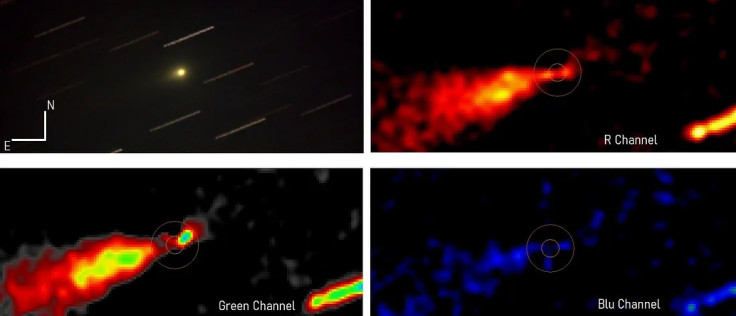
The images in question, captured during routine tracking sessions following its closest approach to Earth on 19 December at a distance of 168 million miles, were designed to isolate the object against the streaking background of distant stars. For weeks, the narrative surrounding 3I/ATLAS has been dominated by its erratic appearance, with some armchair analysts suggesting the object was deliberately shedding material to 'hide' from our sensors. However, the new visual evidence tells a different story: the outer coma is thinning.

The Science Of The 3I/ATLAS Coma Shift
Far from an intentional act of celestial camouflage, the recent 'fading' of the object's outer shell is a classic sign of natural evolution. By comparing these latest frames to captures from earlier in December, astronomers have noted that the diffuse cloud of fine dust—the outer coma—has measurably diminished in both brightness and scale. Simultaneously, the inner coma appears more concentrated and luminous.
This shift is a significant win for researchers. For much of its journey through our solar system, 3I/ATLAS has been obscured by a 'bloated' coma that acted much like a thick fog. This debris scattered light so effectively that it made measuring the object's true shape, rotation, and thermal gradients nearly impossible. With the 'fog' now lifting, we are finally getting a cleaner look at the core, which Hubble Space Telescope data suggests is between 440 metres and 3.5 miles in diameter.
Rather than a deliberate attempt to conceal its form, this process suggests a natural decline in dust production or perhaps a change in the size of the particles being ejected. It is a sign that the interstellar traveller is settling into a new phase of its journey, offering the James Webb Space Telescope a rare opportunity to gather high-fidelity data on its composition (already noted for its unusual richness in carbon dioxide compared to local comets) before it vanishes from view forever.
Debunking The 3I/ATLAS Trajectory Myths
Perhaps more important than what the new images show is what they do not. Despite a tidal wave of social media claims suggesting that NASA has tracked 'unexplained' shifts in the object's path, the hard data tells a very different tale. According to the latest tracking information from the Jet Propulsion Laboratory (JPL), the trajectory of 3I/ATLAS has remained rock-solid since 17 December.
There has been no sudden acceleration, no asymmetric thrust, and no departure from its predicted orbital path. The object continues to move at a staggering 137,000 miles per hour on a hyperbolic trajectory that will see it escape the Sun's gravity entirely. The sensationalist claims of 'controlled navigation' simply do not hold up under the weight of basic physics. Any shroud dense enough to mask a solid body would also cripple that body's ability to observe or exchange energy, making the 'cloaking device' theory scientifically implausible.
This is not to say that 3I/ATLAS has lost its mystery. It remains a bizarre specimen, boasting a persistence and dust behaviour that challenge our standard models of long-period comets—including a strange 'anti-tail' that appeared to point toward the Sun and contained wobbling jets. Its anti-tail geometry continues to puzzle experts, but mystery does not necessitate mythology.
As the signal finally becomes louder than the noise, the goal for the global scientific community is to use this newfound clarity to narrow down what this object actually is—an interstellar messenger that is leaving us with more questions than answers, but no evidence of a pilot.
© Copyright IBTimes 2026. All rights reserved.