

Are Aliens Real? Science Focus Survey Reveals 87% Of Experts Believe Life Is Out There
87% of scientists now believe in alien life. Discover how the search for 'technosignatures' and 3I/ATLAS are bringing us closer to a breakthrough.

Forget the grainy footage of 'flying saucers' or the campy sci-fi tropes of little green men from Mars; the search for extraterrestrial life has officially moved from the fringes of the paranormal into the prestigious halls of mainstream science.
For decades, admitting to a belief in aliens was enough to have an academic's credibility questioned, but a profound shift in the scientific zeitgeist is underway. Today, it is no longer the conspiracy theorists making the loudest noise—it is the astrophysicists, and they are armed with data.
A startling new consensus is emerging among the experts tasked with studying the stars. According to data highlighted by Science Focus, the stigma surrounding the 'E.T.' question has all but evaporated. In a recent survey of 1,055 scientists (including 521 astrobiologists), a staggering 86.6 per cent of respondents agreed that extraterrestrial life almost certainly exists somewhere in the vastness of the cosmos.
This isn't just a hopeful hunch; it is a calculated conclusion based on the sheer scale of a universe that seems increasingly hospitable. The study, published in Nature Astronomy and led by Peter Vickers of Durham University, also revealed that 58.2 per cent of astrobiologists believe intelligent alien life is out there.

The Copernican Shift and 3I/ATLAS: Reassessing Our Place
At the heart of this changing perspective is the Copernican principle—the scientific idea that Earth is not special, but merely one of countless similar worlds. In our own Milky Way alone, there are between 100 billion and 400 billion stars.
When you zoom out to the observable universe, the numbers become truly incomprehensible: roughly 100 sextillion stars. To put that in perspective, there are 13.33 billion times more stars in the sky than there are individual grains of sand on every beach and desert on Earth.
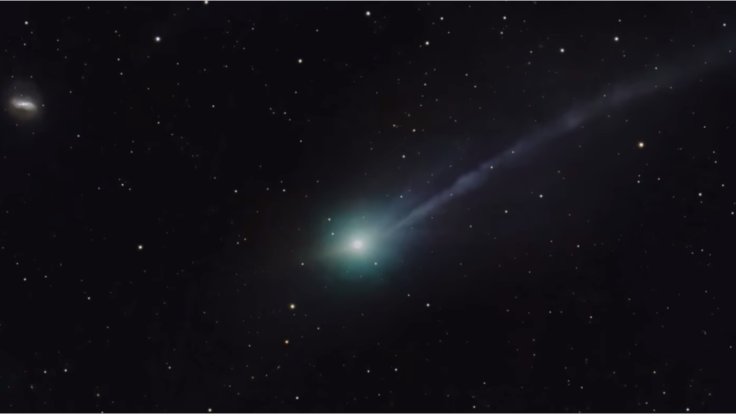
Against this backdrop, the recent passing of the interstellar object 3I/ATLAS has served as a timely reminder of our cosmic connectivity. First detected on 1 July 2025 by the NASA-funded ATLAS survey in Río Hurtado, Chile, the object emerged from the direction of the constellation Sagittarius at a blistering 137,000 miles per hour.
While scientists like Mike Garrett, the Sir Bernard Lovell Chair of Astrophysics at the University of Manchester, maintain that such objects are likely natural, their presence proves that material from other star systems can and does reach our own.
Garrett argues that the ingredients for life—carbon, nitrogen, and oxygen—are far from rare. They are the common currency of the universe, found on comets, asteroids, and distant exoplanets alike.
'We now know that most stars have a planetary system,' Professor Garrett explains. 'That means there are loads of places where life can arise. Besides, simple life arose so quickly on Earth; to me, that's a key sign that it must be happening elsewhere.'
Why 3I/ATLAS Could Be the Key to a New Detection Era
The challenge is no longer debating 'if' life exists, but determining exactly 'where' and 'how' we can find it. The search has moved beyond looking for microbial 'biosignatures' to a more ambitious hunt for 'technosignatures'—measurable evidence of past or present technology, such as radio leakage or atmospheric pollutants.
In fact, recent research from the University of Manchester suggests that human-made radar from international airports could be detected by advanced civilisations up to 200 light-years away—meaning the same applies to us searching for them.
Mike Garrett remains optimistic about our chances of a breakthrough. 'We're in a much better position to discover it now than we were five years ago,' he notes. 'Everything is going in the right direction for detection.' The rapid acceleration of computing power, digitisation, and artificial intelligence is providing researchers with the tools to sift through astronomical data at speeds previously thought impossible.
As we peer deeper into the dark through the lenses of the James Webb Space Telescope—which has already captured 3I/ATLAS using its Near-Infrared Spectrograph—and anticipate the arrival of more interstellar visitors, the scientific community is bracing for a discovery that would change everything.
Having reached its closest point to the Sun on 29 October 2025 at a distance of 1.36 AU, 3I/ATLAS is now on its way out of our system, leaving behind a legacy of data. We are no longer looking at a silent, empty void, but a universe potentially teeming with stories that have yet to be told. The 'fantasy' of alien life is fast becoming the most anticipated reality in human history.
© Copyright IBTimes 2026. All rights reserved.