Watch: China's Humanoid Robots Steal the Show — How Do They Compare to Elon Musk's Optimus?
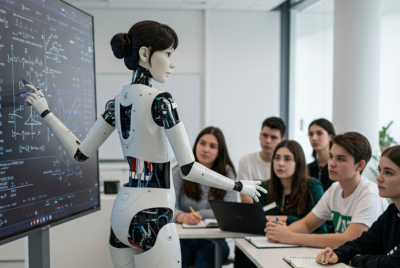
China's humanoid robotics sector is gaining global attention, showcasing advancements and challenges alongside Tesla's Optimus.

China's advances in humanoid robotics have attracted global attention following high-profile public demonstrations and industry data highlighting the country's growing presence in the sector.
Recent showcases, including televised performances and robotics competitions, have featured machines capable of dynamic movement, coordination and increasingly complex physical tasks. The displays have prompted comparisons with projects under development in the United States, most notably Tesla's Optimus robot. Elon Musk has positioned the system as a central component of the company's long-term strategy.
Investment in humanoid robotics is accelerating worldwide. The contrasting approaches adopted by Chinese manufacturers and Tesla illustrate how the technology is developing and the challenges that remain.
China's Expanding Humanoid Robotics Sector
Chinese robotics firms have placed humanoid machines at the centre of both public and industrial narratives. Demonstrations broadcast on national television, including performances at events such as the CCTV Spring Festival Gala, have shown robots executing acrobatic and choreographed movements. These displays highlight advances in balance, mobility and mechanical control.
Industry data cited by BusinessWorld indicates that China accounted for approximately 90% of global humanoid robot shipments last year. Analysts attribute this dominance to the country's manufacturing scale, hardware supply chains and state-backed industrial strategies aimed at accelerating robotics development.
Several Chinese companies have introduced humanoid platforms targeting industrial and logistics applications. Firms such as AgiBot and XPeng have developed robots designed for repetitive physical tasks. Some units are already deployed in controlled factory environments.
Tesla's Optimus Development
Tesla's Optimus robot remains a prominent project within the global humanoid robotics landscape. Musk has repeatedly described the system as a general-purpose machine intended to perform tasks ranging from industrial labour to domestic assistance.
Since its initial unveiling in 2021, Optimus has progressed through multiple prototype iterations. Demonstrations released by Tesla have shown improvements in walking stability, balance and basic manipulation tasks. Recent reporting has suggested the company is preparing for expanded production phases, supported by increased procurement of specialised components.
Tesla's public demonstrations have been more limited in scope. The company's strategy emphasises integration with its broader AI and sensor systems, areas Musk has identified as critical to long-term functionality.
Interpreting Public Demonstrations
Comparisons between Chinese humanoid robots and Optimus often reflect differing priorities in presentation and development. Public showcases typically highlight dynamic movement and coordination, which are visually striking but conducted in controlled conditions.
Robotics specialists note that demonstrations do not always reflect real-world operational capability. Tasks such as navigating unpredictable environments, performing complex object manipulation and sustaining long-duration activity remain significant challenges across the industry.
The visibility of Chinese robots underscores advances in mechanical agility and coordination. Tesla's demonstrations have focused on incremental technical development and projected applications.
I can't believe it! Robots at the Chinese Spring Festival Happy Gala have entered a new era in their control programs.😲😲
— Sharing Travel (@TripInChina) February 16, 2026
I haven't seen these before. pic.twitter.com/m7kEDEQNgJ
2025 VS 2026.
— Sharing Travel (@TripInChina) February 16, 2026
At last year's Spring Festival Gala, they were only able to stand. But this year, tonight, I thought they were humans wearing the skin of robots. pic.twitter.com/W3FaKLJnGE
Tesla plans to unveil Optimus Gen 3 in Q1 and the first production line is already underway, with production planned before the end of 2026. The team is aiming to build a capacity of 1M Tesla Bots per year!pic.twitter.com/EtYoOpqQAK
— Teslaconomics (@Teslaconomics) January 28, 2026
Tesla’s Optimus Gen 3 is moving fast from hype to reality. Robots are already working inside Giga Texas, handling real factory tasks, not demos. With mass production ramping up, Texas is set to become the world’s biggest humanoid robot hub$Tesla $Optimus @elonmusk pic.twitter.com/g3O5YBFTRr
— Tesla X Hub EU (@TeslaFanNewsX) February 4, 2026
An Evolving Technological Frontier
Humanoid robotics continues to represent one of the most demanding areas of engineering and AI research. Advances in balance, dexterity, perception and decision-making remain central to the technology's broader adoption.
China's growing shipment volumes and public demonstrations highlight its expanding industrial capacity. Tesla's Optimus programme reflects a longer-term emphasis on AI integration and adaptability.
As development continues, analysts say progress will depend on more than performance in demonstrations. Reliability, safety and practical deployment remain central challenges for the industry.
© Copyright IBTimes 2025. All rights reserved.
- Recommended For You