

Macau Police Detain Humanoid Robot After 'Harassing' 70-Year-Old Woman Hospitalised Following Street Encounter
The encounter between a humanoid robot and an elderly woman in Macau raises questions about public safety and robotic deployment.
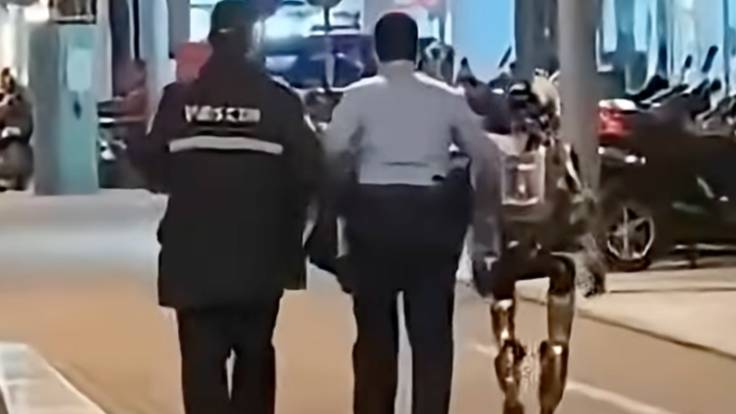
A humanoid robot has been 'detained' by Macau police after it startled a 70-year-old woman on a residential pavement, sending her to hospital and igniting a global debate over the unregulated deployment of advanced machines in public spaces.
The incident occurred on Rua Sul do Patane (沙梨頭南街) in the Patane district of northern Macau. According to the Public Security Police Force (PSP), the woman had paused on the pavement to use her smartphone when she suddenly realised a robot was standing directly behind her.
The robot, a Unitree G1 humanoid model, had been unable to navigate around her stationary figure and had simply waited, illuminated by its onboard lights. The encounter, captured in a 16-second video that spread rapidly across Chinese-language social media platforms, shows the woman confronting the machine at close range before two officers arrive on foot and escort it from the scene.
An Elderly Woman, a Robot, and a Late-Night Street in Patane
The Macau Post Daily, which first reported the incident in English on 11 March 2026, identified the machine's owner as the Study Hard Education Centre (勤學教育中心). The centre's head, Mak Kin Choi (麥健才), told Macau public broadcaster TDM that the centre had scheduled three promotional activities using the robot that week, including the one in Patane on the night in question.
Mak told TDM that he personally accompanied the woman to hospital after officers arrived, and brought her home in the early hours of the following morning. Police confirmed no physical contact occurred between the robot and the woman, and that she sustained no injuries. She was discharged after examination and declined to file a complaint.
In video footage circulating online, the woman shouts in Cantonese at the stationary machine: 'You're making my heart race! You've got plenty to do, so what's the point of messing around with this? Are you freaking crazy?' The robot responds by raising both arms, a gesture that drew considerable online commentary, with some viewers finding dark comedy in the mechanical surrender and others raising more pointed questions about accountability.
The PSP told TDM that the operator, described as a local man in his fifties, informed police he had been testing the robot with a view to refining its operation for future promotional use. Officers reminded him to exercise caution when deploying robots in public to 'avoid endangering or frightening pedestrians,' the only formal consequence recorded in the incident.
The Unitree G1: A £10,500 Machine Increasingly Seen on China's Streets
The Unitree G1 is manufactured by Unitree Robotics, a Hangzhou-based company founded in 2016. Standing 127 centimetres tall and weighing 35 kilograms, it is equipped with 3D LiDAR, Intel RealSense depth cameras, and between 23 and 43 degrees of freedom depending on the variant. It walks at up to 2 metres per second and operates for approximately two hours on a single battery charge.
According to Unitree's official Taobao store, a similar model to the one used in the Patane incident retails for approximately 85,000 yuan — roughly £9,200 ($11,700) at current exchange rates. The base model starts at around £10,600 ($13,500), according to specialist retail analysis, making it one of the most accessible production humanoid robots commercially available in 2026.
The G1 has attracted significant attention beyond China. Stanford University, MIT, and Amazon's robotics division have all adopted the platform for research purposes, according to independent assessments published in February 2026. Unitree reported approximately 5,000 G1 units shipped in the first half of 2025, with deployments spanning academic research, entertainment, and light commercial promotion — the category under which the Macau centre was operating.
Current Macau legislation does not specifically address humanoid robots in public spaces. That absence is not unique to the territory. A December 2025 analysis noted that as of late 2025 there is no federal law in the United States, no EU-wide regulation, and no international standard specifically governing the personal or commercial operation of humanoid robots outside of industrial workplaces where the ISO 25785-1 standard, published in May 2025, provides the sole international benchmark.
The Macau incident sits at a junction between commercial ambition and public welfare that governments have so far been slow to address. Study Hard Education Centre had been conducting promotional activities with the robot across Macau's tourist sites, including the UNESCO World Heritage-listed Ruins of St. Paul's and the Cotai Strip, for six months prior to the incident, Mak told TDM. During that time, the centre reported broadly positive public responses. The Patane encounter was the first to result in police involvement.
As humanoid robots spread from factory floors to city streets without the regulatory frameworks to govern them, the story of one startled woman on a Macau pavement may come to mark the moment the question of public safety and robotic deployment could no longer be deferred.
© Copyright IBTimes 2026. All rights reserved.