Colossal 400bn-Mile 'Dracula' Disc Is 40 Times Wider Than Our Solar System, NASA Reveals
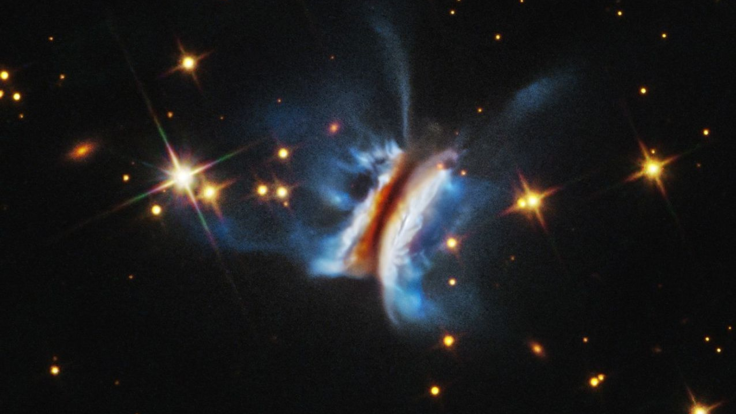
NASA has unveiled the largest planet-forming disc ever recorded, after capturing striking new images with the Hubble Space Telescope that show a chaotic stellar nursery on a scale never seen before.
The discovery made public on 23 December 2025 by NASA's Hubble Mission Team centres on a vast disc of gas and dust located around 1,000 light-years from Earth. It matters because scientists believe the structure offers rare clues into how planets form in extreme environments.
The images were made possible by Hubble's ability to observe the object in visible light, revealing details that had previously remained hidden.
READ MORE: 3I/ATLAS is Finally Broadcasting? New Findings Break the Internet — What We Know
READ MORE: 3I/ATLAS Update: Why Radio Scans Found Zero Sign of Alien Technology
What Dracula Chivito Looks Like
The object is a giant protoplanetary disc surrounding a young stellar body, IRAS 23077+6707.
NASA says the disc stretches nearly 400 billion miles across, making it about 40 times wider than the Solar System measured to the edge of the Kuiper Belt. Its size alone sets it apart, but its appearance has drawn even more attention from astronomers.
The disc is seen almost edge-on and is so thick that it blocks the light from the star at its centre. Researchers believe that the central object could be either a single massive star or a pair of stars forming together.
For the first time, Hubble has shown the disc in visible light, exposing a dark dust lane across the middle and bright layers of gas and dust above and below it. Blue, finger-like wisps of material rise far from the disc's surface.
NASA noted that these features appear mainly on one side, while the opposite edge looks sharply cut off.
This uneven structure suggests powerful and unstable forces are shaping the disc as it evolves.
Dracula Chivito's Playful Name Origin
The unusual name 'Dracula's Chivito' reflects both the disc's appearance and the background of the scientists who studied it. Seen from the side, the disc resembles a sandwich, with a dark centre and brighter layers above and below.
That likeness inspired the reference to a chivito, a popular sandwich from Uruguay. The 'Dracula' element comes from a member of the research team with roots in Transylvania, a region closely linked to the famous legend.
NASA has said the nickname highlights the international nature of the project, which involved researchers from the Centre for Astrophysics, Harvard & Smithsonian.
Despite its playful tone, the agency stresses that the scientific basis for the discovery is highly significant.
Giving New Insights on Planetary Formation
Scientists believe the scale and disorder seen in Dracula Chivito could reshape current thinking on how planets form. Kristina Monsch, lead author of the study and an astronomer at the Centre for Astrophysics | Harvard & Smithsonian, said the images reveal unexpected behaviour in planet-forming discs.
'The level of detail we're seeing is rare in protoplanetary disc imaging, and these new Hubble images show that planet nurseries can be much more active and chaotic than we expected,' she said.
Monsch explained that the near edge-on view allows researchers to track features in visible light with exceptional clarity. Joshua Bennett Lovell, a co-investigator at the same institution, said the disc's uneven shape was striking.
He added: 'We were stunned to see how asymmetric this disc is. Hubble has given us a front row seat to the chaotic processes that are shaping discs as they build new planets.'
NASA estimates the disc holds between 10 and 30 times the mass of Jupiter, enough material to form several giant planets.
The agency says the findings reinforce Hubble's continuing role, more than 30 years after launch, in deepening understanding of how planetary systems like our own may begin.
© Copyright IBTimes 2025. All rights reserved.
- MOST POPULAR IN Trending