

ICE Can Reportedly Access Flock Surveillance Cameras — Now Americans Are Destroying Them
With Flock's cameras feeding data to ICE, a grassroots revolt over who gets to watch whom is erupting on roadsides and in council chambers across the US.
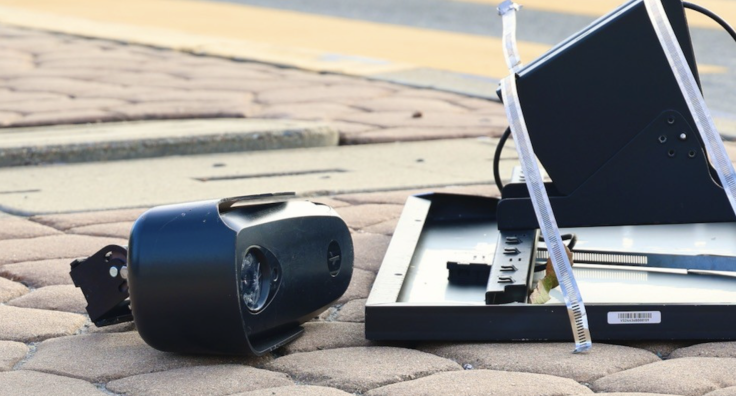
The first camera lay crumpled on the central reservation like roadkill. Its solar panel was twisted, its casing smashed clean off the pole. A few metres away, another had been carefully gutted—key components neatly removed, wires hanging loose.
Someone in La Mesa, a small city east of San Diego, wanted this to be seen.
The two wrecked Flock surveillance cameras were discovered last week, just weeks after the city council brushed aside a wave of furious public opposition and voted to renew its contract with the Atlanta-based company. For many locals, the timing didn't look like coincidence. It looked like a reply.
'There was a huge turnout against them,' says Bill Paul, who runs the independent outlet San Diego Slackers and first reported on the smashed cameras. 'But the council approved continuation of the contract.'
La Mesa is not an outlier. From Oregon to Virginia, a quiet, very physical revolt against Flock's automatic licence plate readers—ALPRs—is underway, with cameras sawn down, poles severed, and devices methodically dismantled. What would once have been fringe anti-surveillance activism is edging into the mainstream, as Americans discover who can access these cameras' data and how it is being used.
And one three-letter agency looms particularly large in the backlash: ICE.
Flock Surveillance Cameras, ICE Access and a Growing Revolt
Flock, valued at around $7.5 billion and headquartered in Atlanta, sells what it describes as crime‑fighting tech to police and local governments. Its cameras now watch roads and car parks in roughly 6,000 communities across the United States, quietly logging vehicles that pass within their gaze.
These cameras don't simply read licence plates. They also capture make, model, colour and other visual markers that can 'fingerprint' a vehicle and, by extension, its owner and movements. The information is stored in vast databases and can be searched by police—and by federal agencies—without needing a warrant.
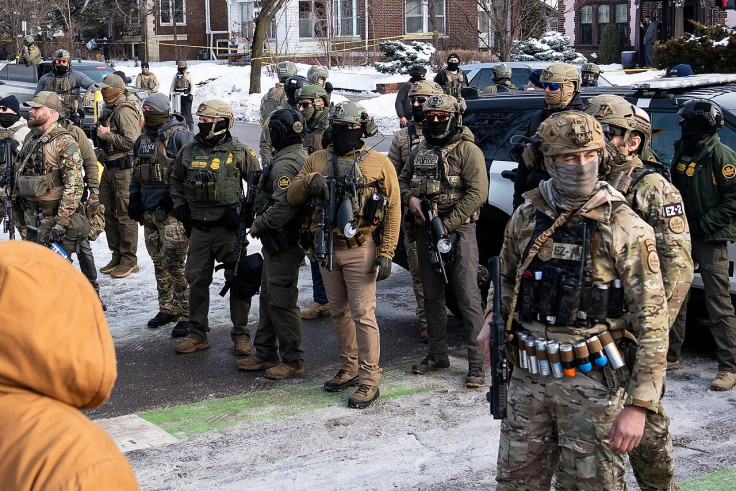
Immigration and Customs Enforcement (ICE), the agency that enforces deportations and immigration raids, is a regular user of this trove of data. For immigrant communities and privacy advocates, that alone is enough to turn a 'smart policing' tool into an instrument of fear.
Flock insists its technology helps catch violent suspects, recover stolen property and solve crimes that might otherwise go cold. But the examples piling up around the US tell a murkier story.
A police chief in Georgia has been charged with using Flock searches to stalk and harass private citizens. Activists and lawyers warn that ALPR data has been used to track people who drive across state lines for abortions after Roe v Wade was overturned. In some cities, local authorities only discovered after the fact that federal agencies had been dipping into their Flock systems without their knowledge.
Civil liberties groups call this a wholesale end‑run around the Fourth Amendment's protection against unreasonable searches. The word 'Orwellian' is doing heavy rotation in council chambers and community meetings.
Some municipalities have backed away. Santa Cruz in California and Eugene in Oregon have both scrapped their deals with Flock following local campaigns. Elsewhere, the anger has taken a more direct form.
From Oregon to Virginia, Flock Cameras Become Targets
In Eugene and nearby Springfield, Oregon, at least six Flock cameras were chopped down last year, poles sliced through and equipment destroyed. One note, taped to a demolished pole and gleefully broadcast on local television, read: 'Hahaha get wrecked ya surveilling fucks.'
In Greenview, Illinois, a camera mast was neatly severed at its base. In Lisbon, Connecticut, police are investigating another destroyed unit. The incidents are no longer isolated.
Virginia has gone further still. There, 41‑year‑old Jefferey S. Sovern has been charged with intentionally destroying 13 Flock cameras between April and October last year. Prosecutors say he used vice grips to take apart the two‑piece poles, kept wiring, batteries and solar panels, and is now facing counts of destruction of property, petit larceny and possession of burglary tools.
This is not a niche, left‑field backlash. DeFlock, an activist site that tracks and opposes Flock's spread, says 46 cities have formally rejected the company's cameras or other ALPR systems. A popular YouTuber, Benn Jordan, has racked up views by showing drivers how to make their licence plates unreadable to Flock's systems. Florida lawmakers promptly passed a law banning people from covering or altering their plates.
The fight is now playing out in small‑town committee rooms as much as on the streets. Paul recalls the December 2025 meeting in San Diego where residents tried—and failed—to get the city to cut ties with Flock. Officials framed the project as a 'smart streetlight' programme with Ubicquia, another tech firm.
This is the pattern: local governments sign lucrative surveillance deals; federal agencies gain another data pipeline; communities discover, often late, how deep the integration runs. When official channels fail to curb it, some residents stop writing testimony and start picking up bolt cutters.
© Copyright IBTimes 2026. All rights reserved.