

ICE Sued After Observers Claim Agents Used Facial Recognition to Add Them in a 'Domestic Terrorist' Watchlist
Maine residents allege ICE agents recorded and threatened them while they peacefully observed immigration enforcement.
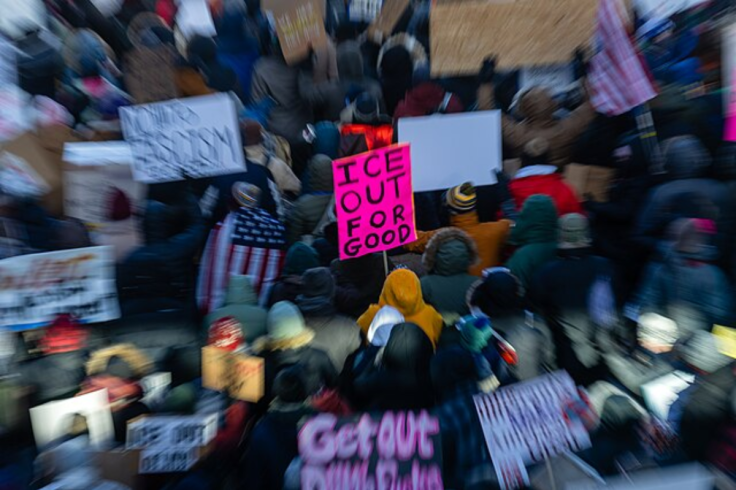
It did not begin with handcuffs or flashing lights. It began with a phone held up in a car park.
Elinor Hilton says she was standing outside a Home Depot in Portland, Maine, filming federal immigration agents during what appeared to be an enforcement action. She was not shouting. She was not blocking anyone. She was recording.
According to a federal lawsuit now filed in Maine, that was enough to draw attention.
Hilton says an ICE officer approached her holding pepper spray and told her she was being added to a 'domestic terrorist watch list.' The words, she claims, were delivered as a warning. She recalls feeling less like a bystander and more like someone being catalogued.
Hilton and another Maine resident, Colleen Fagan, are now suing US Immigration and Customs Enforcement. Their complaint alleges that agents used surveillance tactics, including facial recognition technology, to identify and track people who were observing federal operations in public.
The lawsuit, first reported by the Press Herald, states that agents recorded licence plates, scanned faces using a mobile application and suggested arrest could follow if filming continued.
Neither woman was the target of an enforcement action. Both maintain they were exercising what they see as a basic constitutional right: to document government officials carrying out public duties.
A 'Nice Little Database'
Fagan's account stems from a separate incident. In the video she recorded, an ICE agent can be heard referencing what he described as a 'nice little database' in which she was allegedly entered.
That phrase now anchors the lawsuit.
The women argue that the suggestion they were being catalogued or tracked for filming federal agents raises serious First Amendment concerns. Their legal team says citizens have a right to observe law enforcement in public spaces, provided they do not obstruct or interfere.
JoAnna Suriani, a lawyer with the nonprofit Protect Democracy representing the pair, said the women were present as civic observers.
'They were there to bear witness,' Suriani said, adding that neither woman attempted to disrupt operations.
The Technology at Issue
The lawsuit alleges that ICE and other Department of Homeland Security agencies routinely use tools such as the Mobile Fortify facial recognition application. According to the complaint, the app has access to roughly 200 million images and has reportedly been used more than 100,000 times in Maine alone.
The plaintiffs claim such technology was deployed not against suspects but against individuals documenting enforcement activity.
They argue that using surveillance tools in that context risks chilling public oversight. If observers believe they may be tracked or labelled for recording government officials, they say, fewer people may step forward to document what they see.
The case does not claim that ICE confirmed the existence of a 'domestic terrorist' watchlist. Rather, the plaintiffs contend that agents invoked that language during encounters.
Department of Homeland Security's Response
The Department of Homeland Security (DHS) has denied operating any such database in relation to the case.
Officials have stated that the department monitors threats and potential criminal activity in accordance with the US Constitution and that any data collection is lawful.
DHS has not publicly confirmed whether facial recognition tools were used during the specific incidents described in the lawsuit.
At the centre of the dispute are two sharply different interpretations of the same moments: one side describes routine security precautions, the other, intimidation of lawful observers.
Seeking Removal and Broader Relief
Hilton and Fagan are asking the court for an emergency order requiring any data collected about them to be removed from government systems. They are also seeking class action status, arguing that other residents across Maine who have filmed ICE operations may have been similarly recorded or entered into databases.
Concerns over surveillance of observers have surfaced in other parts of the country. Lawsuits in cities including Chicago and Minneapolis have alleged excessive force or unlawful tracking tied to immigration enforcement activity. The Maine case, however, focuses specifically on the alleged use of facial recognition and database inclusion against bystanders.
Hilton has described her actions as motivated by a desire for transparency. She said she views documenting ICE activity as a form of civic engagement and accountability, particularly in a city that has publicly embraced immigrant communities.
The lawsuit now sits before the US District Court for the District of Maine. A judge will decide whether the alleged surveillance practices crossed constitutional lines and whether broader protections are warranted.
For now, the broader legal question lingers: when citizens point cameras at the state, who is watching whom — and under what authority?
© Copyright IBTimes 2026. All rights reserved.