

It Worked Well – Until It Didn't': Nobel Economists Expose the Limits of Old Economic Thinking
The Stanford and Columbia economists were honoured for models that help policymakers respond to economic shocks and stabilise inflation, output and employment
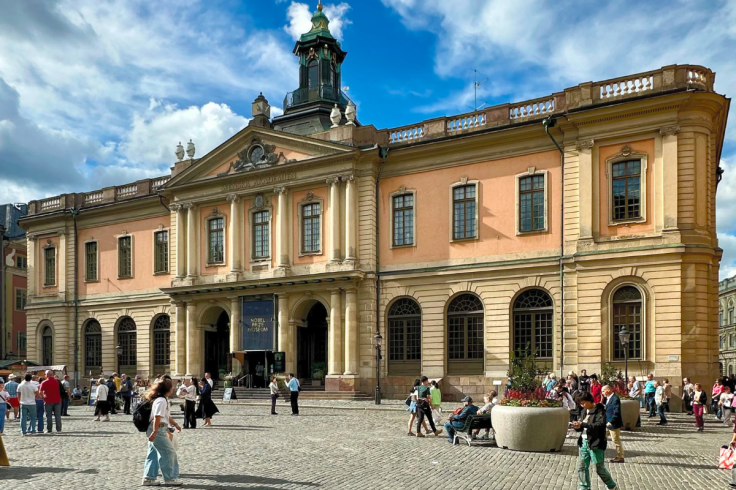
American economists Robert E. Hall and Michael Woodford have been awarded the 2026 Nobel prize in economics for research that underpins how central banks and governments around the world try to keep inflation, output and jobs on a steadier course.
The Royal Swedish Academy of Sciences announced the winners of the Sveriges Riksbank Prize in Economic Sciences in Memory of Alfred Nobel in Stockholm on Monday. Hall is based at Stanford University in California and Woodford at Columbia University in New York. The prize carries 12 million Swedish kronor.
John Hassler, chair of the economics prize committee, said the laureates' work had provided 'a stable theoretical foundation' for models used by central banks and governments worldwide. He said the models helped policymakers prepare for economic shocks, including energy crises and sudden changes in household consumption, by linking high-level policy choices to the behaviour of households and firms.
Why Their Work Matters For Everyday Economies
Macroeconomic stabilisation refers to efforts by governments and central banks to limit swings in inflation, output and employment. The prize citation focuses on grounding such policies in the choices of individual households and firms, rather than treating the economy as a single, uniform entity.
The Academy said the laureates' models had improved the theoretical basis for stabilisation policies and helped policymakers smooth out the economy's peaks and troughs. Such models can help officials assess how fiscal and monetary measures may reduce the severity of downturns, influence expectations and moderate fluctuations in economic activity.
Hall and Woodford each made influential contributions to the field. Their research helped develop models that account for how the decisions and expectations of households and firms affect the wider economy and how policy announcements today can shape behaviour far into the future.
During much of the postwar period, policymakers drew on Keynesian ideas, including the use of fiscal policy to support demand during downturns. The stagflation of the 1970s, when high inflation coincided with high unemployment, challenged important assumptions in prevailing economic models and helped drive the development of new approaches. Keynesian economics encompasses a range of approaches to stabilisation, and the 1970s experience did not establish that it had failed as a whole. The work recognised by this year's prize forms part of those later approaches, which seek to combine Keynesian insights about demand with more explicit modelling of expectations and market behaviour.
Woodford: 'A Tremendous Honour'
Speaking by telephone from New York after the announcement, Woodford described the award as 'a tremendous honour' and 'a surprise'.
Clarivate, the analytics company, had included Woodford among its 2026 Citation Laureates for contributions to monetary policy. Others on that list were recognised for work on information technology economics and organisational behaviour, including Susan Athey, Hal Varian and Sidney Winter. Clarivate says the programme recognises influential research and is not intended to predict Nobel winners.
Woodford's inclusion on that list highlighted how his work on monetary policy rules, interest rates and expectations has been widely cited in academic research and used as a reference point in central bank analysis.
How The Economics Prize Came About
The economics award differs from the original five Nobel prizes established under Alfred Nobel's will. It was created by Sweden's central bank in 1968 in memory of Nobel and first presented in 1969.
Only three women have received it: Elinor Ostrom in 2009, Esther Duflo in 2019 and Claudia Goldin in 2023.
Hall and Woodford are due to receive their medals and diplomas in Stockholm on 10 December, alongside the other Nobel laureates. The date marks the anniversary of Alfred Nobel's death.
© Copyright IBTimes 2026. All rights reserved.