

Harvard's Avi Loeb to Use Rare 3I/ATLAS Alignment to Reveal Interstellar Object Secrets
Avi Loeb claims 3I/ATLAS solar alignment on Jan. 22, 2026 could reveal 'extraterrestrial' secrets

In the velvet darkness of our solar system, a mysterious traveller is currently making its grand exit, leaving a trail of scientific intrigue and whispered theories of 'extraterrestrial' technology in its wake. 3I/ATLAS, the third confirmed interstellar object to visit our cosmic neighbourhood, is about to perform a vanishing act.
But before it disappears into the deep freeze of interstellar space, a rare celestial alignment on Jan. 22, 2026 is set to provide what Harvard Professor Avi Loeb describes as an unprecedented window into the secrets of another star system. The event will see Earth, the sun and 3I/ATLAS align almost perfectly, creating a unique lighting environment that strips away shadows to reveal the true texture of this alien visitor.
The Jan. 22 Window
Writing in a new research note co-authored with Mauro Barbieri, Loeb points out that on Jan. 22, 2026 at 13:00 UTC, 3I/ATLAS will align to within an exceptionally small angle of 0.69 degrees with the Earth-sun axis. This 'near-opposition' event is a rarity in astronomy.
For approximately one week — between Jan. 19 and 26 — Earth will sit almost perfectly between the sun and this visitor, allowing us to observe it without the interference of shadows. NASA's Hubble Space Telescope has already laid the groundwork for this encounter, narrowing the object's nucleus size to between 440 metres and 5.6 kilometres in diameter.
This geometry triggers a phenomenon known as the 'opposition surge'. When an object is illuminated from directly behind the observer, two physical effects occur: shadow-hiding and coherent backscatter. The latter is a quantum mechanical spike in brightness that happens when light travels through a dusty medium and interferes constructively.
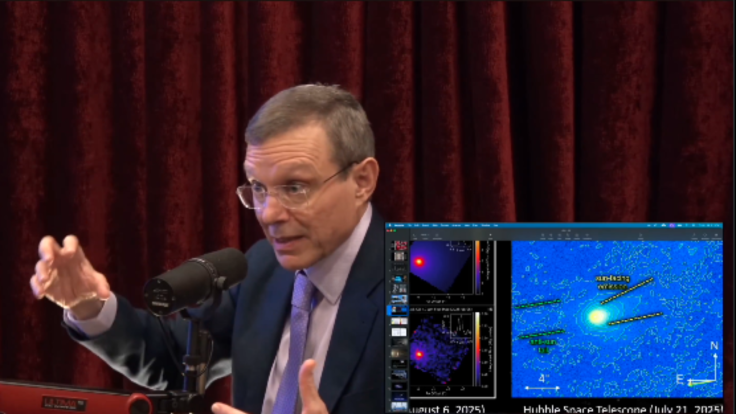
For Loeb, this is not just about pretty pictures; it is a diagnostic tool to determine if 3I/ATLAS is a 'pristine molecular cloud' aggregate or something more structured. Loeb has identified 13 distinct 'anomalies' regarding the object, including its rotation axis being almost perfectly aligned with the Sun and its unusual 'anti-tail' that appears to point towards the Sun rather than away from it.
The stakes are high. Since its discovery on July 1, 2025 by the Asteroid Terrestrial-impact Last Alert System (ATLAS) in Rio Hurtado, Chile, 3I/ATLAS has been a magnet for controversy. Moving at a blistering 57.7 kilometres per second — far faster than its predecessors, 'Oumuamua and 2I/Borisov — it possesses a hyperbolic orbit with an eccentricity of e ≈ 6.139.
Loeb has frequently highlighted its 'anomalous' features, including a sunward 'anti-tail' jet and unusual polarization properties, which he suggests could point to artificial origin. Data from NASA's JPL Horizons system confirms it is moving on a path that appears almost like a straight line, ensuring it will never return to our system.

Deciphering the Dust
The upcoming alignment offers a unique chance to settle the debate over the object's composition. Loeb asks: 'Is the dust shed by 3I/ATLAS dominated by carbonaceous material, or does it retain significant ice fragments?' High-precision photometry during this window could reveal the 'albedo' — or reflectiveness — of the material.
A low albedo would suggest common space dust, while a high albedo (ω0 ∼ 0.1–0.3) might validate Loeb's previous theories regarding the object's strange anti-tail. The James Webb Space Telescope (JWST) has already detected water vapour emissions at distances where most comets remain frozen, adding urgency to the study of this 'interstellar time capsule'.
Unlike the previous interstellar visitor 2I/Borisov, which was never observed at phase angles below 16 degrees, 3I/ATLAS will be visible at less than 2 degrees for days. This provides a 'memory' of the material's microphysical structure. To capture this, Loeb is calling for a global, coordinated effort from the astronomical community.
He recommends high-precision photometry (≲0.03 mag), multi-band observations across filters like BV R or gri, and polarimetric measurements to detect multiple scattering effects. By March 2026, the object will pass within 0.358 AU of Jupiter, a region currently being explored by the Europa Clipper and JUICE missions in the search for life.
At the time of alignment, 3I/ATLAS will be roughly 3.33 AU from the sun and 2.35 AU from Earth, glowing at a magnitude of V ≈ 16.7. While visible now to telescopes with apertures larger than one metre, the object will rapidly fade. By January 2027, it will have receded to 16 AU, dimming to a faint V ≈ 24 mag.
While the CIA recently issued a 'Glomar' response — neither confirming nor denying records — regarding the object following FOIA requests, NASA remains firm that physical evidence points to a natural, albeit highly unusual, origin.
As the window approaches, the scientific community remains divided. While NASA and many peers see a natural, albeit eccentric, comet, Loeb remains steadfast in his pursuit of the 'black swan' event.
Whether 3I/ATLAS is a pristine relic from an 11-billion-year-old star system or a piece of 'extraterrestrial' tech masquerading as a rock, the data gathered this January will be our best — and perhaps final — chance to find out. As Loeb puts it, we are about to have an 'extraordinary fortune' that may not repeat for decades.
© Copyright IBTimes 2026. All rights reserved.