

Harvard Scientist Avi Loeb Claims 3I/ATLAS Could Be Monitoring Earth Pollution
Is this interstellar object tracking Earth? Avi Loeb weighs in on the 'spy' theory

The cosmos has a way of making us feel small, but a recent visitor from the stars is making some scientists feel watched. Imagine a high-tech eye, drifting through the vacuum of space for millennia, finally blinking as it passes our sun. This isn't a scene from a science fiction blockbuster; it is the provocative hypothesis surrounding 3I/ATLAS, the third interstellar object ever detected in our solar system.
First spotted on July 1, 2025 by the ATLAS survey telescope in Chile, this visitor was moving at a staggering 137,000 miles per hour, confirming its origin from beyond our celestial neighbourhood. While most of the astronomical community is content to label it a 'dirty snowball' or a common comet, a few are asking a more unsettling question: could this be a deliberate probe sent to spy on us?
The logic behind the 'spy' theory rests on how a planet looks from afar. When a planet transits in front of its host star, it blocks a tiny fraction of light — for Earth, a mere 0.008%. To a distant observer with the right tools, that dip in brightness is a treasure trove of data.
The starlight filtering through our atmosphere carries the 'spectral fingerprints' of life, such as oxygen and methane. More tellingly, it could reveal industrial pollutants like tetrafluoromethane and trichlorofluoromethane — clear 'techno-signatures' that our planet isn't just inhabited, but industrialised.
The Curious Case of 3I/ATLAS and the Galactic Watcher
Back in 2014, Harvard Professor Avi Loeb and his then-student Henry Lin, now a professor at Princeton, published a paper exploring how we might detect industrial pollution in the atmospheres of exoplanets. They identified specific features of chlorofluorocarbons (CFCs) that would be visible to a sufficiently advanced observer.
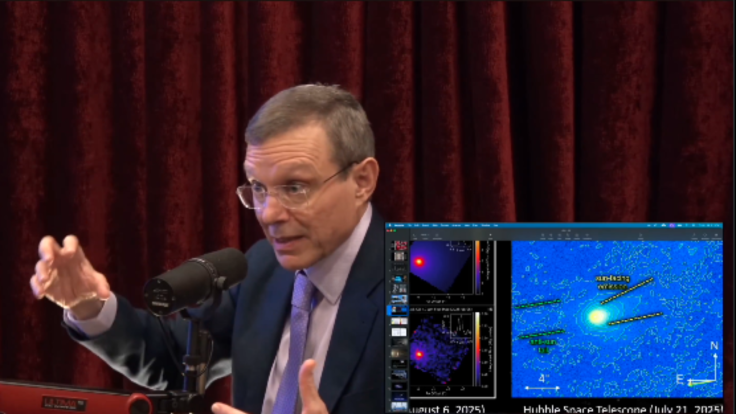
If we can think of doing this to other worlds, Loeb argues, we must consider that an extraterrestrial intelligence might be doing the same to us. Loeb has since pointed to 13 specific 'anomalies' regarding 3I/ATLAS, including its 'anti-tail' sunward jet and a gas composition that contains more industrial-style nickel than iron — a ratio orders of magnitude higher than any known comet.
The ideal path for such a 'transit-focused' probe would be a retrograde trajectory — moving opposite to the planets — aligned perfectly with the ecliptic plane. This path allows the probe to monitor as many planetary transits as possible during its journey. Curiously, 3I/ATLAS follows a retrograde orbit aligned to within just 4.9 degrees of the ecliptic.
While official channels maintain it is a natural comet, the alignment is strikingly convenient for a spectrograph-equipped traveler. Indeed, the object recently caused a stir when it veered 4 arcseconds away from its predicted path near perihelion, a deviation that cannot be explained by the Sun's gravity alone.

A Narrow Miss for 3I/ATLAS in the 2026 Transit Window
If 3I/ATLAS were a technological scout, its timing would be impeccable. Had it been perfectly aligned, it could have detected biological markers like oxygen on Earth from the outskirts of the Oort Cloud nearly 8,000 years ago. By 1950, when physicist Enrico Fermi famously asked 'Where is everybody?', the object was within 1,000 AU of Earth — close enough to detect the chemical signals of our Industrial Revolution.
The most dramatic moment is yet to come. On Jan. 22, 2026, Earth will be nearly aligned with the sun from the vantage point of 3I/ATLAS. At that moment, the object will be just 2.35 AU from our home. However, due to its slight orbital tilt, it will be a 'near miss' rather than a perfect transit for Earth, though it did successfully observe a transit of Venus on Nov. 4, 2024.
The 'spy' hypothesis will face its ultimate test in March 2026, when 3I/ATLAS makes an exceptionally close pass to Jupiter's moon Eupheme. Loeb predicts that if the object is technological, it may use this encounter to release 'daughter probes' into orbit — a move that would be impossible for a natural comet to execute at a relative speed of 66 kilometres per second.
As we look toward the next decade, the NSF-DOE Rubin Observatory in Chile is expected to find dozens more of these interstellar interlopers. Scientists estimate the facility could detect between 5 and 50 similar objects during its 10-year mission, finally providing the statistical data needed to determine if 3I/ATLAS is a one-off freak of nature or part of a vast, interstellar surveillance network.
The mission now is to check if any of these new visitors align more precisely with our planetary transits. Are they just rocks, or are they messengers waiting for us to notice them? In the vast silence of space, 3I/ATLAS might be the closest we have come to an answer.
© Copyright IBTimes 2026. All rights reserved.