

NASA Scientists Are Tracking A Massive Interstellar Comet Older Than The Solar System
8-billion-year-old comet 3I/ATLAS ignites in a blue glow. Read the latest on this record-breaking interstellar visitor.
A massive, ancient relic from a distant corner of the cosmos, far older than the Earth itself, has just performed a dazzling 'vanishing act' behind our Sun, leaving astronomers breathless as it undergoes a dramatic physical transformation. Discovered on 1 July 2025 by Larry Denneau using the NASA-funded ATLAS survey telescope in Río Hurtado, Chile, the object—originally designated C/2025 N1—has quickly become the most scrutinized visitor in modern history.
This gargantuan wanderer, known as 3I/ATLAS, reached its perihelion—its closest point to our star—on Thursday, 29 October. During this high-stakes orbital dive, the comet briefly disappeared from the view of ground-based observers, but it remained firmly under the watchful gaze of a sophisticated network of space-based sentinels. While the world waited for a sign of its survival, data began to trickle back suggesting this visitor is putting on a far more brilliant show than anyone had anticipated.

The Ancient Mysteries Trailing 3I/ATLAS
The first hints of this recent surge in activity came from the keen eyes of the amateur community. On 18 October, Worachate Boonplod, a veteran Thai astronomer and renowned comet hunter, identified the visitor in fresh imagery from the GOES-19 satellite. This craft, which is part of the National Oceanic and Atmospheric Administration's weather-monitoring fleet, carries a CCOR-1 instrument designed to monitor solar activity. Instead of just solar flares, it captured the interstellar interloper streaking across the frame.
Boonplod noted that the brightness of the object was comparable to nearby stars, sitting at roughly magnitude 11. 'It's moving from left to right across the field,' he wrote in a dispatch to the Comets Mailing List, 'and should leave the CCOR-1 view soon.' This orbital path is unprecedented; with an eccentricity of approximately 6.14, 3I/ATLAS is following a much 'straighter' and faster trajectory than its predecessors, 1I/'Oumuamua and 2I/Borisov.
As the comet continued its perilous arc, other high-tech eyes took over the watch. NASA's PUNCH mission and the legendary SOHO observatory followed the progress. SOHO used its LASCO C3 coronagraph to track 3I/ATLAS until 26 October. Even the Perseverance rover on Mars took a moment from its mission in Jezero Crater to snap a picture of the comet as a 'faint smudge' during its close 19-million-mile pass of the Red Planet on 3 October.
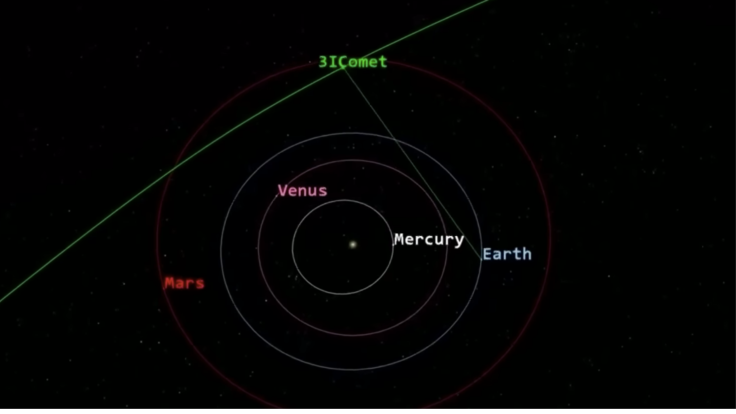
Tracking The Unprecedented Speed Of 3I/ATLAS Through Our Solar System
The most startling discovery arrived just before the comet reached perihelion. Researchers published a paper on arXiv on 28 October detailing a sharp, sudden increase in the object's luminosity. 3I/ATLAS peaked at a magnitude 9, a level of brightness that, while still requiring a telescope, represents a significant surge.
Analysis from the James Webb Space Telescope (JWST) revealed that this glow is fueled by an unusually high concentration of carbon dioxide—outnumbering water ice by a ratio of 8-to-1—and gas that is surprisingly rich in nickel.
Perhaps most intriguing was the comet's colour. Analysis revealed a distinct blue hue, which is a 'smoking gun' for gas emissions. As the 8-billion-year-old ice on its surface felt the intense heat of the Sun, it began to sublimate directly into gas. Interestingly, Hubble observations showed that dust was initially blown toward the sunward side before radiation pushed it back, a rare behavior not typically seen in local comets.
Since its discovery, 3I/ATLAS has shattered records, racing through our solar system at a staggering 130,000 miles per hour. While pop culture icons like Kim Kardashian took to social media to ask NASA to 'spill the tea' on the object, and Elon Musk suggested its motion might be influenced by more than just gravity, the scientific community remains firm: this is a natural, rocky remnant from a distant galaxy. Astronomers believe its incredible age stems from its likely origin in the Milky Way's 'thick disk,' a region containing the galaxy's oldest stars.
For those eager to see the visitor for themselves, the wait is almost over. The comet made its closest approach to Earth on 19 December at a distance of 170 million miles. It is currently visible in the constellation Cancer as it begins its long journey back into the void. The journey doesn't end there; if the comet maintains its current path, spacecraft orbiting Jupiter are expected to catch a rare close-up glimpse as it passes the gas giant in March 2026.
© Copyright IBTimes 2026. All rights reserved.