

Northern Lights Could Reach Oregon and Midwest as G3 Solar Storm Barrels Toward Earth
Northern Lights Could Reach Oregon and Midwest as G3 Solar Storm Barrels Toward Earth
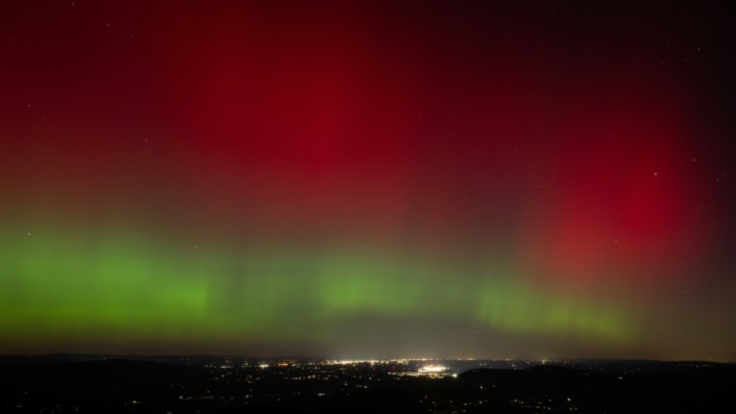
For anyone who has fancied seeing the northern lights but baulked at the logistics of a trip to Iceland, Tuesday morning might offer a rare opportunity closer to home.
The National Oceanic and Atmospheric Administration (NOAA) has issued a G3 geomagnetic storm watch, predicting that a significant solar ejection could push auroral displays as far south as Oregon and Illinois.
The Solar 'Tantrum'
This all kicked off Saturday when the sun decided to have a bit of a tantrum. A patch called Active Region 4299–which has been causing bother for days now–spat out an M8.1 solar flare. That launched a massive bubble of magnetised plasma straight at us.
Scientists term this a coronal mass ejection (CME), which sounds quite polite for what is essentially the sun lobbing a chunk of itself in our direction.
CME Expected to Hit Monday Night Into Tuesday
The CME should wallop Earth's magnetic field sometime early to midday Tuesday. For people in North America, that translates to late Monday night into early Tuesday–decent timing if you are planning to stay up and have a look.
NOAA's list of states that might see something reads like half the country: Washington, Oregon, Idaho, Montana, Wyoming, both Dakotas, Nebraska, Minnesota, Iowa, Wisconsin, Illinois, Michigan, Indiana, Ohio, Pennsylvania, and New York
The catch is you need proper darkness and clear skies. City lights will wash the whole thing out, so you will want to get somewhere properly dark. Look north between about 10 p.m. and 2 a.m. This is the period when geomagnetic activity tends to peak. At these latitudes, auroras usually show up as a greenish glow along the horizon rather than dancing overhead. Still quite lovely, mind you.
Tech Risks and Radio Blackouts
Now, solar storms are not all fun and pretty colours. G3 storms can make satellites act up, throw GPS accuracy off a bit, and cause radio communications to drop out. While power grids are not about to collapse, airlines and shipping companies do pay attention.
Last month Airbus had to rush out a software fix after working out that solar storms 'could corrupt data critical to the functioning of flight controls'.
Just yesterday, an X1.1 solar flare caused an hour-long radio blackout across Australia and Southeast Asia. The sun hit solar maximum back in October–that is the peak of its 11-year cycle, when it exhibits sunspots and eruptions. Scientists thought this cycle would be fairly tame, but the sun clearly did not get that memo.
Solar Activity to Continue Through 2026
Dr Pål Brekke from the Norwegian Space Agency has said we should expect 'the most frequent and intense northern lights displays' running through 2024 and possibly into 2026. Even though we have technically passed the solar maximum peak, activity stays elevated for ages afterwards. Some research suggests the declining phase actually produces the most violent solar events, which is slightly terrifying but excellent news for aurora enthusiasts.
The big unknown with Tuesday's storm is the magnetic field orientation inside the CME. We will not know that until it actually arrives. If the field points southward–opposite to Earth's magnetic field–we get brilliant coupling and spectacular auroras. If it points north, things peter out.
It is a bit like space weather roulette. This solar cycle has been remarkably active compared to the last one, which was the weakest in a century. That means loads of people who have never seen auroras before are getting proper chances without having to fly to Tromsø or Yellowknife.
A powerful solar eruption is expected to hit Earth soon, according to the NOAA. The storm has the potential to disrupt some technology and cause stronger-than-usual auroras, making the northern lights visible in more U.S. regions than usual.
— ABC News (@ABC) December 9, 2025
Read more: https://t.co/mdary8K4NX pic.twitter.com/roE2JE5tK2
Why This Storm Matters Beyond Pretty Lights
Space weather has become increasingly critical as our civilisation depends more heavily on satellite technology and interconnected power grids. The October 2003 solar storms caused widespread disruptions to power systems, airline operations and spacecraft across the globe. Those storms reached G5 intensity–the most severe level–and demonstrated just how vulnerable modern infrastructure can be when the sun goes off.
Whether Tuesday delivers the goods or not, we'll find out soon enough. Space weather forecasting has got massively better over the years, but the sun still does whatever it fancies. We are just along for the ride, hoping the clouds stay away and the magnetic field cooperates.
© Copyright IBTimes 2026. All rights reserved.