Comet 3I/ATLAS Shines Bright: Object Is Spewing Gas And Dust After Sun Pass
The 3I/ATLAS comet is spewing gas after sun pass ahead of Dec. 19 flyby
The sheer speed is almost incomprehensible — a celestial bullet hurtling through the vacuum of space, carrying secrets from a star system light-years away. This is not a local inhabitant of our solar system, but an alien traveller: the interstellar comet, 3I/ATLAS. For months, astronomers, engineers, and space agencies have been gripped by this rare visitor, which is now making its final, spectacular pass before disappearing back into the abyss from which it came.
Discovered in late June and confirmed in July as only the third known interstellar object ever spotted, 3I/ATLAS has spent recent months racing through our planetary neighbourhood at a staggering 210,000 kilometres per hour (130,000 mph). After successfully navigating close encounters with Mars and the sun in October, the comet is preparing for its most significant moment for us Earthlings: its closest approach to our planet on Dec. 19.
On that date, the object will fly by at a distance of approximately 270 million kilometres (170 million miles). To put that distance into perspective, that is nearly twice the vast gulf that separates the Earth from the sun, but in astronomical terms, it represents a precious, fleeting window of opportunity. Space agencies worldwide have seized this chance to study the only direct material we have ever found that was definitively formed around a distant star.
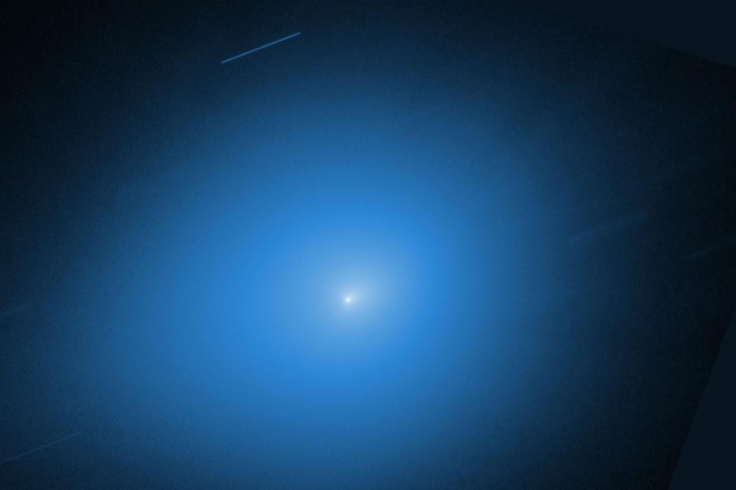
This week, that effort paid off handsomely. Both NASA and the European Space Agency released some of the clearest images to date, showing the comet bright and highly active, having been heated up by its swing around the sun. It is currently spewing gas and dust as its surface ices sublimate — the surest sign of a truly lively comet. This dramatic activity is precisely why the object is 'shining bright' and generating such huge scientific interest: it reveals the deep composition of matter from another star system.

Behind the Streaked Stars: The True Scale of 3I/ATLAS
The most evocative image arrived on Thursday from the US space agency, captured by the mighty Hubble Space Telescope. The image vividly captures the comet's nucleus and its surrounding coma as a bright white glow set against a backdrop of streaked stars. This dramatic star trail is the direct result of the Hubble spacecraft having to track the incredibly fast-moving object for the duration of the exposure.
This photograph was taken on Nov. 30 when 3I/ATLAS was some 286 million kilometres (178 million miles) away. The contrast with the initial images taken in July is stark; the first observation showed little more than a faint blur. Crucially, however, that initial data allowed astronomers to estimate the comet's truly colossal size.
It is believed to measure between 440 metres (1,400 feet) and an enormous 5.6 kilometres (3.5 miles) across, a size that makes it highly likely to be the largest interstellar object ever detected. This dimension alone elevates the importance of the ongoing observations — it is not merely an alien visitor, but a behemoth from beyond our celestial borders.
A Dozen Probes Scramble to Catch the 3I/ATLAS Comet
The scientific community's fascination with this object has prompted a remarkable, impromptu effort across our solar system. Researchers have reported that a staggering dozen spacecraft — many of which were never designed to track comets — have now been repurposed to observe 3I/ATLAS.
This observational armada includes Mars rovers, which typically stick to geology, and deep-space asteroid probes. Each new data set, no matter how small, is deemed incredibly valuable, representing a rare, physical glimpse into the material that formed around a distant, unknown star.
The observational campaign is set to culminate with the closest flyby, where the newest marvel of astrophysics, the James Webb Space Telescope, is expected to deliver its own highly anticipated batch of images and measurements. Scientists are racing against the clock; every single data point gathered now is a permanent record of a cosmic immigrant that will soon be beyond our reach forever. This is truly the final opportunity to study the secrets contained within the heart of 3I/ATLAS before it makes its majestic, one-way journey into the quiet expanse of deep space.
This is truly the final opportunity to study the secrets contained within the heart of 3I/ATLAS before it makes its majestic, one-way journey into the quiet expanse of deep space. Now, as the James Webb Space Telescope prepares for its closest view, readers should follow the official NASA and ESA channels closely, ensuring they do not miss the final, world-class images and data from this fleeting cosmic immigrant.
© Copyright IBTimes 2026. All rights reserved.
- MOST POPULAR IN Trending