Nvidia Unveils Vera Rubin at CES 2026 — The AI Platform That Could Reshape Work
Nvidia CEO Jensen Huang reveals full production of Vera Rubin, an AI platform that could reshape work and productivity
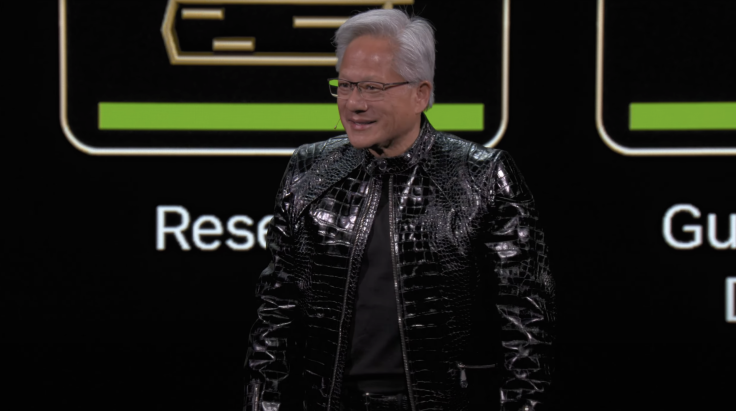
Nvidia founder and Chief Executive Officer (CEO) Jensen Huang announced Vera Rubin's official launch at CES 2026 held in Las Vegas, Nevada. The Vera Rubin AI computing platform, widely regarded as a highly anticipated technology in AI and computing, will arrive on schedule later this year, according to the CEO.
'Today, I can tell you that Vera Rubin is in full production', Huang confirms during the Nvidia press event Monday, 5 January, at the annual Consumer Electronics Show (CES) 2026 at the Wynn Las Vegas where he presented the Vera Rubin platform.
Nvidia's Vera Rubin AI redefines a major artificial intelligence (AI) infrastructure evolution used in the workplace. In a video shared by the Verge, Nvidia Senior Director of HPC and AI infrastructure solutions Dion Harris described Vera Rubin as 'six chips that make one AI supercomputer'.
Vera Rubin is in full production.
— NVIDIA (@nvidia) January 6, 2026
We just kicked off the next generation of AI infrastructure with the NVIDIA Rubin platform, bringing together six new chips to deliver one AI supercomputer built for AI at scale.
Here are the top 5 things to know 🧵 pic.twitter.com/TiQKUK4eY3
In Huang's presentation, Vera Rubin's architecture is described as 'a system of six chips engineered to work as one, born from extreme code design.'
What is Vera Rubin?
Vera, or the Nvidia Vera CPU, is a custom-designed CPU that doubles the previous generation's performance, was co-designed with the Nvidia Rubin GPU to 'bi-directionally and coherently share data faster, and with lower latency', per Nvidia's YouTube upload. The Vera Rubin compute board comprises 17,000 components placed with precision by robots, as claimed by Nvidia.
Nvidia further claims that the Vera Rubin is 'capable of delivering 100 petaflops of AI - five times that of its predecessor.'
According to Nvidia, the Vera Rubin, or the integrated platform, can train complex 'mixture of experts' AI models by utilising only a quarter of the GPUs needed for its previous Blackwell-based systems. This quantifies the compute power required to run AI workloads, per the Verge.
Vera Rubin lowers token costs by another 90% over Blackwell
— Alex (@TickerSymbolYOU) January 5, 2026
VERY LONG $NVDA pic.twitter.com/JN659sIefO
With Vera Rubin making the creation of powerful AI models that are faster and easier to operate at cheaper rates possible, AI tools that are more responsive, more economically viable, and capable of advanced reasoning may be at business's fingertips. And by lowering barriers to intensive AI computation such as infrastructure costs, Nvidia's Vera Rubin may just help accelerate the adoption of AI across global industries. This may mean that healthcare and education can get access to advanced, next-gen machine learning tools previously restricted to large-scale data facilities.
Reshaping Work
One of Vera Rubin's most interesting aspects is how it can potentially impact workplace structures, particularly as AI is being developed to handle more complex tasks. As such, it is widely discussed how AI may cause certain roles to be displaced, or, at the very least, transformed.
The arrival of Vera Rubin can come with opportunities and challenges alike in the workplace. For instance, the high demand for professionals to interpret AI systems might rise, but jobs underscoring data processing or pattern recognition may be replaced with automation.
Vera Rubin's unveiling at CES 2026 is a reflection of Nvidia's strategic approach towards integrating AI in the future of technology and work. Placing emphasis on efficiency, Vera Rubin can easily become the foundation of next-generation AI-driven applications. Approaching its 2026 deployment, it is clear that developers and firms will be closely watching, betting on productivity, impact on humans, and innovation.
© Copyright IBTimes 2026. All rights reserved.
- MOST POPULAR IN Technology