

Trump Renames Lake Ontario 'Lake America' as Canada Rejects Controversial Name Change
US executive order sparks diplomatic tensions over Lake Ontario's renaming
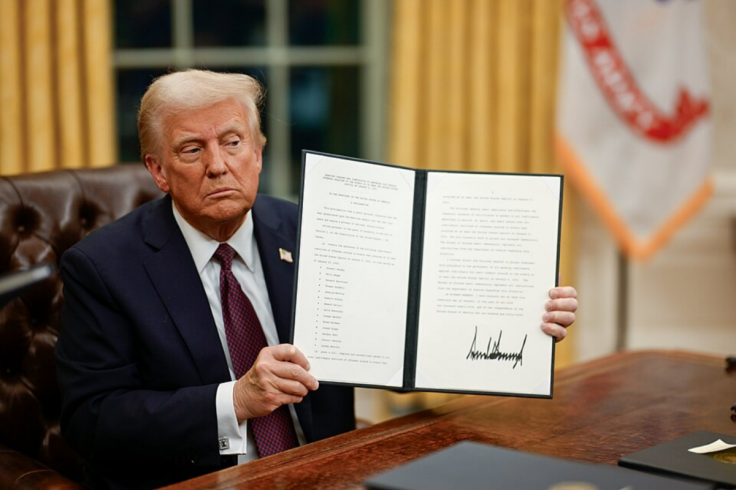
Donald Trump has signed an executive order directing US federal agencies to call Lake Ontario 'Lake America', provoking an immediate rejection from Canada as relations between the neighbouring countries deteriorate.
The order requires the US Department of the Interior to replace Lake Ontario with the new name across federal maps, databases, contracts and official communications.
However, the decision applies only to US federal usage. It does not require Canada, state governments, private organisations or international bodies to adopt the name.
Canadian Prime Minister Mark Carney responded by declaring that Canadians would continue calling it Lake Ontario 'then, now and always'.
Trump Gives Interior Department 30 Days
Trump signed the order at the White House on Thursday, 27 August, with a large map of the Great Lakes displayed behind him. 'Lake America' had been printed across Lake Ontario in prominent red letters.
The official executive order gives the Interior Department 30 days to work with the US Board on Geographic Names and update the Geographic Names Information System.
Federal departments and agencies will subsequently be expected to use Lake America on maps, contracts, documents and public communications.
Trump said the change was 'effective immediately', although the order provides a 30-day period for officials to complete the formal process.
The order describes the lake as an important American economic resource. It says the broader Great Lakes-St Lawrence Seaway system supports hundreds of thousands of US jobs and generates billions of dollars through shipping, manufacturing, agriculture and related industries.
It also claims that the United States holds most of Lake Ontario's volume because its deepest waters lie within US territory. Approximately 52 per cent of the lake's surface area is in Canada with the remainder in New York.
Canada Refuses to Adopt Lake America
Carney rejected the decision by stressing that the name Lake Ontario has been used for more than 400 years. It predates both Canadian Confederation and the US Declaration of Independence.
He said Canada understood the importance of recognising historical and geographical reality, making clear that Canadian government maps and documents would retain the existing name.
The name Lake Ontario comes from the Wendat word Ontari’io, which, appropriately, means “the lake is beautiful, the lake is big”.
— Mark Carney (@MarkJCarney) August 27, 2026
The name is more than 400 years old, predating both the Confederation of Canada and the Declaration of Independence of the United States of America.…
Ontario Premier Doug Ford also rejected the change, saying the body of water would remain Lake Ontario to Canadians and the rest of the world.
New York Governor Kathy Hochul joined the opposition from the American side of the border, stating that her state would not use Trump's new name.
Vermont Governor Phil Scott, a Republican, described the decision as 'petty and disappointing'.
Indigenous Leader Accuses Trump of Erasing History
The name Ontario has Indigenous origins and comes from the Wendat language. It has been translated as meaning 'the lake is beautiful, great'.
Grand Chief Pierre Picard of the Wendat Nation in Quebec condemned the order and accused Trump of attempting to erase Indigenous history.
The criticism adds a cultural dimension to a dispute already involving sovereignty, trade and diplomatic relations.
Although Trump's order changes the name used by the US federal government, it does not alter the international border running through the lake or affect Canada's authority over its portion.
Trade War Fuels Naming Dispute
The controversy follows the collapse of negotiations intended to prevent a new round of tariffs between the United States and Canada.
Washington announced 50 per cent tariffs on approximately $20 billion (about £15 billion) of Canadian goods after talks between the countries failed.
Canada responded with retaliatory duties covering approximately $20 billion of American products, including steel, dairy goods, appliances and agricultural equipment.
Trump has accused Canada of treating the United States unfairly on trade and relying too heavily on American military protection. Canadian leaders argue that tariffs will increase costs for businesses and consumers on both sides of the border.
The president has also repeatedly suggested that Canada should become America's 51st state, an idea Canadian officials have rejected.
Renaming Lake Ontario is largely symbolic, but it demonstrates how the commercial dispute has expanded into a wider confrontation involving geography, history and national identity.
What the Executive Order Can Change
US presidents can direct federal agencies to use particular geographical names, but those decisions do not automatically bind state governments, foreign countries, private publishers or international organisations.
The Canadian government will continue using Lake Ontario, while Governor Kathy Hochul said New York would not use the new name.
As a result, US federal documents and Canadian government maps will use different names for the same lake. Private mapping companies and publishers will decide independently which designation to display.
A similar dispute followed Trump's 2025 decision to rename the Gulf of Mexico as the Gulf of America for US federal purposes.
Trump has also suggested that he could consider changing US references to the Atlantic and Pacific oceans. No formal executive orders covering either ocean have been announced.
Lake Becomes Symbol of US-Canada Rift
Lake Ontario is the smallest of the Great Lakes by surface area, covering approximately 18,960 square kilometres. It is bordered by the Canadian province of Ontario and the US state of New York.
The lake connects to the Atlantic Ocean through the St Lawrence River and forms a crucial part of the Great Lakes shipping system.
It supplies drinking water to surrounding communities, supports electricity generation and carries commercial traffic between the interior of North America and international markets.
Trump's order will change what US federal agencies call the lake, but it will not settle the disagreement over its identity.
Canada's rejection means the shared waterway will carry different names in US federal and Canadian government records, becoming another visible symbol of the deteriorating relationship between the longtime allies.
© Copyright IBTimes 2026. All rights reserved.