

From Prototype to Production: How Yalantis Helps Companies Bring IoT Devices to Market
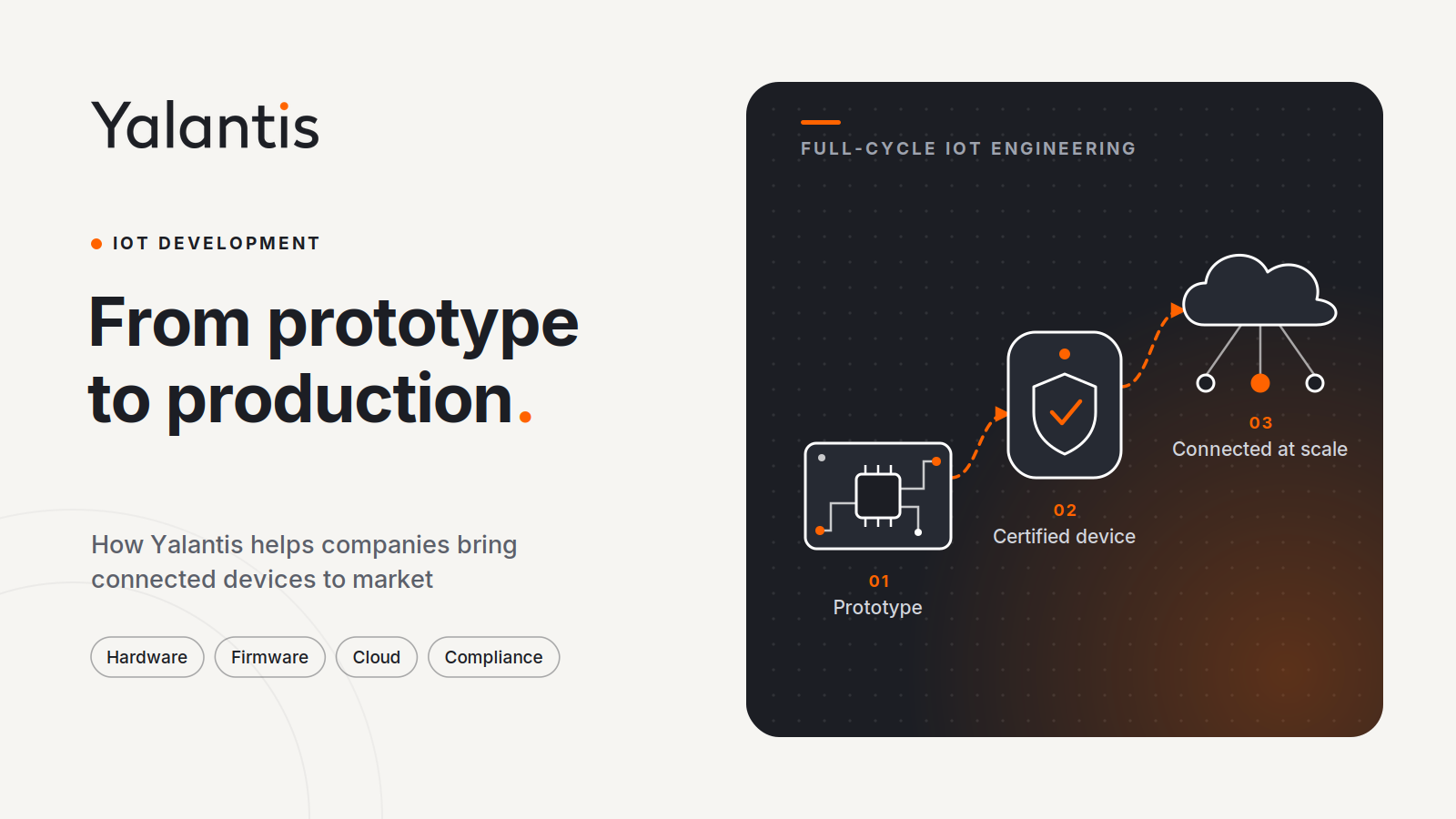
Almost every connected product starts the same way: a working prototype on a lab bench, a few enthusiastic demos, and a plan to ship within a year. Far fewer reach the market on schedule.
Between a prototype and a product that can be manufactured, certified, secured, and supported in the field lies a stretch of engineering that many companies underestimate, and it is precisely where Yalantis, a Warsaw-headquartered IoT and embedded engineering company, has built its business.
Why So Many IoT Projects Stall After the Prototype
A prototype proves that an idea works once. A product has to work millions of times, in hostile environments, on a battery, under regulatory scrutiny, and for years after launch. Getting there typically requires hardware and radio-frequency design, firmware, connectivity, mobile and cloud software, security engineering, and certification, disciplines that rarely sit inside one company.
Many teams assemble them from separate vendors, and the gaps between those vendors are where schedules slip and costs climb: a firmware change that invalidates a certification test, an antenna redesign discovered only after the enclosure is tooled, a cloud integration nobody owned.
'The most common IoT device or app failure is a gap between teams. One vendor builds the firmware, another builds the app, a third handles the cloud. Nobody owns the data flow end to end. We do, and that is why our systems work at scale,' says Denys Hukov, Chief Growth Officer at Yalantis.
That end-to-end ownership is the core of Yalantis's full-cycle model: one engineering team responsible for every layer of a connected product, from circuit board to cloud dashboard. Rather than coordinating separate hardware, firmware, and software vendors, clients work with a single team spanning IoT, embedded systems, hardware design, AI, and cloud development, so decisions made in one layer are always taken with the others in view.
How Yalantis Takes a Device From Lab to Market
The company's process follows the natural lifecycle of a hardware product:
- Discovery and feasibility. Before anything is built, engineers assess technical risk, component availability, power budgets, and the regulatory path, so the design freeze happens with full information.
- Hardware and RF design. Yalantis's Warsaw lab covers industrial design, PCB engineering, antenna design, and rapid prototyping, allowing several hardware iterations before committing to production tooling.
- Firmware and embedded software. The team develops board support packages, drivers, and RTOS-based firmware, with secure boot and over-the-air update mechanisms designed in from the start.
- Connectivity, apps, and cloud. Bluetooth Low Energy, Wi-Fi, LTE-M, NB-IoT, and other protocols are paired with mobile applications and scalable cloud back ends. Yalantis is an AWS Advanced Tier Services Partner.
- Validation and certification. Testing against industry standards, pre-compliance checks, and documentation prepare the product for regional approvals and manufacturing hand-off.
In August 2026, the company became an official Design Partner of Nordic Semiconductor, formalising years of work with the Norwegian chipmaker's low-power wireless platforms, including the nRF52, nRF54, and nRF91 families used across medical devices, industrial systems, EV charging, and connected retail.
Compliance-First IoT: Security Built in From Day One
For connected devices, security has stopped being a feature and become a condition of market access. The EU Cyber Resilience Act introduced vulnerability reporting obligations for manufacturers in September 2026, with full requirements applying from December 2027.
The UK's Product Security and Telecommunications Infrastructure regime already bans default passwords and requires vulnerability disclosure for consumer connectables. Any company selling into both markets now faces two overlapping rulebooks.
Yalantis describes its approach as compliance-first: regulatory and security requirements are mapped at the discovery stage and shape engineering decisions rather than being audited at the end.
In practice, that means hardware roots of trust and secure boot chains, firmware encryption, device authentication and encrypted communication, signed OTA updates with rollback protection, software bills of materials, and security assessments at the firmware level rather than only in the companion app.
The company holds ISO 27001, ISO 9001, and ISO 13485 certifications, and in 2026 published an IoT Compliance and Security Readiness Checklist to help product teams benchmark their own readiness against the CRA timeline. The underlying argument is simple: retrofitting security into a shipped fleet means recalls and field updates, while building it in costs a line item in a design review.
Building IoT for Regulated Industries
The disciplines above matter most where the cost of failure is highest, and that is where Yalantis has concentrated its work.
In healthcare and medtech, the company develops connected devices and wearables under ISO 13485 quality management, aligning with FDA and EU MDR expectations, IEC 62304 for medical software, and HIPAA and GDPR for data handling. Typical projects include patient-monitoring wearables, connected diagnostic equipment, and medical imaging systems handling large data volumes.
In industrial and manufacturing settings, projects range from sensor networks and predictive-maintenance systems to EV charging infrastructure, built against IEC 62443 for industrial cybersecurity and, in automotive contexts, ISO 26262 for functional safety. The company's client list spans start-ups to enterprises, including Home Connect for Bosch and Toyota Tsusho.
What unites these sectors is a procurement reality: buyers increasingly ask not just whether a device works, but whether its development process can be documented, audited, and defended to a regulator. A compliance-first engineering partner turns that question into a competitive advantage.
Where Yalantis Sees IoT Heading
Three shifts are shaping the company's engineering roadmap.
Edge AI. Machine learning is moving from data centres into the devices themselves. Microcontrollers with built-in neural accelerators now ship in volume, enabling on-device anomaly detection, keyword spotting, and basic computer vision without streaming raw data to the cloud, improving latency, privacy, and battery life at once. In October 2026, Yalantis added Axelera AI, a European developer of AI acceleration hardware for the edge, to its technology partners, complementing its work on low-power microcontroller platforms.
Secure firmware and memory-safe languages. With US cybersecurity agencies recommending memory-safe languages and the CRA raising the bar for vulnerability handling, Yalantis has made Rust in embedded development a core technical differentiator, eliminating entire classes of memory-safety bugs at compile time in safety-critical firmware.
Smarter connectivity. The company designs for multi-protocol flexibility from the outset, combining Bluetooth Low Energy, cellular IoT, and emerging options such as 5G RedCap, so products can adapt to changing coverage, cost, and power requirements over a multi-year lifecycle.
The Road From Lab Bench To Market Shelf
As connected devices spread deeper into hospitals, factories, vehicles, and homes, the companies that succeed will be those that treat the journey from prototype to production as an engineering discipline in its own right.
Yalantis has positioned itself for exactly that journey: full-cycle capability, compliance built in from the start, and a technology roadmap aimed at the next generation of secure, intelligent devices.
About Yalantis
Founded in 2008 and headquartered in Warsaw, Poland, Yalantis is a full-cycle IoT, software, and hardware engineering company. It designs and builds connected and compliant systems for clients in healthcare, medtech, manufacturing, logistics, automotive, and other industries. Yalantis is ISO 27001, ISO 9001, and ISO 13485 certified, an AWS Advanced Tier Services Partner, and an official Nordic Semiconductor Design Partner.
© Copyright IBTimes 2026. All rights reserved.