

Robots, AI Agents, Generative Models: The Path That Led Paras Savnani to Physical AI

Paras Savnani built autonomous robots before training generative models, and he worked on AI agents years before the category became a dominant technology conversation. Over nearly a decade, his work has moved through robotics, machine learning, logistics automation, video-generation systems, and deployed AI products. That range now shapes how Savnani, founder and CEO of Robolens, approaches physical AI: he has seen intelligent systems from both the model side and the machine side.
His earliest serious robotics work came as an undergraduate competing in ABU Robocon. Teams had roughly six months to build entire autonomous robots, which meant working across mechanical components, custom printed circuit boards, and the complete software stack rather than specializing in one layer. Savnani eventually became team captain, leading the group through competitions that forced rapid decisions about how those pieces would function together.
"You could not treat the robot like a software project with hardware attached at the end," Savnani said. "The mechanics, electronics, and software all had to work together, and you learned very quickly where a decision in one part of the system created a problem somewhere else." The compressed competition cycle also taught him to iterate under practical constraints. Teams had limited time to move from design to a machine capable of completing the required task.
In 2018, as the lead contributor to the robots, Savnani helped drive Nirma University to India's national ABU Robocon championship against 107 teams, with the team also winning the award for fastest task completion. He was then chosen to captain India's team at the internationals in Vietnam. A year later, he captained the team, fielding an unconventional quadrupedal robot that dominated the national rounds before losing the final by two seconds.
"Competition robotics gave me a very direct education in what it takes to make a complete system work," he said. "You can have an elegant idea, but the machine still has to move, sense, make decisions, and finish the task under pressure." The experience pushed Savnani deeper into robotics rather than toward one narrow engineering specialty.
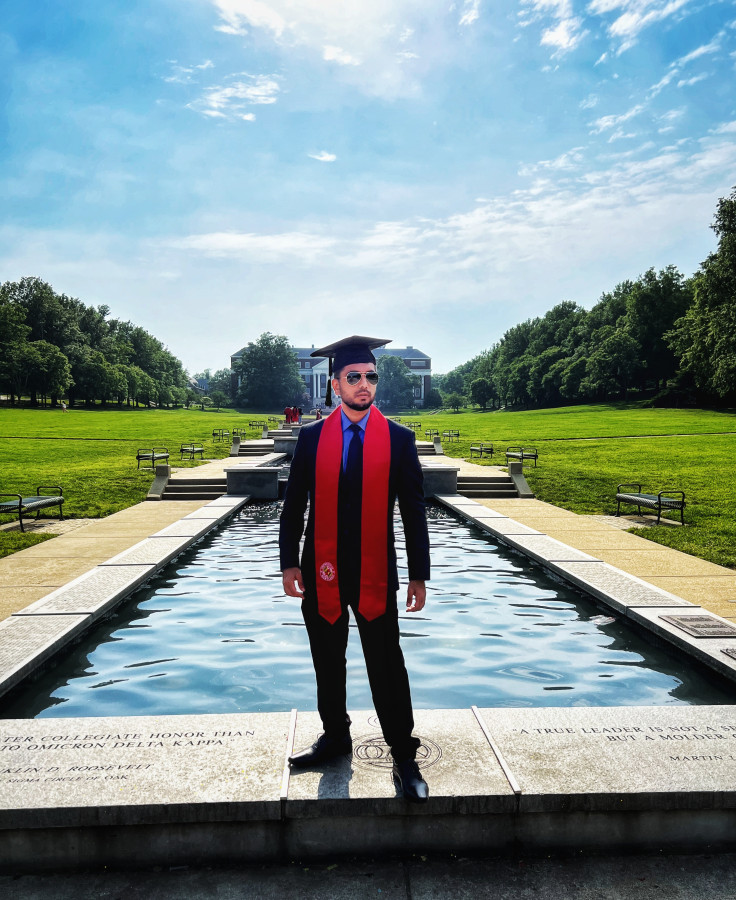
He later completed a master's in robotics at the University of Maryland, finishing the two-year program in 15 months. His graduate work included machine-learning research involving drones and virtual AI avatars, exposing him to intelligent systems that differed sharply in how they interacted with their environments. The work broadened his experience beyond the full-stack robot building of Robocon and deeper into the learning systems behind autonomous and digitally generated behavior.
At Fero AI in 2020, Savnani co-built TiA, an NLP-powered system for freight logistics that he describes as one of the first intelligent AI agents developed for the sector. The work gave him experience with software expected to operate inside an actual business process rather than remain confined to a standalone model task.
"The interesting part was giving software enough context to do useful work inside an actual operational process," Savnani said. "That changed how I thought about AI because the system had to interact with a workflow, not just produce an isolated result." The freight setting introduced another form of complexity, this time through software that needed to function inside an existing operational environment.
His work later moved into generative modeling at Samsung Research's NEON Labs. Savnani trained foundational motion and video-generation models used for real-time AI avatars, and the project was deployed for enterprise users. The project also received outside media coverage, adding generative modeling to a body of work that had begun with autonomous physical systems.
"Generative models gave me another way to think about motion and behavior," Savnani said. "The technical problem was very different from building a competition robot, but it still required thinking carefully about how a system represents something dynamic." What might have looked like a detour from robotics turned out to be a preview of where the field was heading: the same video-generation techniques now power the world models frontier labs use both as robotics foundation models and as learned simulators for testing robots.
Through his company Lunaris AI, Savnani later deployed AI agents and computer-use models for clients. That work placed him inside another generation of artificial intelligence, where software systems were increasingly expected to take actions through digital interfaces rather than only return information.
Savnani's own work has repeatedly brought learning systems and physical machines into the same technical picture. That breadth is now central to how he interprets the problems emerging at the intersection of AI and robotics.
"Working across both types of systems changes the questions you ask," Savnani said. "With robotics, the model is only one part of a machine whose mechanics, electronics, and software all have to work together." That perspective traces back to the full-system discipline of Robocon while also reflecting the AI research and deployment work that followed.
Savnani is now bringing that combination of experience into Robolens, where his current focus is data and evaluation infrastructure for robotics. Robolens is still early, so the record that precedes it is what shows how he builds and deploys systems. Taken together, those projects made Savnani fluent in the machines, the models, and the software around them, and taught him to treat physical AI as one system rather than a set of specialties. His current robotics work draws on that range, combining lessons from physical machines with experience building increasingly capable forms of intelligent software.
© Copyright IBTimes 2026. All rights reserved.