

Is 3I/ATLAS An Alien Spacecraft? Breakthrough Listen Confirms Interstellar Comet Is Only a 'Space Rock'
New research confirms the third interstellar visitor is a natural comet

In the vast, silent expanse of our solar system, a new visitor has sparked a familiar question: are we truly alone? For those who grew up on a diet of science fiction, the discovery of 3I/ATLAS—the third interstellar object ever found in our neighbourhood — carried the tantalising possibility of being more than just a lump of ice.
Named as the third 'interstellar' (I) object after 1I/'Oumuamua and 2I/Borisov, the body was found racing into our system at a staggering 137,000 miles per hour (221,000 kilometres per hour). However, a new study has effectively closed the book on the 'alien probe' theory, replacing speculation with the cold, hard data of modern astronomy.
The visitor was first spotted on July 1, 2025 by the NASA-funded ATLAS survey in Chile. Since then, it has been the subject of an intense, global scientific investigation. Most recently, a team led by Benjamin Jacobson-Bell from the University of California, Berkeley, utilised the formidable 100-metre Robert C. Byrd Green Bank Telescope in West Virginia to hunt for 'technosignatures' — the radio fingerprints of artificial technology.

Tuning Into the Silence of 3I/ATLAS
The team focused their search on narrowband radio signals, which are the most likely candidates for long-distance interstellar communication. Because these signals require relatively little energy to produce and can traverse the void effectively, they are exactly what we would expect from a functioning extraterrestrial probe.
The observations were specifically timed for Dec. 18, 2025, just 24 hours before the object made its closest pass to Earth, ensuring the highest possible chance of detecting even the faintest of transmissions. Jacobson-Bell's team pushed the equipment to its limits, achieving a level of sensitivity that is almost difficult to fathom. 'Its sensitivity enables us to verify the absence of transmitters down to 0.1 watts,' Jacobson-Bell told Space, providing the strongest evidence against technology to date.
To put that into perspective, a standard mobile phone emits about 1 watt of power. Essentially, if there were a transmitter on 3I/ATLAS even ten times weaker than your smartphone, the Green Bank Telescope would have heard it.
The search did yield nine 'events' — signals that initially looked promising out of nearly 470,000 potential candidates. However, after rigorous filtering to separate cosmic whispers from our own technological chatter, all nine were traced back to mundane, human-made transmitters right here on Earth.
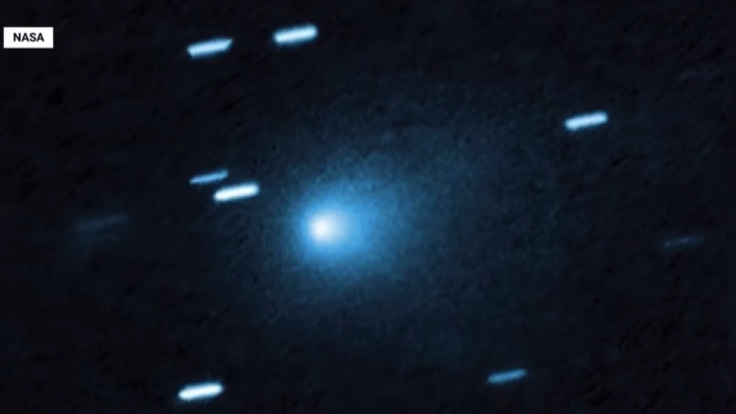
'Past work has shown that 3I/ATLAS looks like a comet and behaves like a comet,' Jacobson-Bell noted, 'and our observations show that, like a comet, 3I/ATLAS is not a source of technological signals'. The team also noted that 3I/ATLAS features a clear coma and a nucleus estimated to be between 440 metres and 5.6 kilometres in diameter, further cementing its identity as a natural icy body.
The Future of Interstellar Hunting Beyond 3I/ATLAS
While the lack of alien life might feel like a letdown to some, the scientific community is far from disappointed. In fact, researchers like Michele Bannister have estimated that 3I/ATLAS could be between 8 and 14 billion years old — potentially predating our own sun.
It remains a prehistoric relic of a distant star system, offering a rare glimpse into the chemistry of a world we may never visit. Furthermore, the techniques refined during this hunt are paving the way for a new era of discovery.
The recently completed Vera C. Rubin Observatory in Chile is set to change the game entirely. Its 10-year Legacy Survey of Space and Time (LSST) is expected to identify a vast population of interstellar objects. Some estimates suggest it could find up to 70 new visitors every year. As our sample size grows, astronomers will finally be able to distinguish between the 'typical' cosmic debris and truly anomalous objects that might warrant even closer inspection.
As 3I/ATLAS begins its long journey back into the darkness of interstellar space, reaching its closest point to Earth on Dec. 19, 2025 at roughly 167 million miles (1.7 AU), it leaves us with a better understanding of our cosmic backyard. 'If we don't look, we'll never know,' Jacobson-Bell concluded. The search continues, and while 3I/ATLAS wasn't the one, the next visitor might be.
© Copyright IBTimes 2026. All rights reserved.