3I/ATLAS Shock: Why This Faint Speck of Light Is Now a Global Security Priority
Interstellar visitor 3I/ATLAS turned a scientific find into a global security priority

The moment history was made, it did not arrive with a bang or a blinding flash of light. Instead, it arrived at precisely 05:15:11 UT on the morning of July 1, 2025. In the high-altitude silence of Rio Hurtado, Chile, the NASA-funded ATLAS survey telescope captured a routine field of stars that seemed, for all intents and purposes, perfectly ordinary.
Yet, hidden within those thousands of points of light was a faint, moving source that would eventually be recognised as 3I/ATLAS — the third confirmed interstellar traveller to ever grace our solar neighbourhood. This faint speck did not just represent a scientific curiosity; it acted as a jarring wake-up call for planetary defence experts who realised that our current net for catching cosmic threats might be full of holes.
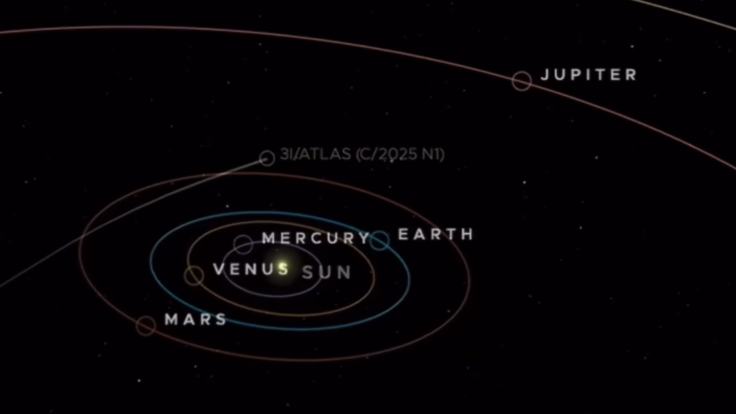
This was not just any comet or asteroid that had moved. As the data was processed, the object's true nature began to show. Researchers were interested in more than just its speed; they were also interested in its path. 3I/ATLAS was moving in a hyperbolic way, which is a mathematical proof that it was never pulled toward our sun by gravity.
It was just passing through, like a hitchhiker from the dark depths of the Milky Way. Orbital solutions confirmed within hours that its speed was too high and its angle of approach was too steep to be explained by the gravity of Jupiter or the outer planets. It wasn't a local who had been moved; it was a 'arrival'.
Why 3I/ATLAS Exposed Our Orbital Blind Spots
When astronomers reconstructed the object's journey using archival data from the Zwicky Transient Facility and other worldwide installations, they found a remarkable consistency. 3I/ATLAS had journeyed from the direction of the Sagittarius constellation. This is not just a random patch of sky; Sagittarius is a dense, chaotic corridor of our galaxy, home to stellar nurseries and supernova remnants.
Its origin suggests that 3I/ATLAS was forged in a region where star systems are born and violently rearranged, carrying with it a chemical history entirely alien to our own. Crucially, the fact that such an object could reach 420 million miles from Earth before being 'flagged' by algorithms suggests that faster, more dangerous interstellar 'bullets' could be lurking in our blind spots.
At the time of its discovery, the object was roughly 420 million miles from Earth. While that sounds like a vast distance, in cosmic terms, it was right on our doorstep. What stood out to experts was the object's 'restraint'. It did not boast a dramatic tail or sudden flares. Instead, it was 'too quiet'. Its brightness did not evolve as predicted for a typical icy body warming up under the sun's rays.
This initial silence was merely the calm before the scientific storm, as later observations revealed strange jet activity and non-gravitational acceleration that continues to baffle the brightest minds in astrophysics. Further analysis by the James Webb Space Telescope revealed a staggering 8:1 ratio of carbon dioxide to water, a chemical signature that proves this visitor is fundamentally different from anything born in our own Solar System.

What 3I/ATLAS Teaches Us About Cosmic 'Fast-Movers'
The detection of 3I/ATLAS has highlighted just how vital our planetary defence systems have become. While the ATLAS system was designed to protect Earth from near-Earth objects (NEOs), it has inadvertently become our primary interstellar early-warning system. It forces us to ask a chilling question: how many of these visitors have we missed in the past?
Before our current age of algorithmic scrutiny and constant sky surveillance, such objects likely slipped through our 'detection net' unnoticed. If an object like 3I/ATLAS — which was found to be releasing water vapour at a rate of forty kilograms per second despite being far from the sun's heat — had been on a collision course, our window for a response would have been terrifyingly short.
Harvard astrophysicist Avi Loeb has been vocal about the importance of these visitors, noting that they offer a rare chance to study 'material formed around other stars'. As the object moved through our system, every major telescope on the planet pivoted to watch. They saw its rotation rates change and its thermal signatures shift in ways that defied standard models.
Every bit of data added 'texture, not clarity,' as the object refused to fit neatly into our existing categories of comets or asteroids. Ultimately, this discovery has shifted 3I/ATLAS from a mere astronomical footnote to a matter of global security priority, as it proves that the space between stars is far more crowded and dynamic than we ever dared to imagine.
This first look is really a turning point for all of humanity. It shows that our solar system is not a walled garden, but a busy crossroads in a galaxy. 3I/ATLAS is a reminder that the universe is always changing and sending us messages.
We need to stay alert as we keep going through the pixels of our past and future. The same sky that brought this visitor may already be hiding the next one, waiting for us to see that it doesn't belong.
© Copyright IBTimes 2026. All rights reserved.
- MOST POPULAR IN Trending