

3I/ATLAS Mystery: Is The Third Interstellar Visitor A 'Dark Forest' Reconnaissance Probe?
Is 3I/ATLAS an alien probe? Discover why experts are debating the nature of the third interstellar visitor as it heads towards Jupiter in 2026.

When something the size of Manhattan flies through our solar system from deep space, scientists usually watch with a clinical interest. For Harvard astrophysicist Professor Avi Loeb, though, the mysterious visitor 3I/ATLAS is much more than just a rock that moves around. The object was first seen on July 1, 2025, by the NASA-funded Asteroid Terrestrial-impact Last Alert System (ATLAS) in Chile.
It was quickly identified as only the third interstellar interloper ever recorded, following the well-known 1I/'Oumuamua and 2I/Borisov. Most people agree that the object is a common comet, but Loeb has sparked a heated debate by saying that this cosmic traveler looks like a highly advanced alien probe sent to gather information on our doorstep.

Interstellar Intrigue: Is 3I/ATLAS a Natural Phenomenon or a Probe?
The object, which came closest to Earth on December 19, 2025, at a distance of 1.8 astronomical units (about 170 million miles), has become the center of a radical theory. Loeb, who once famously guessed that 1I/'Oumuamua was made by people, says that 3I/ATLAS has strange features that don't fit with what we know about comets.
He specifically points to its 'anti-tail,' which is a jet of material that points toward the sun, as a possible smoking gun. Recent pictures from the Hubble Space Telescope taken in late December 2025 have made the mystery even more interesting. They show a complicated and symmetrical double-jet structure that some people say looks more mechanical than natural.
Solar wind usually blows gas and dust away from the sun in a natural comet. Loeb's analysis, on the other hand, says that 3I/ATLAS's anti-tail shouldn't have 'streaming gas beyond a distance of 5,000 kilometers from the nucleus.'
Writing on his blog, the Harvard professor noted: 'Interestingly, this is roughly the traverse radius of the glowing halo (coma) around the nucleus of 3I/ATLAS.' The nucleus itself is estimated to be between 440 metres and 5.6 kilometres in diameter, moving at a staggering hyperbolic excess velocity of 58 kilometres per second—far faster than its predecessors.
The stakes of this investigation are immense. If 3I/ATLAS is a natural rock, the gas launched by the sublimation of CO2 ice should be limited to speeds of approximately 200 metres per second, leaving the outer reaches of the anti-tail gas-free. 'If it is a natural comet,' Loeb explains, 'then the anti-tail jet should not include streaming gas beyond a distance of 5,000 kilometres from the nucleus. At distances much larger... the anti-tail should be composed primarily of a stream of 10-micron dust particles.'
The Search for Artificial Life Beyond our Solar System
To settle the argument, Loeb is calling for a 'clean test' using molecular tracers. By tagging molecules like CO2 or carbon monoxide along the axis of the anti-tail jet, scientists can determine whether the object is behaving like an icy rock or a technological marvel. Loeb remains hopeful that data from prestigious observatories, including the James Webb Space Telescope and the Keck Observatory, will provide the clarity needed.
He has specifically pointed to the 'Duck Test' logic: if it looks like a comet and quacks like a comet, it is likely a comet unless the chemical signature of the gas plumes shows an industrial ratio of metals, such as the unusually high levels of nickel reported in early spectral scans.
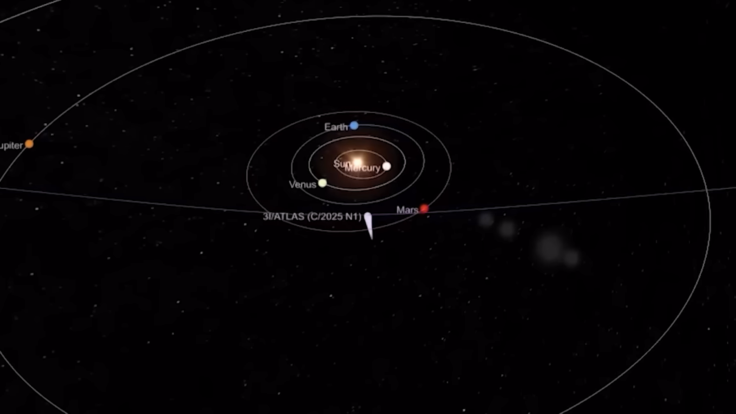
Loeb's theory has very important effects. If gas is found in the wrong place on the anti-tail, it could mean that 'technological thrusters' are at work instead of natural sublimation. This would transform 3I/ATLAS from a scientific curiosity into the most significant discovery in human history: proof of non-human intelligence. Loeb has even suggested that the timing and trajectory of the object which passed remarkably close to Mars on 3 October 2025 could indicate an intentional 'flyby' of our neighbouring planet.
Even though the object 'ignored' Earth by passing on the other side of the sun during its closest approach, the search for its true nature goes on. The scientific community is still split as the object moves toward its next milestone: a pass by Jupiter in March 2026.
The search to figure out what 3I/ATLAS is shows how much we are still interested in things we don't know. It could be a 'message in a bottle' from a distant civilisation or just a piece of space junk. For now, the world waits for the telescopes to tell us what they see. We hope that the next set of data will finally show us if we are really alone in the dark.
© Copyright IBTimes 2026. All rights reserved.