

3I/ATLAS Secrets: Scientists Clock Massive Water Loss From Alien Comet
Ancient interstellar comet 3I/ATLAS reveals its secrets before vanishing past Jupiter
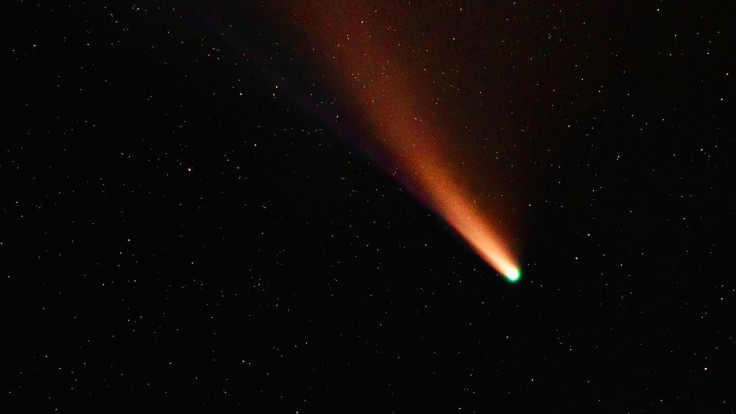
For a long time, people have looked up at the stars with both curiosity and fear, wondering when the next messenger from the deep galaxy would come. That time has come, and it has a billion-year-old secret following it. The object, called 3I/ATLAS, has become the center of attention for astronomers all over the world. It is a rare, time-limited sample of material that formed around a distant star.
The ATLAS survey in Chile first saw the visitor on July 1, 2025. It came into our inner solar system at an incredible speed of 61 km/s (136,000 mph). Scientists are finally putting together the basic structure of this strange visitor, which is thought to be between 8 and 13 billion years old — almost three times the age of our own sun — as it starts its long, lonely journey away from our sun.

A Celestial Time Capsule: Tracking the Water Trail of 3I/ATLAS
Unlike the comets that call our solar system home, 3I/ATLAS is a cosmic nomad on a hyperbolic trajectory — a one-time flyby that will never be repeated. Calculations reveal an orbital eccentricity of 6.1, confirming its origins in a distant, ancient part of the Milky Way.
Since its discovery, the object has been under constant surveillance. Most recently, the joint ESA/NASA SOHO mission utilized its SWAN instrument to measure the 'hydrogen coma' — the glowing envelope created when solar radiation splits water molecules apart.
The data, detailed in a preprint for The Astrophysical Journal Letters, provides a staggering look at the comet's volatile nature. On Oct. 29, 2025, the comet reached perihelion — its closest point to the sun —at a distance of 1.36 AU.
Shortly after, on Nov. 6, the comet was shedding water at a peak rate of 3.17×10^29 molecules per second. This activity is significantly higher than that of local comets at comparable distances, suggesting a nucleus up to 20 kilometres in diameter with a surface that is 8% active.
By the time it reached early December, this output had plummeted to roughly 1–2×10^28 molecules per second. For context, researchers estimate that during the month following its perihelion, 3I/ATLAS spewed more than 13.5 million metric tons of water into the void.
Tracking this decline is vital; it allows astronomers to compare the 'interstellar recipe' of 3I/ATLAS — which notably includes a unique abundance of atomic nickel compared to fellow interloper 2I/Borisov — with the familiar chemistry of our own Oort Cloud inhabitants.

Beyond the Alien Hype: Why the Technosignature Hunt for 3I/ATLAS Went Quiet
Whenever an interstellar object passes through our neighbourhood, the question of 'technosignatures' — signs of advanced alien technology — inevitably arises. 3I/ATLAS is only the third confirmed interstellar visitor in history, after 'Oumuamua and Borisov. This made things even more interesting.
On Dec. 19, 2025, tensions reached their highest point when the object came closest to Earth, passing just 1.8 AU (270 million km) away. But the most recent results from the Breakthrough Listen program show that the 'alien probe' theories should stay in the realm of science fiction for now.
Using the massive 100-metre Green Bank Telescope on Dec. 18, lead author Ben Jacobson-Bell and his team scanned the object for narrowband radio signals across a 1–12 gigahertz range. Despite the initial processing flagging 471,000 candidate signals, every single one was eventually traced back to Earth-based interference.
As Jacobson-Bell noted in a recent report, 'we find no credible detections of narrowband radio technosignatures originating from 3I/ATLAS.' The study concluded that no artificial transmitter stronger than a mere 0.1 watts — less than the power of a modern mobile phone — was active at the comet's location.
For the amateur astronomer, 3I/ATLAS remains a ghost in the night sky. BBC Sky at Night Magazine reports that the comet was at a magnitude of +15.6 on Jan. 1, 2026, making it far too faint for the naked eye. Currently drifting through the constellation Leo toward Cancer, it requires high-end imaging equipment to be seen. Yet, even as it fades, the impact of its visit lingers.
Writing for the Times of Israel, Rafi Glick argued that 3I/ATLAS is a 'wake-up call.' He suggests that with interstellar arrivals becoming more frequent, the world needs a coordinated global strategy — one that treats these visitors not just as anomalies, but as the key to understanding our place in the wider Milky Way. Scientists now have one final chance for a close-up study, as 3I/ATLAS is expected to pass near Jupiter on March 16, 2026 before vanishing into deep space forever.
© Copyright IBTimes 2026. All rights reserved.