

3I/ATLAS Mystery: Scientists Reveal Rare Visitor Could Deliver Organic Material to Europa
3I/ATLAS may be seeding life on Europa and reshaping the search for alien life

In the vast, silent corridors of our solar system, a visitor from the deep galactic past is currently rewriting the rules of cosmic chemistry. When the interstellar object 3I/ATLAS first flickered into view on July 1, 2025, it was greeted with a mixture of professional relief and scientific curiosity. Here, at last, seemed to be a 'known quantity' — a third interloper from beyond our sun that appeared to behave exactly like the icy wanderers we have studied for centuries.
But as 3I/ATLAS speeds toward its meeting with Jupiter in March 2026, the simple story of a 'dirty snowball' is starting to fall apart. The James Webb Space Telescope (JWST) used spectroscopy to find an unusual amount of tholins and complex amino acids in the object's nucleus. These are the building blocks of proteins on Earth.
New information from NASA's MAVEN spacecraft and the European Space Agency's Juice mission is making things much more complicated. This has brought back one of the most interesting debates in modern science: where did life come from?

Is 3I/ATLAS a Galactic Seed?
The discovery has breathed fresh life into the panspermia theory — the hypothesis that the building blocks of existence are not unique to Earth but are scattered throughout the universe, ferried between star systems by cometary 'couriers'. While the idea was famously championed by Nobel laureate Francis Crick, 3I/ATLAS provides something a theory never can: a physical sample from another world.
Recent observations have detected a dual-tail morphology — a classic ion tail and a faint dust trail — confirming that the object is in a state of intense activity as it reacts to solar radiation. What makes 3I/ATLAS distinct from previous interlopers like 'Oumuamua or Borisov is its outgassing rate; researchers have measured a carbon-to-nitrogen ratio that suggests the object originated in a 'cold-trap' region of a distant M-dwarf star system, potentially preserved for billions of years.
However, it is the chemistry within those tails that has astrobiologists on edge. If 3I/ATLAS carries complex organic molecules, it represents a tangible mechanism for the spread of prebiotic chemistry across the galaxy.
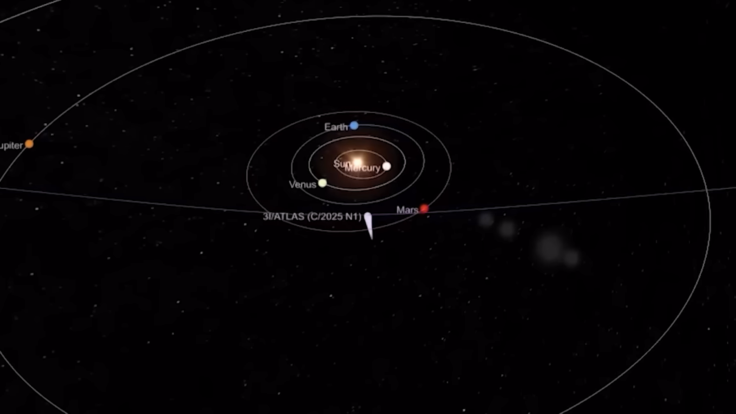
3I/ATLAS and the Secrets of Europa
The timing of this visit is nothing short of lucky. As 3I/ATLAS gets closer to the Jovian system, it comes close to Europa, Jupiter's ice-covered moon and one of the best places to look for alien life. The Minor Planet Center's calculations show that when 3I/ATLAS gets closest to Jupiter, it will pass through the outer edge of the Jovian magnetosphere. This could cause tiny dust particles to fall off and be caught by Europa's gravity and land on its cracked, icy surface.
Europa is believed to hold a salty, subsurface ocean larger than all of Earth's combined, and the passage of an interstellar object through this region raises a startling question: could such visitors deliver or exchange organic material with worlds already primed for life? Astrobiologists are particularly interested in whether the 'cryovolcanic plumes' recently observed on Europa might interact with the interstellar dust trail, creating a rare chemical exchange between two entirely different star systems.
While NASA and the ESA have been careful to separate evidence from speculation — emphasising that there is no proof of biological material or microorganisms — the convergence of this trajectory with our own search for life is undeniable. '3I/ATLAS does not answer the question of whether life exists beyond Earth,' as one researcher noted, 'but it sharpens the question itself'.
As the object prepares to exit our solar system, passing the orbit of Jupiter in spring 2026, it leaves behind a scientific community emboldened by the realization that our solar system is not a closed circuit. With the ESA's Juice mission already in the vicinity to monitor the gravitational interaction, the next six months will provide a once-in-a-generation window to study the 'interstellar delivery' model in real-time. For now, the evidence suggests a world of possibility, reminding us that in the silence of space, we are rarely as alone as we think.
© Copyright IBTimes 2026. All rights reserved.