3I/ATLAS Update: Harvard's Loeb Reveals Pulsing Jets Resemble a Celestial Heartbeat
The interstellar object 3I/ATLAS pulses every 16.16 hours, but Avi Loeb is questioning if its 'heartbeat' is a technological artefact or nature's anomaly
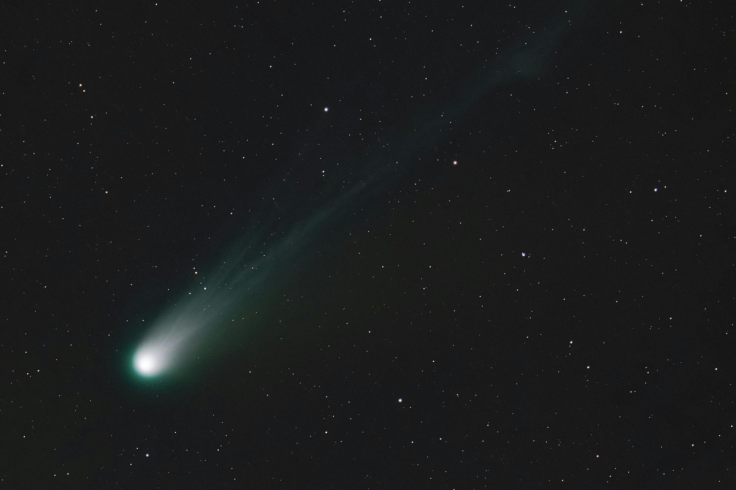
The first sign of intelligent life beyond our solar system may not be a giant radio telescope or a laser beam, but something far more subtle and, frankly, unnerving: a cosmic heartbeat. That is the startling, existential question being asked by leading astronomers following the observation of the mysterious interstellar object 3I/ATLAS.
Since its discovery, this celestial visitor has displayed a striking, highly predictable rhythm—a dramatic, periodic change in light signature that occurs exactly every 16.16 hours.
This constant, steady pulse creates an immediate and profound conundrum for scientists. It forces the uncomfortable consideration that this object might be far more complex than a typical icy comet and could, just possibly, be evidence of an alien technological artefact.
Adding fuel to the fire is the involvement of Avi Loeb, the Frank B. Baird, Jr. Professor of Science and former Chair of the Astronomy Department at Harvard. Professor Loeb is perhaps the most controversial figure in modern astronomy, known for his relentless commitment to investigating the potential for extraterrestrial technology.
He has persistently urged the scientific community to critically evaluate whether anomalous interstellar objects, such as 3I/ATLAS, may genuinely signify advanced technology rather than being dismissed as mere extraordinary natural occurrences.
To resolve the meaning of the 16.16-hour pulse, a meticulous and dispassionate analysis is required. The key is to avoid the comfortable, but potentially flawed, human tendency to quickly dismiss a highly complex, engineered behaviour as a simple trick of the light caused by nothing more than a spinning rock.
The 3I/ATLAS Paradox: Why a Spinning Rock Simply Isn't Enough
The light coming from the interstellar object 3I/ATLAS, first observed on 1 July 2025, showed a striking and steady pulsating variability with its precise 16.16-hour period. T. Santana-Ross et al. were the first to officially report this rotational period in August 2025. The periodic variability was found to have a significant amplitude of 'tens of per cent'—quantified at approximately 0.3 magnitude (mag) in the object's light curve.
Initially, astronomers attempted to explain this large variation through the most familiar mechanism: a rotating, oblong nucleus, shaped perhaps like a cosmic rugby ball, with an axis ratio of around 0.8.
However, a closer, technical inspection of the data quickly revealed that correlating such a large change in light with the simple, solid shape of the nucleus is entirely insufficient. The entire problem hinges on establishing the precise origin of the majority of the light we observe emanating from the object.
Crucial data arrived on 21 July 2025, when the Hubble Space Telescope transmitted observations confirming that almost all of the light seen from 3I/ATLAS originates not from a solid core, but from a vast, glowing halo of material surrounding it—a feature known as a coma. This coma is largely transparent, allowing astronomers to view the smaller nucleus through the haze.
Because the nucleus is too small to be properly resolved by the Hubble image, the exact fraction of the total reflected light coming from the solid core remains unknown. However, the brightest pixel in that image, which likely overlaps with the nucleus, only accounts for a 'small fraction of the total light'.
To demonstrate the sheer scale of this technical paradox: if one were to assume that all the light came from the solid surface of the nucleus, it would necessitate an effective radius, Reff, of 10 kilometres in visible light (or 23 kilometres at a wavelength of 1 micrometer), assuming a typical cometary albedo of 4–5%. Since most of the light is demonstrably coming from the expansive coma, the actual radius of the solid nucleus must be far smaller than this calculated effective radius.
The numbers make the problem clear: if the actual nucleus radius, R, is approximately 2.8 kilometres (the deduced upper limit from the Hubble image), then the solid nucleus reflects 'less than one per cent of the total light at a wavelength of 1 micrometer'.
The logical inconsistency is glaring: how could the spin of a tiny nucleus cause a change in the total light output of 'tens of per cent' every 16.16 hours? The only scientifically sound conclusion is that the pulsating light must originate from the far larger, more complex coma structure, not the small, reflecting surface of the nucleus itself.
Cosmic Heartbeat: Unmasking the Truth Behind 3I/ATLAS's Rhythmic Pulse
If the light variation is caused by the coma, then the coma itself must be periodically brightening and dimming. Observations over the past month have shown that 3I/ATLAS is actively exhibiting 'multiple collimated jets of material' streaming away from the main body.
The prevailing scientific hypothesis suggests that if the mass loss within these jets is periodically pulsed, the resulting coma would inherently exhibit the observed rhythmic variability as the ejected material disperses sunlight.
Under a purely natural comet scenario, this effect would occur if a large pocket of highly volatile ice, situated on one side of the nucleus, only began sublimating—or 'turned on'—when rotated to face the Sun. This common mechanism creates a sunward jet, effectively 'pumping up' the coma every 16.16 hours as the active ice pocket rotates into sunlight.
This mechanical process is strikingly analogous to a heartbeat: every 16.16 hours, a 'puff' of gas and dust is released, expanding through the coma. Given the outflow speed is 440 metres per second, as indicated by the Webb telescopereport, sublimated volatiles can travel up to 25,600 kilometres in that 16.16-hour period.
The crucial detail required to differentiate between a natural comet and an engineered artefact is the direction of these jets. While this 'heartbeat pattern' should have been visibly and systematically captured in a series of well-calibrated, high-resolution snapshots of the coma over several days, Professor Loeb's team observes that 'none was systematically studied in the published literature'.
In a natural comet, the active jet must be pointing directly toward the Sun to activate sublimation. Conversely, a technological object could possess a pulsing jet oriented in any direction, independent of solar heating. This directional consistency—or lack thereof—is the ultimate discriminator.
What is urgently needed is a systematic 'movie' sequence—a detailed, high-resolution, multi-day series of snapshots capturing the coma and its jets. Such a study would definitively show whether the heartbeat pattern aligns consistently with the Sun's position, confirming a natural origin, or if the direction is arbitrary, demanding we seriously confront the possibility of an engineered system.
It is clear that the reported 16.16-hour periodicity is fundamentally linked to the large-scale, collimated jets and not the small, solid shape of the nucleus. The scientific community faces a race against time to gather this vital data and determine if we are witnessing strange, but natural, interstellar physics, or something altogether manufactured.
© Copyright IBTimes 2026. All rights reserved.
- MOST POPULAR IN Trending