

3I/ATLAS Update: 'Third Ever' Interstellar Object Caught by Oregon Man as It Exits
Oregon man captures rare photo of interstellar comet 3I/ATLAS as it returns to deep space
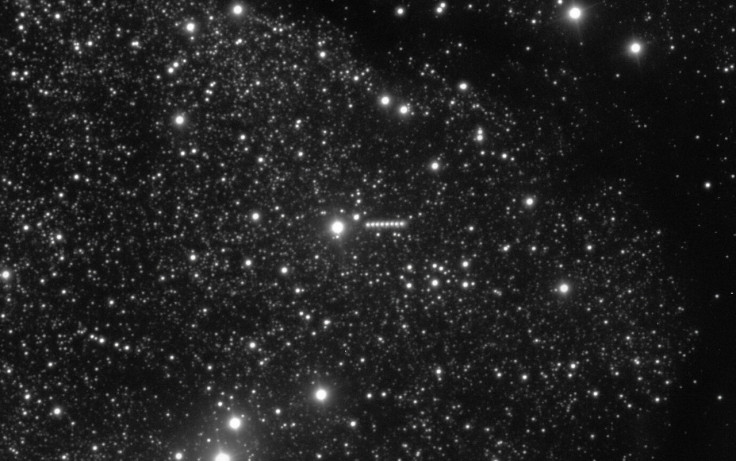
While the holiday season usually draws our eyes toward festive lights on the ground, a rare celestial wanderer was making its final bow across the Pacific Northwest sky. A mysterious visitor from the furthest reaches of the cosmos, known as 3I/ATLAS, has spent the last few months trekking through our solar system, offering astronomers a fleeting glimpse of a world beyond our own.
This isn't your garden-variety comet. It holds the prestigious, albeit rare, title of being only the third extra-solar object ever detected by humanity, following the 2017 discovery of the asteroid-like 1I/'Oumuamua and the 2019 detection of the interstellar comet 2I/Borisov.
Having journeyed from a distant point far beyond our sun's influence, it is now beginning its long trek back into the eternal 'black'. While most of the world relied on massive observatory data to track its progress, one amateur astronomer in Portland, Oregon, managed to capture the interloper from his own backyard.
The Backyard Discovery of the Interstellar 3I/ATLAS
Patrick Finney is no stranger to the heavens. A seasoned stargazer whose work has previously featured captures of Comet Lemmon and Comet KT/Atlas, Finney managed to snap a particularly poignant shot of the visitor just as the New Year dawned.
Though the image possesses a slight, ethereal blur, it perfectly captures the kinetic energy of the object. Looking at the photograph, you can almost feel the sheer velocity as the comet whizzes away from our planetary neighbourhood.
Finney's success wasn't down to luck alone, but rather the burgeoning technology of 'smart' telescopes. He utilised a ZWO SeeStar S50, a compact yet powerful piece of kit that has revolutionised amateur astronomy. 'This is a smart telescope, meaning it has GPS tracking, and can find the object you want to see,' Finney explained. 'It also has edit features and filtering, to enhance imagery. All imagery is viewable on your cellphone via SeeStar's downloadable app'.
Capturing 3I/ATLAS was a feat of patience and precision. Despite the advanced tech, Finney only managed one clear shot that successfully illustrated the distinct separation between the comet's nucleus and its trailing tail. It is a rare perspective, as many professional captures struggle to define that specific boundary as clearly as his backyard setup did.

Scientific Significance of the 3I/ATLAS Trajectory
The scientific community has been buzzing since the ATLAS (Asteroid Terrestrial-impact Last Alert System) survey telescope in Rio Hurtado first spotted the object last summer. At that time, it was roughly 420 million miles away, emerging from the direction of the constellation Sagittarius. NASA confirmed the rarity of the event, stating, 'Comet 3I/ATLAS is the third object in history from outside of our solar system to be discovered within our solar system'.
Recent measurements from the Hubble Space Telescope have helped refine our understanding of the comet's physical scale, estimating the diameter of its nucleus to be between 320 metres and 5.6 kilometres. Furthermore, its incredible speed of 58 kilometres per second suggests it originated from the Milky Way's 'thick disk' — a region of ancient stars — making it potentially the oldest comet ever observed at a staggering 11 billion years of age.
The comet reached its perigee — its closest approach to Earth — on Dec. 19, passing at a distance of 270 million km, or 1.8 AU. For those in the Pacific Northwest, including the Washington and Oregon coasts, the comet remained frustratingly invisible to the naked eye, requiring high-end optics to pierce the winter gloom.
As the comet moves away from the sun, its behaviour is a masterclass in orbital physics. Having accelerated significantly during its approach due to solar gravity, it is now slowing down. NASA scientists noted that as it neared the Sun, rising temperatures caused its ices to sublimate, releasing gas.
This 'outgassing' acts like a tiny thruster, causing minute shifts in its path — a phenomenon that has matched researchers' predictions almost perfectly. By the time it finally exits our solar system, it will have returned to the steady, lonely pace it maintained before it ever met our sun. We likely won't see its like again for a very long time.
© Copyright IBTimes 2026. All rights reserved.